

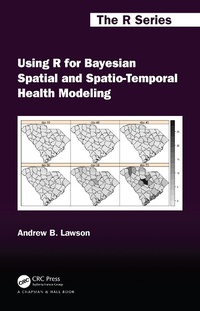
Using R for Bayesian Spatial and Spatio-Temporal Health Modeling
1st Edition
Published on 28. April 2021
300 pages
978-1-000-37670-8 (ISBN)
Description

Progressively more and more attention has been paid to how location affects health outcomes. The area of disease mapping focusses on these problems, and the Bayesian paradigm has a major role to play in the understanding of the complex interplay of context and individual predisposition in such studies of disease. Using R for Bayesian Spatial and Spatio-Temporal Health Modeling provides a major resource for those interested in applying Bayesian methodology in small area health data studies.
Features:
Review of R graphics relevant to spatial health data
Overview of Bayesian methods and Bayesian hierarchical modeling as applied to spatial data
Bayesian Computation and goodness-of-fit
Review of basic Bayesian disease mapping models
Spatio-temporal modeling with MCMC and INLA
Special topics include multivariate models, survival analysis, missing data, measurement error, variable selection, individual event modeling, and infectious disease modeling
Software for fitting models based on BRugs, Nimble, CARBayes and INLA
Provides code relevant to fitting all examples throughout the book at a supplementary website
The book fills a void in the literature and available software, providing a crucial link for students and professionals alike to engage in the analysis of spatial and spatio-temporal health data from a Bayesian perspective using R. The book emphasizes the use of MCMC via Nimble, BRugs, and CARBAyes, but also includes INLA for comparative purposes. In addition, a wide range of packages useful in the analysis of geo-referenced spatial data are employed and code is provided. It will likely become a key reference for researchers and students from biostatistics, epidemiology, public health, and environmental science.
Features:
Review of R graphics relevant to spatial health data
Overview of Bayesian methods and Bayesian hierarchical modeling as applied to spatial data
Bayesian Computation and goodness-of-fit
Review of basic Bayesian disease mapping models
Spatio-temporal modeling with MCMC and INLA
Special topics include multivariate models, survival analysis, missing data, measurement error, variable selection, individual event modeling, and infectious disease modeling
Software for fitting models based on BRugs, Nimble, CARBayes and INLA
Provides code relevant to fitting all examples throughout the book at a supplementary website
The book fills a void in the literature and available software, providing a crucial link for students and professionals alike to engage in the analysis of spatial and spatio-temporal health data from a Bayesian perspective using R. The book emphasizes the use of MCMC via Nimble, BRugs, and CARBAyes, but also includes INLA for comparative purposes. In addition, a wide range of packages useful in the analysis of geo-referenced spatial data are employed and code is provided. It will likely become a key reference for researchers and students from biostatistics, epidemiology, public health, and environmental science.
More details
Series
Edition
1. Auflage
Language
English
Place of publication
London
United Kingdom
Publishing group
Taylor & Francis Ltd
Target group
College/higher education
Illustrations
13 Tables, black and white; 104 Line drawings, black and white; 2 Halftones, black and white; 106 Illustrations, black and white
ISBN-13
978-1-000-37670-8 (9781000376708)
Copyright in bibliographic data and cover images is held by Nielsen Book Services Limited or by the publishers or by their respective licensors: all rights reserved.
Schweitzer Classification
Other editions
Additional editions
Andrew B. Lawson
Using R for Bayesian Spatial and Spatio-Temporal Health Modeling
Book
05/2023
1st Edition
Chapman & Hall/CRC
€71.80
Shipment within 15-20 days
Andrew B. Lawson
Using R for Bayesian Spatial and Spatio-Temporal Health Modeling
Book
04/2021
1st Edition
Chapman & Hall/CRC
€186.50
Shipment within 15-20 days
Person
Dr Lawson is Professor of Biostatistics in the Division of Biostatistics and Bioinformatics, Department of Public Health Sciences, College of Medicine, MUSC and is an MUSC Distinguished Professor Emeritus and ASA Fellow. His PhD was in Spatial Statistics from the University of St. Andrews, UK.
He has over 190 journal papers on the subject of spatial epidemiology, spatial statistics and related areas. In addition to a number of book chapters, he is the author of 10 books in areas related to spatial epidemiology and health surveillance. The most recent of these is Lawson, A.B. et al (eds) (2016) Handbook of Spatial Epidemiology. CRC Press, New York, and in 2018 a 3rd edition of Bayesian Disease Mapping: Hierarchical Modeling in Spatial Epidemiology CRC Press. He has acted as an advisor in disease mapping and risk assessment for the World Health Organization (WHO) and is the founding editor of the Elsevier journal Spatial and Spatio-temporal Epidemiology. Dr Lawson has delivered many short courses in different locations over the last 20 years on Bayesian Disease Mapping with OpenBUGS, INLA, and Nimble, and more general spatial epidemiology topics.
Web site: http://people.musc.edu/~abl6/
He has over 190 journal papers on the subject of spatial epidemiology, spatial statistics and related areas. In addition to a number of book chapters, he is the author of 10 books in areas related to spatial epidemiology and health surveillance. The most recent of these is Lawson, A.B. et al (eds) (2016) Handbook of Spatial Epidemiology. CRC Press, New York, and in 2018 a 3rd edition of Bayesian Disease Mapping: Hierarchical Modeling in Spatial Epidemiology CRC Press. He has acted as an advisor in disease mapping and risk assessment for the World Health Organization (WHO) and is the founding editor of the Elsevier journal Spatial and Spatio-temporal Epidemiology. Dr Lawson has delivered many short courses in different locations over the last 20 years on Bayesian Disease Mapping with OpenBUGS, INLA, and Nimble, and more general spatial epidemiology topics.
Web site: http://people.musc.edu/~abl6/
Content
1. Introduction and Data Sets
2. R Graphics and Spatial Health Data
3. Bayesian Hierarchical Models
4. Computation
5. Bayesian model Goodness of Fit Criteria
6. Bayesian Disease Mapping Models
Part I Basic Software Approaches
7. BRugs/OpenBUGS
8. Nimble
9. CARBayes
10. INLA and R-INLA
11. Clustering, Latent Variable and Mixture Modeling
12. Spatio-Temporal Modeling with MCMC
13. Spatio-Temporal Modeling with INLA
Part II Some Advanced and Special topics
14. Multivariate Models
15. Survival Modeling
16. Missingness, Measurement Error and Variable Selection
17. Individual Event Modeling
18. Infectious Disease Modeling
2. R Graphics and Spatial Health Data
3. Bayesian Hierarchical Models
4. Computation
5. Bayesian model Goodness of Fit Criteria
6. Bayesian Disease Mapping Models
Part I Basic Software Approaches
7. BRugs/OpenBUGS
8. Nimble
9. CARBayes
10. INLA and R-INLA
11. Clustering, Latent Variable and Mixture Modeling
12. Spatio-Temporal Modeling with MCMC
13. Spatio-Temporal Modeling with INLA
Part II Some Advanced and Special topics
14. Multivariate Models
15. Survival Modeling
16. Missingness, Measurement Error and Variable Selection
17. Individual Event Modeling
18. Infectious Disease Modeling
