

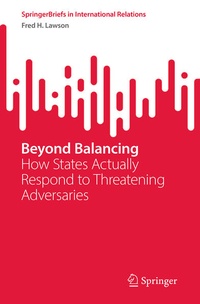
Beyond Balancing
Description

This Brief revisits the question of whether states tend to resist a threatening adversary. It begins by assessing one influential contribution to the debate that offers an elegant reformulation of the problem, and then advances a plausible alternative analytical framework. It surveys three situations in which several states faced the choice of mobilizing against or aligning with a prospective aggressor. In each case, proximity to the expansionist state and the clarity of the danger it posed to the existing order might well have prompted adjacent states to engage in balancing. The fact that balancing did not predominate in any of these situations challenges the orthodox view of how states respond to evident threats and compels a reconsideration of the circumstances under which bandwagoning is likely to occur in the anarchic international arena.
Building on influential studies of bandwagoning in international politics, the volume reassesses states' responses to aggressive adversaries. It offers an alternative explanation for why states often-indeed, usually-choose not to resist aggressors, and illustrates this argument by revisiting East Asia in 1931 and Central and Eastern Europe in 1938. It also provides a new perspective on the reactions of the Arab Gulf states to the abrogation of the Joint Comprehensive Plan of Action.
More details
Other editions
Additional editions
Person
Fred H. Lawson is Emeritus Professor of Government at Northeastern University. Over four decades, he taught international relations and Middle East politics at the University of North Carolina, Smith College, and Mills College. He is a Past President of the Society for Gulf Arab Studies and the Syrian Studies Association, and has held Fulbright fellowships in Syria and Yemen.
Content
Chapter 1: Introduction.- Chapter 2: A Provisional Bestiary of Bandwagoning.- Chapter 3: Revising the Bestiary of Bandwagoning.- Chapter 4: Japan's 1931 Threat to East Asia.- Chapter 5: Germany's 1939 Threat to East-Central Europe.- Chapter 6: Iran's 2018-20 Threat to the Persian Gulf.- Chapter 7: Conclusion.
