

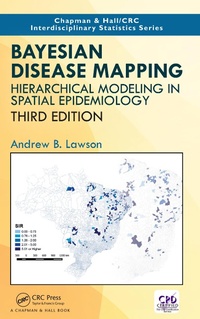
Bayesian Disease Mapping
Hierarchical Modeling in Spatial Epidemiology, Third Edition
3rd Edition
Published on 20. May 2018
486 pages
978-1-351-27175-2 (ISBN)
Description

Since the publication of the second edition, many new Bayesian tools and methods have been developed for space-time data analysis, the predictive modeling of health outcomes, and other spatial biostatistical areas. Exploring these new developments, Bayesian Disease Mapping: Hierarchical Modeling in Spatial Epidemiology, Third Edition provides an up-to-date, cohesive account of the full range of Bayesian disease mapping methods and applications.
In addition to the new material, the book also covers more conventional areas such as relative risk estimation, clustering, spatial survival analysis, and longitudinal analysis. After an introduction to Bayesian inference, computation, and model assessment, the text focuses on important themes, including disease map reconstruction, cluster detection, regression and ecological analysis, putative hazard modeling, analysis of multiple scales and multiple diseases, spatial survival and longitudinal studies, spatiotemporal methods, and map surveillance. It shows how Bayesian disease mapping can yield significant insights into georeferenced health data.
The target audience for this text is public health specialists, epidemiologists, and biostatisticians who need to work with geo-referenced health data.
In addition to the new material, the book also covers more conventional areas such as relative risk estimation, clustering, spatial survival analysis, and longitudinal analysis. After an introduction to Bayesian inference, computation, and model assessment, the text focuses on important themes, including disease map reconstruction, cluster detection, regression and ecological analysis, putative hazard modeling, analysis of multiple scales and multiple diseases, spatial survival and longitudinal studies, spatiotemporal methods, and map surveillance. It shows how Bayesian disease mapping can yield significant insights into georeferenced health data.
The target audience for this text is public health specialists, epidemiologists, and biostatisticians who need to work with geo-referenced health data.
Reviews / Votes
Praise for the Previous EditionThis book provides a technical grounding in spatial models while maintaining a strong grasp on applied epidemiological problems. ... A welcome effort is made to clarify concepts which might, in other texts, have been skimmed over in a rush to fit models. ... From the start, the concepts are illustrated with disease mapping examples, including R and WinBUGS code. ... The book has relatively few errors ... I recommend the book. It taught me new ideas and clarified existing ones. I shall continue to use it and I expect it to be useful for other statisticians with an interest in spatial analysis.
-Journal of the Royal Statistical Society, Series A, April 2011
The readers who would like to get a big picture of hierarchical modeling in spatial epidemiology in a quick fashion will find this book very useful. This book covers a range of topics in hierarchical modeling for spatial epidemiological data and provides a practical, comprehensive, and up-to-date overview of the use of spatial statistics in epidemiology. ... useful for readers to track down the topics of interests and see the varieties of up-to-date modeling techniques in spatial epidemiology or, more generally, spatial binary or count data. The author also lists the reference following each method for further information.
-Hongfei Li, Technometrics, November 2010
Lawson begins by building a solid Bayesian background ... The remaining seven chapters provide a thorough review of modeling relative risk ... Lawson provides well-written reviews of many topics and many aspects of those topics are covered in his reviews. The literature cited is huge and diverse, showing the current importance of the subjects covered. One can also gain hands-on training in analysis and visual presentations ... by following carefully the detailed introduction to R and WinBUGS given in the book. Many important data sets used in the book are available online...
-International Statistical Review (2009), 77, 2
This book is an excellent reference for intermediate learners of Bayesian disease mapping ... many of the methodologies discussed in this book are applicable not only to spatial epidemiology but also to many other fields that utilize spatial data.
-J. Law, Biometrics, June 2009
More details
Series
Edition
3rd edition
Language
English
Place of publication
London
United Kingdom
Publishing group
Taylor & Francis Ltd
Target group
Professional and scholarly
Illustrations
22 Tables, black and white; 156 Line drawings, black and white; 156 Illustrations, black and white
File size
22,18 MB
ISBN-13
978-1-351-27175-2 (9781351271752)
Copyright in bibliographic data and cover images is held by Nielsen Book Services Limited or by the publishers or by their respective licensors: all rights reserved.
Schweitzer Classification
Other editions
Additional editions
Andrew B. Lawson
Bayesian Disease Mapping
Hierarchical Modeling in Spatial Epidemiology, Third Edition
Book
03/2021
3rd Edition
Chapman & Hall/CRC
€78.20
Shipment within 15-20 days
Andrew B. Lawson
Bayesian Disease Mapping
Hierarchical Modeling in Spatial Epidemiology, Third Edition
Book
05/2018
3rd Edition
CRC Press
€187.80
Shipment within 10-20 days
Person
Andrew B. Lawson is a professor of biostatistics and eminent scholar in the Division of Biostatistics and Epidemiology in the College of Medicine at the Medical University of South Carolina. He is an ASA fellow and an advisor in disease mapping and risk assessment for the World Health Organization. Dr. Lawson has published over 100 journal papers and eight books and is the founding editor of Spatial and Spatio-temporal Epidemiology. He received a PhD in spatial statistics from the University of St. Andrews. His research interests include the analysis of clustered disease maps, spatial and spatio-temporal disease surveillance, nutritional measurement error, and Bayesian latent variable and SEM modeling.
Content
Introduction. Bayesian Inference and Modeling. Computational Issues. Residuals and Goodness-of-Fit. Disease Map Reconstruction and Relative Risk Estimation. Disease Cluster Detection. Regression and Ecological Analysis. Putative Hazard Modeling. Multiple Scale Analysis. Multivariate Disease Analysis. Spatial Survival and Longitudinal Analyses. Spatiotemporal Disease Mapping. Disease Map Surveillance. Infectious Disease Modeling. Computational Software Issues. Basic R and Win/OpenBUGS. Selected WinBUGS Code. R Code for Thematic Mapping. Appendices.
