

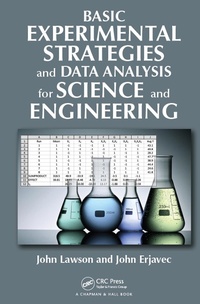
Basic Experimental Strategies and Data Analysis for Science and Engineering
Published on 3. November 2016
450 pages
978-1-4665-1218-4 (ISBN)
Description

Every technical investigation involving trial-and-error experimentation embodies a strategy for deciding what experiments to perform, when to quit, and how to interpret the data. This handbook presents several statistically derived strategies which are more efficient than any intuitive approach and will get the investigator to their goal with the fewest experiments, give the greatest degree of reliability to their conclusions, and keep the risk of overlooking something of practical importance to a minimum.
Features:
Provides a comprehensive desk reference on experimental design that will be useful to practitioners without extensive statistical knowledge
Features a review of the necessary statistical prerequisites
Presents a set of tables that allow readers to quickly access various experimental designs
Includes a roadmap for where and when to use various experimental design strategies
Shows compelling examples of each method discussed
Illustrates how to reproduce results using several popular software packages on a companion web site
Following the outlines and examples in this book should quickly allow a working professional or student to select the appropriate experimental design for a research problem at hand, follow the design to conduct the experiments, and analyze and interpret the resulting data.
John Lawson and John Erjavec have a combined 25 years of industrial experience and over 40 years of academic experience. They have taught this material to numerous practicing engineers and scientists as well as undergraduate and graduate students.
Features:
Provides a comprehensive desk reference on experimental design that will be useful to practitioners without extensive statistical knowledge
Features a review of the necessary statistical prerequisites
Presents a set of tables that allow readers to quickly access various experimental designs
Includes a roadmap for where and when to use various experimental design strategies
Shows compelling examples of each method discussed
Illustrates how to reproduce results using several popular software packages on a companion web site
Following the outlines and examples in this book should quickly allow a working professional or student to select the appropriate experimental design for a research problem at hand, follow the design to conduct the experiments, and analyze and interpret the resulting data.
John Lawson and John Erjavec have a combined 25 years of industrial experience and over 40 years of academic experience. They have taught this material to numerous practicing engineers and scientists as well as undergraduate and graduate students.
Reviews / Votes
"The purpose of this book is to educate scientists and engineers on statistical strategies for developing and improving products and processes, because: 'Companies that use these strategies as standard operating procedures can expect large cost reductions in manufacturing, improved product quality, and reduced lead time for the introduction of new products and/or manufacturing methods' (Preface). The material covered in the book has been taught in a one-semester course and portions of the book have been taught in workshop settings."~Robert Easterling, Technometrics
"This book aims to present the fundamentals of data analysis and interpretation for the sciences and engineering. Overall, the topics are very informative, and the book is dense in useful knowledge. This material is appropriate for undergraduate or graduate level students; it will be of great use to practitioners across a range of technical fields and for professionals who wish to gain a stronger understanding of experimental design and statistics. There is an emphasis on practical working knowledge, with many examples that are detailed enough to seem realistic. The book starts with basic definitions and concepts related to experimental design and does not presuppose a background in this area. Abundant supporting black-and-white figures and tables allow readers to consider the implementation of statistical concepts. A nice benefit is the exposure to a variety of graphical ways to present dataaEUR"from dot plots and dot diagrams to histograms, boxplots, three-dimensional surface plots, etc. The work mentions open source programs as an alternative to commonly used proprietary software, such as Excel and Minitab. The volume is strongly recommended for all readers in the sciences and engineering fields."
~M. R. King, Vanderbilt University
More details
Language
English
Place of publication
Philadelphia, PA
United States
Publishing group
Taylor & Francis Inc
Target group
College/higher education
Professional and scholarly
This book is intended for working professionals, students in laboratory courses and students working on research projects who have need to do empirical experimentation to answer research questions.
Illustrations
199 s/w Abbildungen, 131 s/w Tabellen
131 Tables, black and white; 199 Illustrations, black and white
File size
17,52 MB
ISBN-13
978-1-4665-1218-4 (9781466512184)
Copyright in bibliographic data and cover images is held by Nielsen Book Services Limited or by the publishers or by their respective licensors: all rights reserved.
Schweitzer Classification
Other editions
Additional editions
John Lawson | John Erjavec
Basic Experimental Strategies and Data Analysis for Science and Engineering
Book
06/2020
1st Edition
Chapman & Hall/CRC
€72.60
Shipment within 15-20 days
John Lawson | John Erjavec
Basic Experimental Strategies and Data Analysis for Science and Engineering
Book
12/2016
1st Edition
CRC Press
€117.50
Shipment within 15-20 days
Persons
John Lawson is a professor of statistics in the Department of Statistics at Brigham Young University, Provo, Utah. John Erjavec is a retired professor and chair of the Department of Chemical Engineering, University of North Dakota, Grand Forks, North Dakota.
Content
Strategies for Experimentation. Statistical Analysis of Experimental Data. Basic Two-Level Factorial Experiments. Advanced Topics in the Design and Analysis of 2k Factorial Experiments. General Factorial Experiments and ANOVA. Regression Analysis of Experimental Data. Variance Component Studies. Screening Designs. Optimization Experiments. Response Surface Model Fitting. Sequential Experimentation. Mixture Experiments. Practical Suggestions for Successful Experimentation. Appendix.
