

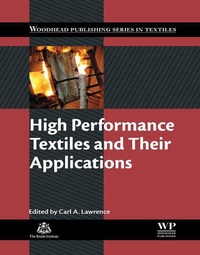
High Performance Textiles and Their Applications
Published on 21. August 2014
460 pages
978-0-85709-907-5 (ISBN)
Description

High performance textiles represent one of the most dynamic sectors of the international textile and clothing industry. With contributions from leading experts in the field, this book provides an important overview of key developments in the field. Chapters cover the use of high performance textiles in such areas as protective clothing, heat and fire protection, medicine, civil engineering and the energy sector.
- Reviews various approaches to modelling the geometry, structure and mechanical and physical properties of advanced textile materials
- Evaluates novel surface treatments involving plasma and laser technologies for a range of high performance textiles
- Focuses on textiles for specific purposes, with chapters devoted to textiles for heat and fire protection, wound care, industrial filtration, geotextiles, civil engineering and sustainable energy applications
More details
Other editions
Additional editions
C. Lawrence
High Performance Textiles and Their Applications
Book
07/2014
Woodhead Publishing Ltd
€231.76
Shipment within 10-15 days
Content
- Contributor contact details
- Woodhead Publishing Series in Textiles
- 1. Modelling structure-property relationships in advanced textile materials
- Abstract:
- 1.1 Introduction to textile modelling
- 1.2 Approaches to modelling geometry, structure, properties and processes
- 1.3 Experimental models
- 1.4 Modelling the geometry of fibre, yarn and fabric
- 1.5 Modelling the structure of textiles
- 1.6 Modelling the mechanical properties of textiles
- 1.7 Modelling the physical properties of textiles
- 1.8 Modelling textile processes: continuous models
- 1.9 Modelling textile processes: discrete models
- 1.10 Optimization of performance characteristics: linear and non-linear methods
- 1.11 Sources of further information and advice
- 1.12 References
- 2. Novel surface treatments for high performance textiles
- Abstract:
- 2.1 Introduction
- 2.2 Plasma technologies for textiles
- 2.3 Plasma treatments for high performance textiles
- 2.4 Laser technologies for textiles
- 2.5 Comparing plasma and laser treatments of textile surfaces
- 2.6 Conclusions
- 2.7 References
- 3. High performance textiles for protective clothing
- Abstract:
- 3.1 Introduction
- 3.2 Requirements for protective clothing
- 3.3 High performance textile fibres
- 3.4 Conventional and high performance fibre blends for protective clothing
- 3.5 Cut resistant and energy absorption materials
- 3.6 Clothing for firefighters
- 3.7 Chemical protective clothing (CPC)
- 3.8 Materials to improve thermo-physiological comfort of protective clothing
- 3.9 References
- 4. High performance textiles for heat and fire protection
- Abstract:
- 4.1 Introduction
- 4.2 Principles of textile heat and fire protection
- 4.3 Routes to achieving fire and heat protection
- 4.4 Evolving technologies and future trends for heat and fire protection
- 4.5 Applications of heat protective textiles
- 4.6 Sources of further information and advice
- 4.7 References
- 5. High performance medical textiles: an overview
- Abstract:
- 5.1 Introduction
- 5.2 Textiles for hygiene and infection control
- 5.3 High performance implantable textiles
- 5.4 Textiles for tissue engineering applications
- 5.5 Textiles for healthcare monitoring
- 5.6 Future trends
- 5.7 References
- 6. High performance textiles for wound care
- Abstract:
- 6.1 Introduction
- 6.2 Wounds and wound management
- 6.3 Wound dressings
- 6.4 Hi-tech wound dressings: non-adherent, odour adsorbent, activated charcoal cloth (ACC), and antimicrobial dressings
- 6.5 Treatment of venous leg ulcers
- 6.6 Venous leg ulcer treatment using compression bandages
- 6.7 Improving compression bandages: non-woven vari-stretch compression bandages (NVCB) and three-dimensional compression bandages
- 6.8 Conclusions
- 6.9 References
- 7. High performance textiles for industrial filtration
- Abstract:
- 7.1 Introduction
- 7.2 Dust collection
- 7.3 Fibre selection for dust collection
- 7.4 Fabric types for dust collection
- 7.5 Fabric finishing techniques
- 7.6 Solid-liquid filtration
- 7.7 Filtration equipment
- 7.8 Fabric selection for solid-liquid filtration
- 7.9 Fabric constructions and yarn types for solid-liquid filtration
- 7.10 Fabric finishing techniques
- 7.11 Future trends
- 7.12 Sources of further information and advice
- 7.13 References
- 8. High performance textiles for geotechnical engineering: geotextiles and related materials
- Abstract:
- 8.1 Introduction
- 8.2 Classification of geosynthetics
- 8.3 Functions of geosynthetics: filtration
- 8.4 Functions of geosynthetics: drainage
- 8.5 Functions of geosynthetics: separation
- 8.6 Functions of geosynthetics: reinforcement
- 8.7 Functions of geosynthetics: containment (fluid barrier) and protection
- 8.8 Index and performance testing of geotextiles
- 8.9 Geotextile materials: polymers and fibres
- 8.10 Geotextile materials: non-woven geotextiles
- 8.
