

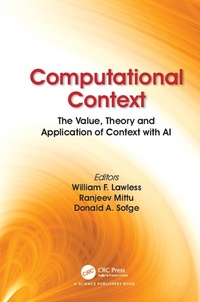
Computational Context
The Value, Theory and Application of Context with AI
1st Edition
Published on 7. December 2018
328 pages
978-0-429-84185-9 (ISBN)
Description

This volume addresses context from three comprehensive perspectives: first, its importance, the issues surrounding context, and its value in the laboratory and the field; second, the theory guiding the AI used to model its context; and third, its applications in the field (e.g., decision-making). This breadth poses a challenge. The book analyzes how the environment (context) influences human perception, cognition and action. While current books approach context narrowly, the major contribution of this book is to provide an in-depth review over a broad range of topics for a computational context no matter its breadth. The volume outlines numerous strategies and techniques from world-class scientists who have adapted their research to solve different problems with AI, in difficult environments and complex domains to address the many computational challenges posed by context.
Context can be clear, uncertain or an illusion. Clear contexts: A father praising his child; a trip to the post office to buy stamps; a policewoman asking for identification. Uncertain contexts: A sneak attack; a surprise witness in a courtroom; a shout of "Fire! Fire!" Contexts as illusion: Humans fall prey to illusions that machines do not (Adelson's checkerboard illusion versus a photometer). Determining context is not easy when disagreement exists, interpretations vary, or uncertainty reigns. Physicists like Einstein (relativity), Bekenstein (holographs) and Rovelli (universe) have written that reality is not what we commonly believe. Even outside of awareness, individuals act differently whether alone or in teams.
Can computational context with AI adapt to clear and uncertain contexts, to change over time, and to individuals, machines or robots as well as to teams? If a program automatically "knows" the context that improves performance or decisions, does it matter whether context is clear, uncertain or illusory? Written and edited by world class leaders from across the field of autonomous systems research, this volume carefully considers the computational systems being constructed to determine context for individual agents or teams, the challenges they face, and the advances they expect for the science of context.
Context can be clear, uncertain or an illusion. Clear contexts: A father praising his child; a trip to the post office to buy stamps; a policewoman asking for identification. Uncertain contexts: A sneak attack; a surprise witness in a courtroom; a shout of "Fire! Fire!" Contexts as illusion: Humans fall prey to illusions that machines do not (Adelson's checkerboard illusion versus a photometer). Determining context is not easy when disagreement exists, interpretations vary, or uncertainty reigns. Physicists like Einstein (relativity), Bekenstein (holographs) and Rovelli (universe) have written that reality is not what we commonly believe. Even outside of awareness, individuals act differently whether alone or in teams.
Can computational context with AI adapt to clear and uncertain contexts, to change over time, and to individuals, machines or robots as well as to teams? If a program automatically "knows" the context that improves performance or decisions, does it matter whether context is clear, uncertain or illusory? Written and edited by world class leaders from across the field of autonomous systems research, this volume carefully considers the computational systems being constructed to determine context for individual agents or teams, the challenges they face, and the advances they expect for the science of context.
More details
Edition
1. Auflage
Language
English
Place of publication
London
United Kingdom
Publishing group
Taylor & Francis Ltd
Target group
College/higher education
Illustrations
30 Tables, black and white; 35 Illustrations, color; 31 Illustrations, black and white
File size
19,82 MB
ISBN-13
978-0-429-84185-9 (9780429841859)
Copyright in bibliographic data and cover images is held by Nielsen Book Services Limited or by the publishers or by their respective licensors: all rights reserved.
Schweitzer Classification
Other editions
Additional editions

William F. Lawless | Ranjeev Mittu | Donald Sofge
Computational Context
The Value, Theory and Application of Context with AI
Book
03/2021
1st Edition
CRC Press
€68.19
Shipment within 15-20 days
William F. Lawless | Ranjeev Mittu | Donald Sofge
Computational Context
The Value, Theory and Application of Context with AI
Book
12/2018
1st Edition
CRC Press
€282.73
Shipment within 10-20 days
Persons
William Lawless, as an engineer, in 1983, Lawless blew the whistle on Department of Energy's mismanagement of radioactive wastes. For his PhD, he studied the causes of mistakes by organizations with world-class scientists and engineers. Afterwards, DOE invited him onto its citizen advisory board at its Savannah River Site where he co-authored numerous recommendations on the site's clean-up. In his research on mathematical metrics for teams, he has published two co-edited books on AI, and over 200 articles, book chapters and peer-reviewed proceedings. He has co-organized eight AAAI symposia at Stanford (e.g., in 2018: Artificial Intelligence for the Internet of Everything).
Ranjeev Mittu, is a Branch Head for the Information Management and Decision Architectures Branch within the Information Technology Division at the U.S. Naval Research Laboratory.? He is the Section Head of Intelligent Decision Support Section which develops novel decision support systems through applying technologies from the AI, multi-agent systems and web services. He brings a strong background in transitioning R&D solutions to the operational community, demonstrated through his current sponsors including DARPA, OSD/NII, NSA, USTRANSCOM and ONR.? He has authored 2 books, 5 book chapters, and numerous conference publications.?? He has an MS in Electrical Engineering from Johns Hopkins University.?
Donald (Don) Sofge?is a Computer Scientist and?Roboticist at the U.S. Naval Research Laboratory (NRL) with 30 years of?experience in Artificial Intelligence and?Control Systems R&D. He has?served as PI/Co-PI on dozens of federally funded R&D programs and has?authored/co-authored approximately 110 peer-reviewed publications,?including?several edited books, many journal articles, and several conference?proceedings. Don leads the Distributed Autonomous Systems Group at NRL where he?develops?nature-inspired computing solutions to challenging problems in?sensing, artificial intelligence, and control of autonomous robotic systems.?His current research focuses?on control of autonomous teams or swarms of robotic?systems.
Ranjeev Mittu, is a Branch Head for the Information Management and Decision Architectures Branch within the Information Technology Division at the U.S. Naval Research Laboratory.? He is the Section Head of Intelligent Decision Support Section which develops novel decision support systems through applying technologies from the AI, multi-agent systems and web services. He brings a strong background in transitioning R&D solutions to the operational community, demonstrated through his current sponsors including DARPA, OSD/NII, NSA, USTRANSCOM and ONR.? He has authored 2 books, 5 book chapters, and numerous conference publications.?? He has an MS in Electrical Engineering from Johns Hopkins University.?
Donald (Don) Sofge?is a Computer Scientist and?Roboticist at the U.S. Naval Research Laboratory (NRL) with 30 years of?experience in Artificial Intelligence and?Control Systems R&D. He has?served as PI/Co-PI on dozens of federally funded R&D programs and has?authored/co-authored approximately 110 peer-reviewed publications,?including?several edited books, many journal articles, and several conference?proceedings. Don leads the Distributed Autonomous Systems Group at NRL where he?develops?nature-inspired computing solutions to challenging problems in?sensing, artificial intelligence, and control of autonomous robotic systems.?His current research focuses?on control of autonomous teams or swarms of robotic?systems.
Content
Introduction. Learning Context through Cognitive Priming. The Use of Contextual Knowledge in a Digital Society. Challenges with addressing the issue of context within AI and human-robot teaming. Machine Learning Approach for Task Generation in Uncertain Contexts. Creating and Maintaining a World Model for Automated Decision Making. Probabilistic Scene Parsing. Using Computational Context Models to Generate Robot Adaptive Interactions with Humans. Context-Driven Proactive Decision Support: Challenges and Applications. The Shared Story - Narrative Principles for Innovative Collaboration. Algebraic Modeling of the Causal Break and Representation of the Decision Process in Contextual Structures. A Contextual Decision-Making Framework. Cyber-(in)Security, context and theory: Proactive Cyber-Defenses.
