

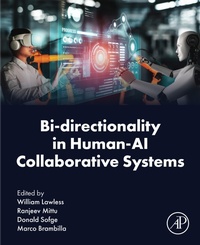
Bi-directionality in Human-AI Collaborative Systems
Published on 11. June 2025
300 pages
978-0-443-40554-9 (ISBN)
Description

Bi-directionality in Human-AI Collaborative Systems investigates the foundations, metrics, and applications of human-machine systems, along with the legal ramifications of autonomy, including standards, trust by the public, and bidirectional trust by users and AI systems. The book addresses the challenges in creating synergistic human and AI-based autonomous system-of-systems by focusing on the underlying challenges associated with bi-directionality. Chapters cover advances in LLMs, logic, machine learning choices, the development of standards, as well as human-centered approaches to autonomous human-machine teams. This is a valuable resource for world-class researchers and engineers who are theorizing on, designing, and developing autonomous systems.It will also be useful for government scientists, business leaders, social scientists, philosophers, regulators and legal experts interested in the impact of autonomous human-machine teams and systems.
- Investigates the challenges in creating synergistic human and AI-based autonomous system-of-systems
- Integrates concepts from a wide range of disciplines, including applied and theoretical AI, quantum mechanics, social sciences, and systems engineering
- Presents debates, models, and concepts of mutual dependency for autonomous human-machine teams, challenging assumptions across AI, systems engineering, data science, and quantum mechanics
More details
Other editions
Additional editions
William Lawless | Ranjeev Mittu | Donald Sofge
Bi-directionality in Human-AI Collaborative Systems
Book
07/2025
Academic Press
€163.50
Shipment within 15-20 days
Content
Chapter 1 Introduction to bidirectionality in human-AI collaborative systemsChapter 2 Foundational approaches to post-hoc explainability for image classificationChapter 3 Explaining poisoned AI modelsChapter 4 Desirability vs. feasibility: a research through design inquiry of explainable AIChapter 5 Credition, uncertainty, consciousness, and communicationChapter 6 On the principles and effectiveness of gamification in bidirectional artificial intelligence and explainable AIChapter 7 Employing Kolmogorov-Arnold network for man-machine collaborationChapter 8 Collaborative communication for unnamable risks: a creative writing approach to aligning human-machine situation models in an open worldChapter 9 Not all explanations are created equal: investigating the pitfalls of current XAI evaluationChapter 10 A mixture-of-experts flock: examining expert influenceChapter 11 On replacing humans with human simulators in human-in-the-loop systems built to interact with humansChapter 12 Addressing procrastination and improving task completion efficiency through agent-based interventionsChapter 13 Navigating the sociotechnical labyrinth: dynamic certification for responsible embodied AIChapter 14 Searching XAI collaborating with manager: bidirectional learning for human-tech applicationsChapter 15 Natural perception-based control types for human/machine systemsChapter 16 Hybrid forums as a means to perceive bidirectional risksChapter 17 Credit assignment: challenges and opportunities in developing human-like learning agentsChapter 18 Human-machine teams: advantages afforded by the quantum-likeness of interdependence
