

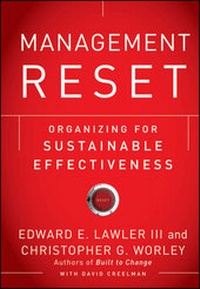
Management Reset
Description

More details
Other editions
Additional editions
Persons
Content
Foreword
When I was first introduced to integrating environmental concerns into a company's thinking, I was working for a private lumber company in Northern California. The company had been family owned for over a hundred years. Clear-cutting (removing all of the trees in one area) was not allowed. Instead, the company left the biggest, most prolific trees to seed the land after the other trees had been taken. The result of this century-old silviculture prescription was a business that worked in every way. The land produced a steady, sustainable volume of trees to keep the mill running near capacity. The small company town of Scotia was a robust center of commerce where the well-paid and motivated employees intertwined their lives with the company and the sacred land with which they coexisted. Hunting, fishing, hiking, and camping were all regular weekend activities.
The day that a large financial company purchased our lumber company was a sad one. Within a month of the purchase we were directed to write timber harvest plans to cut down the very trees that were giving life to the next generation of trees. Clear-cutting became the standard method of extracting as much, as fast as we could. In an instant a previously sustainable company began maximizing short-term growth and profits to pay off the leverage that was used to gain control of the hundred-year-old firm. We all know the rest of the story: a quick rise of wealth creation for the raiders and bankruptcy for the company.
Unfortunately, this story and many like it are all too common. I do not think that short-term financial engineering is what Milton Friedman had in mind when he wrote of management's goal to "maximize shareholders' wealth." I'm convinced Mr. Friedman would not have sanctioned the actions of the lumber company.
It is time for us to be clear that there are right and wrong ways to maximize shareholder value. It is time to embrace a new way of thinking, or, as Lawler and Worley posit, a reset, that brings social responsibility and environmental stewardship to the mission of the organization. The authors also argue that organizations are designed for stability, not change. This puts the focus on a different kind of sustainability-the ability of an organization to sustain itself in a tumultuous world. Put the need to see beyond short-term profit together with the need for organizational structures that are built to change and you are talking about the need for a complete management reset.
After my forestry experience I went to business school to find out what had happened and why. I wanted to understand leveraged buyouts and their value to society. Who, exactly, did this one-time wealth creation event enrich? It certainly was not the employees. It was not the company's suppliers, who also had a short-term spike in sales for a few years, after which the revenue stream ended. It was not the company's customers, who started getting inferior-quality product after the virgin trees were gone. Unsurprisingly, those who were enriched turned out to be a few financial engineers who "cracked the code" and optimized their personal financial situation to the detriment of society at large.
We are at the crossroads. Will we evolve Friedman's message to include a long-term perspective or will we fail to glean the wisdom of our recent history and continue to follow a path that is not sustainable? We need to accept business models that don't destroy the forest in an attempt to get more trees. We need business models in which being nimble and future-focused is coded into the organization's DNA so that change does not threaten the survival of firms. This book presents one that does just that.
In another chapter of my career I was the CEO of Patagonia, Inc. Patagonia, much like the lumber company in Northern California, is a private company that makes all of its strategic decisions with a long-term perspective. The founders, Yvon (YC) and Malinda Chouinard, handcrafted the corporate culture in a mirror image of themselves. They are the antithesis of the financial engineers who bankrupted the lumber company. YC is committed to "the best product possible" and to the product being made "with the least amount of harm to the environment." Malinda is committed to social responsibility and understanding and preserving the wisdom of the past (architecture, indigenous cultures, customs, and so on). Together they synergistically developed a unique culture, which has propelled their company to the top echelons of successful organizations worldwide.
There was something at Patagonia that was "magic." Something about the value alignment between the stakeholders and the organization. Customers had a strong emotional connection to the brand. Internally, job satisfaction (happiness) was very high. We had over nine hundred applications for every job opening in the organization, and we were moving up Fortune's "Best Companies to Work For" list on a regular basis.
I started referring to this "magic" as FLOW, as defined by Mihaly Csikszentmihalyi. I had read his ground-breaking book describing a condition in which an individual becomes so involved in an activity that nothing else matters; as the task becomes harder, the individual skill set increases and the feedback mechanism delivers motivation to keep the activity escalating. Often this state is described when paradigm-breaking creativity is launched.
Serendipitously, Mihaly came to Patagonia in 2000 to interview YC and me for a book he was writing, Good Business. When I got the chance to talk to him directly, I surmised that FLOW (and the motivation associated with it) could be a by-product of alignment around powerful values guiding shared goals and objectives. I had "come under its spell" at the lumber company pre-buyout and at Patagonia. I wondered out loud if this FLOW had anything to do with our high job satisfaction and overall success. Mihaly was intrigued. I entered the PhD program at Claremont Graduate University within months, and Mihaly and I started working on the IV Forces model.
The IV Forces (IVF) is a model of contemporary values. It is hoped that this model could be thought of as an "update" to Mr. Friedman's model. The IVF model captures the relevant "macro-values" of society today: environmental stewardship, corporate citizenship, product or service quality, and financial strength.
These four macro-values encompass the most pressing issues facing organizations today and were the bedrock beneath the lumber company and Patagonia. I refer to them as macro-values or forces because they are essentially broad categories that encircle numerous related values. For example, the macro-value of environmental stewardship refers to the need for organizations to recognize and mitigate their impact on the natural environment; it also represents the ultimate goal of integrating environmental concerns into product (and service) design in order to develop closed-loop manufacturing processes that eliminate waste. Corporate citizenship represents the social realm and the organization's relationships with stakeholders, ranging from employees to suppliers to neighbors in the local community to government entities. Product or service quality echoes Patagonia's mission to make the best product and relates to the need to excel at the organization's core competency. Finally, financial strength refers to the need for organizations to be financially sound; without this, the other values become irrelevant.
The main point of the IVF model is that none of the four forces can be ignored without massive degradation of the organization's output. The values do not operate in isolation; rather, they function as a system and feature many areas of overlap and interaction. Decision making is rarely, if ever, guided by one of the four forces individually. For example, product or service quality is defined as striving to achieve the best possible product with the least possible social and environmental harm. Financial strength is integrally related to the other three values, which cannot function without an economically viable organization.
Furthermore, the four forces are mutually reinforcing: each of the elements is important individually, but when leveraged as a collective group the relationships are synchronous. The power of environmental stewardship is amplified when financial strength is realized, and vice versa. The same can be said of any of the values. For example, when an organization is financially successful, it can invest in environmental innovations, such as new recycled and recyclable fabrics or not having to harvest trees close to a stream, which prevents erosion and increases biological activity in the stream; these are examples of activities that ultimately reduce long-term expenses and enhance long-term financial performance.
So how do we begin to develop an organization that wants to embed and integrate these values or forces into an organization? How do we create structures that not only respect those values, but are robust in the face of disruptive change? I believe that reading Management Reset: Organizing for Sustainable Effectiveness is a mandatory prerequisite. Edward E. Lawler III and Christopher G. Worley have, without question, developed the building blocks of executing an IV Forces model. The book not only captures the spirit of the moment but also interprets that spirit into a guide on how to design sustainably effective organizations. The authors outline exactly how a sustainably effective...
