

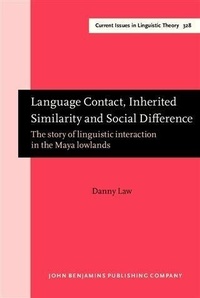
Language Contact, Inherited Similarity and Social Difference
The story of linguistic interaction in the Maya lowlands
1st Edition
Published on 19. June 2014
XI, 206 pages
978-90-272-7047-4 (ISBN)
Description

This book offers a study of long-term, intensive language contact between more than a dozen Mayan languages spoken in the lowlands of Guatemala, Southern Mexico and Belize. It details the massive restructuring of syntactic and semantic organization, the calquing of grammatical patterns, and the direct borrowing of inflectional morphology, including, in some of these languages, the direct borrowing of even entire morphological paradigms. The in-depth analysis of contact among the genetically related Lowland Mayan languages presented in this volume serves as a highly relevant case for theoretical, historical, contact, typological, socio- and anthropological linguistics. This linguistically complex situation involves serious engagement with issues of methods for distinguishing contact-induced similarity from inherited similarity, the role of social and ideological variables in conditioning the outcomes of language contact, cross-linguistic tendencies in language contact, as well as the effect that inherited similarity can have on the processes and outcomes of language contact.
More details
Other editions
Additional editions
Danny Law
Language Contact, Inherited Similarity and Social Difference
The story of linguistic interaction in the Maya lowlands
Book
06/2014
John Benjamins Publishing Co
€111.30
Shipment within 10-15 days
Person
Content
- LANGUAGE CONTACT, INHERITED SIMILARITY AND SOCIAL DIFFERENCE
- Editorial page
- Title page
- LCC data
- Table of contents
- Preface & acknowledgements
- List of abbreviations
- Chapter 1. Language contact in the Maya Lowlands
- 1.1 Contact and inherited similarity
- 1.2 Identifying contact effects between related languages
- 1.3 Mayan languages
- 1.4 The Maya Lowlands: Definition and history
- 1.5 The linguistic geography of the Maya Lowlands, past and present
- 1.5.1 The Preclassic period (2200 B.C. - 200 A.D.)
- 1.5.2 The Classic period (200-900 A.D.)
- 1.5.3 The Postclassic period (900-1521 A.D.)
- 1.5.4 Differences in current linguistic geography
- 1.6 Previous work on Mayan language contact
- 1.7 Overview of the book
- Chapter 2. Mayan languages and linguistic areas
- 2.1 Phonological diffusion
- 2.2 Phonological diffusion in Mayan
- 2.2.1 pM */r/ to /j/ (merged with pM */j/)
- 2.2.2 pM */?/ to /n/ (merged with pM */n/)
- 2.2.3 Loss of vowel length
- 2.2.4 Merging of pM */x/ and */h/
- 2.2.5 Fronting of pM */q(')/
- 2.2.6 Innovation of /p'/ phoneme
- 2.3 Mechanisms of transfer and Lowland phonemic innovations
- Chapter 3. Mayan languages and linguistic areas
- 3.1 Processes of contact-induced change beyond phonemes
- 3.2 Contact-induced change in Mayan aspect
- 3.3 Contact-induced changes in Mayan person marking
- 3.3.1 Pattern borrowing in person markers
- 3.3.2 Matter borrowing in person markers
- 3.4 Contact-induced changes in Mayan quantification
- 3.5 Contact-induced changes in Mayan numeral classifiers
- 3.5.1 Pattern borrowing in numeral classifiers
- 3.5.2 Matter borrowing in numeral classifiers
- 3.6 Contact-induced changes in Mayan word order and agent focus
- 3.7 The Lowland Maya region as a linguistic area
- 3.7.1 History of the 'linguistic area' concept
- 3.7.2 Defining the Lowland Mayan linguistic area
- 3.7.3 Explaining the Lowland Mayan linguistic area
- Chapter 4. Person marking and pattern borrowing in Lowland Mayan languages
- 4.1 Language contact and the category of person
- 4.2 Person marking in Mayan languages
- 4.3 Types of pronouns and pronoun borrowing
- 4.4 Pattern borrowing in Lowland Mayan person marking
- 4.4.1 Third person suppletive to transparent plural forms
- 4.4.2 Second person
- 4.4.3 First person
- 4.4.4 Suffixation of absolutive
- 4.5 Overlapping isoglosses and layers of borrowing
- Chapter 5. Cholan, Yukatekan and matter borrowing in person markers
- 5.1 Matter borrowing in person markers
- 5.2 Shared innovations and matter borrowing in Set A
- 5.3 Shared innovations in Set B
- 5.4 Relative chronology of changes in person marking
- 5.5 Person marking and borrowability in Mayan
- Chapter 6. Contact effects in the Lowland Mayan aspectual systems
- 6.1 Borrowed aspectual morphology in Lowland Mayan languages
- 6.2 The 'ti' completive proclitic
- 6.3 The '-oom' perfect incompletive
- 6.3.1 The -oom in hieroglyphs
- 6.3.2 -oom in Colonial Yukatek
- 6.3.3 Borrowing or shared retention?
- 6.4 The progressive with *iyuwal
- 6.5 Matter borrowing and areal linguistic processes
- Chapter 7. Pattern borrowing and split ergativity
- 7.1 Ergativity in Mayan
- 7.2 The 'Lowland' type of split ergativity
- 7.3 The areal distribution of Lowland style split ergativity
- 7.4 Peripheral influence: The verbal form of the incompletive intransitive
- 7.4.1 Poqom
- 7.4.2 Ixil
- 7.4.3 Ch'orti'
- 7.5 The semantic range of the nominative-accusative pattern
- 7.5.1 Languages with a more limited range of accusative pattern
- Chapter 8. Secondary contact effects
- 8.1 The internal ramifications of language contact
- 8.2 Secondary contact effects in the completive aspect
- 8.3 Secondary contact effects in transitive verbs
- 8.4 Contact-induced grammaticalization and contact-induced drift
- 8.4.1 Contact-induced grammaticalization and Poqom
- 8.4.2 Contact-induced drift
- Chapter 9. Language ideology and contact
- 9.1 The consequences of linguistic similarity
- 9.2 Language boundaries in mind and society
- 9.2.1 Managing discrete linguistics systems in the mind
- 9.2.2 Mental organization and contact-induced change
- 9.2.3 Language boundaries and speech communities
- 9.2.4 Ideologies of language contact
- 9.2.5 The linguistic consequences of social difference
- 9.3 Mayan ideologies of language and community
- Chapter 10. Conclusions
- 10.1 Lowland Mayan language contact
- 10.2 Implications of relatedness for methods in contact linguistics
- 10.2.1 Regularity of sound change
- 10.2.2 Trees and waves
- 10.3 Convergence and paradigmatic interchangeability
- 10.4 Systemic overlap and interlingual adjustments
- 10.5 Conclusion: Mayan diversity and unity in the linguistic past
- References
- Index
