

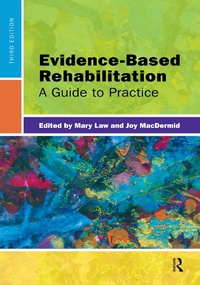
Evidence-Based Rehabilitation
A Guide to Practice
3rd Edition
Published on 1. June 2024
376 pages
978-1-040-14105-2 (ISBN)
Description

While evidence-based practice (EBP) has greatly influenced rehabilitation in the past decade, it continues to evolve and practitioners need guidance to implement evidence into their practice. Evidence-Based Rehabilitation: A Guide to Practice, the best-selling text providing step-by-step EBP guidance for rehabilitation professionals, has been updated into an expanded Third Edition.
In Evidence-Based Rehabilitation, Third Edition Drs. Mary Law and Joy MacDermid, along with their contributors, explain evidence-based rehabilitation, the concepts underlying EBP, and build the reader's knowledge and skills through specific learning. The text is organized by the steps of the EBP process-introduction to EBP, finding the evidence, assessing the evidence, and using the evidence.
EBP focuses first and foremost on making the best decisions for each client and using the best information available. For many rehabilitation practitioners, building skills in EBP is best done one step at a time. Evidence-Based Rehabilitation helps the rehabilitation student and practitioner develop his or her knowledge and skills to implement evidence-based rehabilitation in practice.
Benefits of the Third Edition:
* All chapters have been updated with new information and resources
* New chapters about systematic reviews, and knowledge transfer
* Extensive guide available with specific student activities and answers for faculty use
* Critical review forms included for student use-these forms have been used by practitioners and researchers around the world for 10 to 20 years
* Recognition throughout the book that EBP in rehabilitation means bringing together research evidence, clinical reasoning of the therapist and client values and goals
* Fits the standard 3-unit course design with 11 to 12 sessions
Included with the text are online supplemental materials for faculty use in the classroom.
Designed and written by an occupational therapist and a physical therapist with extensive research, education, and practice experience, Evidence-Based Rehabilitation: A Guide to Practice, Third Edition will guide both occupational therapy and physical therapy students and practitioners as they incorporate evidence-based practice into their work.
In Evidence-Based Rehabilitation, Third Edition Drs. Mary Law and Joy MacDermid, along with their contributors, explain evidence-based rehabilitation, the concepts underlying EBP, and build the reader's knowledge and skills through specific learning. The text is organized by the steps of the EBP process-introduction to EBP, finding the evidence, assessing the evidence, and using the evidence.
EBP focuses first and foremost on making the best decisions for each client and using the best information available. For many rehabilitation practitioners, building skills in EBP is best done one step at a time. Evidence-Based Rehabilitation helps the rehabilitation student and practitioner develop his or her knowledge and skills to implement evidence-based rehabilitation in practice.
Benefits of the Third Edition:
* All chapters have been updated with new information and resources
* New chapters about systematic reviews, and knowledge transfer
* Extensive guide available with specific student activities and answers for faculty use
* Critical review forms included for student use-these forms have been used by practitioners and researchers around the world for 10 to 20 years
* Recognition throughout the book that EBP in rehabilitation means bringing together research evidence, clinical reasoning of the therapist and client values and goals
* Fits the standard 3-unit course design with 11 to 12 sessions
Included with the text are online supplemental materials for faculty use in the classroom.
Designed and written by an occupational therapist and a physical therapist with extensive research, education, and practice experience, Evidence-Based Rehabilitation: A Guide to Practice, Third Edition will guide both occupational therapy and physical therapy students and practitioners as they incorporate evidence-based practice into their work.
Reviews / Votes
"I use this book to refine my capacity for judging and using evidence in my own clinical practice, as well as in working with students in an occupational therapy graduate program. The Third Edition has enough updates and new content to support replacement of the Second Edition...The book will be on my desk!"- Carla Wilhite, OTD, OTR/L, University of New Mexico, Doody's Review Service
"This updated edition of Law and MacDermid's text is a highly recommended resource for educational settings as well as for practice teams looking to enhance the evidence-based nature of their practice."
- Tanya Rihtman, Coventry University, British Journal of Occupational Therapy
"This textbook will appeal to beginners wishing to develop a better grasp of EBP as well as seasoned practitioners wishing to attain exemplary practice. The sheer number of examples, solutions, and models provided will support readers in defining an optimal process to conduct EBP in their milieu. This book is convincing in its demonstration of the importance of EBP for continuing professional development as well as for the advancement of the profession."
- Julie Lapointe, Canadian Journal of Occupational Therapy
More details
Edition
3rd edition
Language
English
Place of publication
London
United Kingdom
Publishing group
Taylor & Francis Ltd
Target group
College/higher education
Professional and scholarly
ISBN-13
978-1-040-14105-2 (9781040141052)
Copyright in bibliographic data and cover images is held by Nielsen Book Services Limited or by the publishers or by their respective licensors: all rights reserved.
Schweitzer Classification
Other editions
Additional editions
Book
11/2013
3rd Edition
SLACK Incorporated
€98.90
Shipment within 3-4 weeks
Persons
Mary Law, PHD, OTReg(Ont), FCAOT, FCAHS is a Professor and Associate Dean (Health Sciences) Rehabilitation Science and associate member of the Department of Clinical Epidemiology and Biostatistics at McMaster University. She holds the John and Margaret Lillie Chair in Childhood Disability Research. Mary, an occupational therapist by training, is Co-Founder of CanChild Centre for Childhood Disability Research, a multidisciplinary research center at McMaster University. Mary's research centers on the development and validation of client-centered outcome measures, evaluation of occupational therapy interventions with children, the effect of environmental factors on the participation of children with disabilities in day to day activities, and transfer of research knowledge into practice. In her educational activities, Mary is involved in teaching the theoretical basis of occupational therapy practice and evidence-based occupational therapy practice in the occupational therapy program, as well as supervising graduate students. Mary is the lead author of the Canadian Occupational Performance Measure, a client-centered outcome measure for occupational therapy, and has written books on client-centered occupational therapy and measurement of occupational performance.
Joy MacDermid, PT, PhD, is an Associate Professor in Rehabilitation Science at McMaster University (Hamilton, ON), and is the Co-director of Clinical Research at the Hand and Upper Limb Centre (London, ON). She is funded as a (physical therapist/epidemiologist) scientist by the Canadian Institutes of Health (CIHR New Investigator). She has published more than 100 articles including systematic reviews, development/evaluation of outcomes measures, clinical trials, knowledge transfer, clinical practice guidelines, and identification of clinical predictors. Her clinical interests are in musculoskeletal pain and disability resulting from upper quadrant disorders and the impact of these disorders on work and subsequent health and quality of life. Joy teaches courses in upper extremity musculoskeletal clinical skills, evidence-based practice, work disability, quality of life, and knowledge exchange and transfer. She is the Vice-President of the American Society of Hand Therapists (ASHT); has twice won its best scientific paper award; and was awarded the Natalie Barr Lecture in 2006, the Philadelphia Hand Meeting Honored Professorship in 2006, and the CIHR Quality of Life Award in 2007. She is an associate editor for The Journal of Hand Therapy and The Journal of Orthopaedic and Sports Physical Therapy and is the editor for the ASHT Clinical Outcome Assessment Recommendations for the Wrist/Hand.
Joy MacDermid, PT, PhD, is an Associate Professor in Rehabilitation Science at McMaster University (Hamilton, ON), and is the Co-director of Clinical Research at the Hand and Upper Limb Centre (London, ON). She is funded as a (physical therapist/epidemiologist) scientist by the Canadian Institutes of Health (CIHR New Investigator). She has published more than 100 articles including systematic reviews, development/evaluation of outcomes measures, clinical trials, knowledge transfer, clinical practice guidelines, and identification of clinical predictors. Her clinical interests are in musculoskeletal pain and disability resulting from upper quadrant disorders and the impact of these disorders on work and subsequent health and quality of life. Joy teaches courses in upper extremity musculoskeletal clinical skills, evidence-based practice, work disability, quality of life, and knowledge exchange and transfer. She is the Vice-President of the American Society of Hand Therapists (ASHT); has twice won its best scientific paper award; and was awarded the Natalie Barr Lecture in 2006, the Philadelphia Hand Meeting Honored Professorship in 2006, and the CIHR Quality of Life Award in 2007. She is an associate editor for The Journal of Hand Therapy and The Journal of Orthopaedic and Sports Physical Therapy and is the editor for the ASHT Clinical Outcome Assessment Recommendations for the Wrist/Hand.
Content
Dedication Acknowledgments About the Editors Contributing Authors Preface Chapter 1 Introduction to Evidence-Based Practice FCAHS Chapter 2 Development of Evidence-Based Knowledge Chapter 3 Becoming an Evidence-Based Practitioner Chapter 4 Outcome Measurement in Evidence-Based Rehabilitation Chapter 5 Asking Clinical Questions and Searching for the Evidence Chapter 6 Evaluating the Evidence Chapter 7 Systematically Reviewing the Evidence Chapter 8 Evaluating the Evidence: Economic Evaluations Chapter 9 Knowledge Translation Chapter 10 Strategies to Build Evidence Into Practice Chapter 11 Evidence Synthesis Practice Tools: Guidelines, Algorithms, Clinical Pathways, Prediction Rules, and Patient Decision Aids Chapter 12 Communicating Evidence to Clients, Managers, and Funders Chapter 13 Moving Evidence Into Practice: Case Examples of the Knowledge-to-Action Cycle at Work Appendix A Quality Appraisal for Clinical Measurement Studies: Evaluation Form and Guidelines Appendix B Outcome Measures Review: Form and Guidelines Appendix C Qualitative Review: Form and Guidelines Appendix D Quantitative Review: Form and Guidelines Appendix E Evaluation of Quality of an Intervention Study: Form and Guidelines Appendix F Critical Appraisal Prognostic Study: Form and Guidelines Appendix G Worksheet for Evaluating and Using Articles About Diagnostic Tests Appendix H Taxonomy of Knowledge Translation Interventions Financial Disclosures Index
