

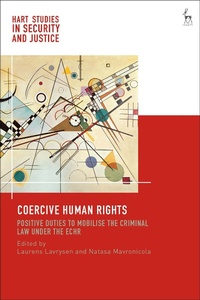
Coercive Human Rights
Positive Duties to Mobilise the Criminal Law Under the Echr
1st Edition
Published on 12. November 2020
288 pages
978-1-5099-3789-9 (ISBN)
Description

Traditionally, human rights have protected those facing the sharp edge of the criminal justice system. But over time human rights law has become increasingly infused with duties to mobilise criminal law towards protection and redress for violation of rights. These developments give rise to a whole host of questions concerning the precise parameters of coercive human rights, the rationale(s) that underpin them, and their effects and implications for victims, perpetrators, domestic legal systems, and for the theory and practice of human rights and criminal justice. This collection addresses these questions with a focus on the rich jurisprudence of the European Court of Human Rights (ECtHR).
The collection explores four interlocking themes surrounding the issue of coercive human rights:
First, the key threads in the doctrine of the ECtHR on duties to mobilise the criminal law as a means of delivering human rights protection.
Secondly, the factors that contribute to a readiness to demand coercive measures, including discrimination and vulnerability, and other key justificatory reasoning shaping the development of coercive human rights.
Thirdly, the most pressing challenges for the ECtHR's coercive duties doctrine, including:
- how it relates to theories and rationales of criminalisation and criminal punishment;
- its implications for the fundamental tenets of human rights law itself;
- its relationship to transitional justice objectives; and
- how (far) it coheres with the imperative of effective protection for persons in precarious or vulnerable situations.
Fourthly, the (prospective) evolution of the coercive human rights doctrine and its application within national jurisdictions.
The collection explores four interlocking themes surrounding the issue of coercive human rights:
First, the key threads in the doctrine of the ECtHR on duties to mobilise the criminal law as a means of delivering human rights protection.
Secondly, the factors that contribute to a readiness to demand coercive measures, including discrimination and vulnerability, and other key justificatory reasoning shaping the development of coercive human rights.
Thirdly, the most pressing challenges for the ECtHR's coercive duties doctrine, including:
- how it relates to theories and rationales of criminalisation and criminal punishment;
- its implications for the fundamental tenets of human rights law itself;
- its relationship to transitional justice objectives; and
- how (far) it coheres with the imperative of effective protection for persons in precarious or vulnerable situations.
Fourthly, the (prospective) evolution of the coercive human rights doctrine and its application within national jurisdictions.
More details
Series
Edition
1. Auflage
Language
English
Place of publication
London
United Kingdom
Publishing group
Bloomsbury Publishing PLC
Target group
College/higher education
ISBN-13
978-1-5099-3789-9 (9781509937899)
Copyright in bibliographic data and cover images is held by Nielsen Book Services Limited or by the publishers or by their respective licensors: all rights reserved.
Schweitzer Classification
Other editions
Additional editions

Laurens Lavrysen | Natasa Mavronicola
Coercive Human Rights
Positive Duties to Mobilise the Criminal Law under the ECHR
Book
07/2022
Hart Publishing
€65.79
Shipment within 15-20 days

Laurens Lavrysen | Natasa Mavronicola
Coercive Human Rights
Positive Duties to Mobilise the Criminal Law under the ECHR
Book
11/2020
Hart Publishing
€133.70
Shipment within 15-20 days
Persons
Laurens Lavrysen is a Postdoctoral Researcher (funded by the FWO - Research Foundation Flanders), connected to the Human Rights Centre of Ghent University.
Natasa Mavronicola is Reader in Law at Birmingham Law School, University of Birmingham.
Natasa Mavronicola is Reader in Law at Birmingham Law School, University of Birmingham.
Content
1. Coercive Human Rights: Introducing the Sharp Edge of the European Convention on Human Rights
Natasa Mavronicola and Laurens Lavrysen
PART I
KEY THREADS IN ECtHR DOCTRINE
2. Positive Obligations and the Criminal Law: A Bird's-Eye View on the Case Law of the European Court of Human Rights
Laurens Lavrysen
3. Positive Obligations and Coercion: Deterrence as a Key Factor in the European Court of Human Rights' Case Law
Paul Lemmens and Marie Courtoy
PART II
PERSPECTIVES ON VICTIMS' PROTECTION AND REDRESS
4. Retribution through Reparations? Evaluating the European Court of Human Rights' Jurisprudence on Gross Human Rights Violations from a Victim's Perspective
Alina Balta
5. Shaping Coercive Obligations through Vulnerability: The Example of the ECtHR
Corina Heri
6. Criminal Law Responses to Hate Speech: Towards a Systematic Approach in Strasbourg?
Stephanos Stavros
PART III
CRITICAL REFLECTIONS: THEORY, IMPACT, LIMITATIONS
7. Positive Obligations in View of the Principle of Criminal Law as a Last Resort
Nina PerSak
8. Sowing a 'Culture of Conviction': What Shall Domestic Criminal Justice Systems Reap from Coercive Human Rights?
Mattia Pinto
9. Coercive Overreach, Dilution and Diversion: Potential Dangers of Aligning Human Rights Protection with Criminal Law (Enforcement)
Natasa Mavronicola
10. Separating Protection from the Exigencies of the Criminal Law: Achievements and Challenges under Article 4 ECHR
Vladislava Stoyanova
11. The Limitations of a Criminal Law Approach in a Transitional Justice Context
Brice Dickson
PART IV
UNCHARTED WATERS FOR THE ECtHR'S COERCIVE DUTIES DOCTRINE
12. Preventive Obligations, Risk and Coercive Overreach
Liora Lazarus
13. Coercive Human Rights and Unlawfully Obtained Evidence in Domestic Criminal Proceedings
Kelly M Pitcher
Postscript: Coercive Human Rights in Times of Coronavirus
Natasa Mavronicola and Laurens Lavrysen
Natasa Mavronicola and Laurens Lavrysen
PART I
KEY THREADS IN ECtHR DOCTRINE
2. Positive Obligations and the Criminal Law: A Bird's-Eye View on the Case Law of the European Court of Human Rights
Laurens Lavrysen
3. Positive Obligations and Coercion: Deterrence as a Key Factor in the European Court of Human Rights' Case Law
Paul Lemmens and Marie Courtoy
PART II
PERSPECTIVES ON VICTIMS' PROTECTION AND REDRESS
4. Retribution through Reparations? Evaluating the European Court of Human Rights' Jurisprudence on Gross Human Rights Violations from a Victim's Perspective
Alina Balta
5. Shaping Coercive Obligations through Vulnerability: The Example of the ECtHR
Corina Heri
6. Criminal Law Responses to Hate Speech: Towards a Systematic Approach in Strasbourg?
Stephanos Stavros
PART III
CRITICAL REFLECTIONS: THEORY, IMPACT, LIMITATIONS
7. Positive Obligations in View of the Principle of Criminal Law as a Last Resort
Nina PerSak
8. Sowing a 'Culture of Conviction': What Shall Domestic Criminal Justice Systems Reap from Coercive Human Rights?
Mattia Pinto
9. Coercive Overreach, Dilution and Diversion: Potential Dangers of Aligning Human Rights Protection with Criminal Law (Enforcement)
Natasa Mavronicola
10. Separating Protection from the Exigencies of the Criminal Law: Achievements and Challenges under Article 4 ECHR
Vladislava Stoyanova
11. The Limitations of a Criminal Law Approach in a Transitional Justice Context
Brice Dickson
PART IV
UNCHARTED WATERS FOR THE ECtHR'S COERCIVE DUTIES DOCTRINE
12. Preventive Obligations, Risk and Coercive Overreach
Liora Lazarus
13. Coercive Human Rights and Unlawfully Obtained Evidence in Domestic Criminal Proceedings
Kelly M Pitcher
Postscript: Coercive Human Rights in Times of Coronavirus
Natasa Mavronicola and Laurens Lavrysen
