

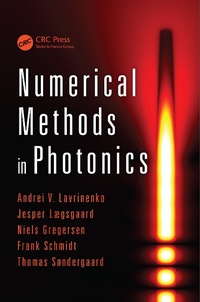
Numerical Methods in Photonics
1st Edition
Published on 3. September 2018
364 pages
978-1-4665-6389-6 (ISBN)
Description

Simulation and modeling using numerical methods is one of the key instruments in any scientific work. In the field of photonics, a wide range of numerical methods are used for studying both fundamental optics and applications such as design, development, and optimization of photonic components. Modeling is key for developing improved photonic devices and reducing development time and cost.
Choosing the appropriate computational method for a photonics modeling problem requires a clear understanding of the pros and cons of the available numerical methods. Numerical Methods in Photonics presents six of the most frequently used methods: FDTD, FDFD, 1+1D nonlinear propagation, modal method, Green's function, and FEM.
After an introductory chapter outlining the basics of Maxwell's equations, the book includes self-contained chapters that focus on each of the methods. Each method is accompanied by a review of the mathematical principles in which it is based, along with sample scripts, illustrative examples of characteristic problem solving, and exercises. MATLAB (R) is used throughout the text.
This book provides a solid basis to practice writing your own codes. The theoretical formulation is complemented by sets of exercises, which allow you to grasp the essence of the modeling tools.
Choosing the appropriate computational method for a photonics modeling problem requires a clear understanding of the pros and cons of the available numerical methods. Numerical Methods in Photonics presents six of the most frequently used methods: FDTD, FDFD, 1+1D nonlinear propagation, modal method, Green's function, and FEM.
After an introductory chapter outlining the basics of Maxwell's equations, the book includes self-contained chapters that focus on each of the methods. Each method is accompanied by a review of the mathematical principles in which it is based, along with sample scripts, illustrative examples of characteristic problem solving, and exercises. MATLAB (R) is used throughout the text.
This book provides a solid basis to practice writing your own codes. The theoretical formulation is complemented by sets of exercises, which allow you to grasp the essence of the modeling tools.
Reviews / Votes
"... useful to students and researchers who want to have a deeper understanding of the methods commonly used in computational electromagnetics. After addressing the basic principles, this book provides the readers with the details and mathematical/numerical framework of commonly used methods including FDTD, finite element, Green's function, and modal. It then goes on to more advanced topics such as modelling nonlinear materials and materials with gain. This book is a useful addition to the library of any research university."-C T Chan, Hong Kong University of Science and Technology
More details
Series
Edition
1. Auflage
Language
English
Place of publication
Baton Rouge
United States
Publishing group
Taylor & Francis Inc
Target group
College/higher education
Researchers, optical telecommunications engineers, engineers in the photonics industry. PhD and MSc students undertaking courses in the areas of photonics and optical telecommunications
Illustrations
96 s/w Abbildungen, 3 s/w Tabellen
3 Tables, black and white; 96 Illustrations, black and white
File size
15,74 MB
ISBN-13
978-1-4665-6389-6 (9781466563896)
Copyright in bibliographic data and cover images is held by Nielsen Book Services Limited or by the publishers or by their respective licensors: all rights reserved.
Schweitzer Classification
Other editions
Additional editions
Andrei V. Lavrinenko | Jesper Laegsgaard | Niels Gregersen
Numerical Methods in Photonics
Book
11/2017
1st Edition
CRC Press
€114.80
Shipment within 10-20 days
Andrei V. Lavrinenko | Jesper Laegsgaard | Niels Gregersen
Numerical Methods in Photonics
Book
09/2014
1st Edition
CRC Press
€242.70
Shipment within 15-20 days
Persons
Andrei V. Lavrinenko, Technical University of Denmark, Kongens Lyngby
Jesper Laegsgaard, Technical University of Denmark, Kongens Lyngby
Niels Gregersen, Technical University of Denmark, Kongens Lyngby
Frank Schmidt, Zuse Institute, Berlin, Germany
Thomas Sondergaard, Aalborg University, Denmark
Jesper Laegsgaard, Technical University of Denmark, Kongens Lyngby
Niels Gregersen, Technical University of Denmark, Kongens Lyngby
Frank Schmidt, Zuse Institute, Berlin, Germany
Thomas Sondergaard, Aalborg University, Denmark
Content
Introduction. Maxwell's Equations. FDTD. Finite-Difference Modeling of Straight Waveguides. Modeling of Nonlinear Propagation in Waveguides. The Modal Method. Green's Function Integral Equation Methods for Electromagnetic Scattering Problems. Finite Element Method.
