

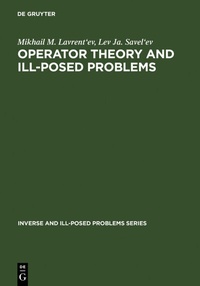
Operator Theory and Ill-Posed Problems
Description

This book consists of three major parts. The first two parts deal with general mathematical concepts and certain areas of operator theory. The third part is devoted to ill-posed problems. It can be read independently of the first two parts and presents a good example of applying the methods of calculus and functional analysis.
The first part "Basic Concepts" briefly introduces the language of set theory and concepts of abstract, linear and multilinear algebra. Also introduced are the language of topology and fundamental concepts of calculus: the limit, the differential, and the integral. A special section is devoted to analysis on manifolds. The second part "Operators" describes the most important function spaces and operator classes for both linear and nonlinear operators. Different kinds of generalized functions and their transformations are considered. Elements of the theory of linear operators are presented. Spectral theory is given a special focus. The third part "Ill-Posed Problems" is devoted to problems of mathematical physics, integral and operator equations, evolution equations and problems of integral geometry. It also deals with problems of analytic continuation.
Detailed coverage of the subjects and numerous examples and exercises make it possible to use the book as a textbook on some areas of calculus and functional analysis. It can also be used as a reference textbook because of the extensive scope and detailed references with comments.
More details
Other editions
Additional editions

Persons
Content
- Intro
- BASIC CONCEPTS
- Chapter 1. Set theory
- 1.1 Sets
- 1.2 Correspondences
- 1.3 Relations
- 1.4 Induction
- 1.5. Natural numbers
- Chapter 2. Algebra
- 2.1 Abstract algebra
- 2.2 Linear algebra
- 2.3 Multilinear algebra
- Chapter 3. Calculus
- 3.1. Limit
- 3.2. Differential
- 3.3 Integral
- 3.4 Analysis on manifolds
- OPERATORS
- Chapter 4. Linear operators
- 4.1 Hubert spaces
- 4.2 Fourier series
- 4.3. Function spaces
- 4.4 Fourier transform
- 4.5 Bounded linear operators
- 4.6 Compact linear operators
- 4.7 Self-adjoint operators
- 4.8 Spectra of operators
- 4.9. Spectral theorem
- 4.10. Operator exponential
- Chapter 5. Nonlinear operators
- 5.1 Fixed points
- 5.2 Saddle points
- 5.3 Monotonie operators
- 5.4 Nonlinear contractions
- 5.5 Degree theory
- ILL-POSED PROBLEMS
- Chapter 6. Classic problems
- 6.1 Mathematical description of the laws of physics
- 6.2 Equations of the first order
- 6.3 Classification of differential equations of the second order
- 6.4 Elliptic equations
- 6.5 Hyperbolic and parabolic equations
- 6.6 The notion of well-posedness
- Chapter 7. Ill-posed problems
- 7.1 Ill-posed Cauchy problems
- 7.2 Analytic continuation and interior problems
- 7.3. Weakly and strongly ill-posed problems. Problems of differentiation
- 7.4. 7.4 Reducing ill-posed problems to integral equations
- Chapter 8. Physical problems leading to ill-posed problems
- 8.1 Interpretation of measurement data from physical devices
- 8.2 Interpretation of gravimetric data
- 8.3 Problems for the diffusion equation
- 8.4 Determining physical fields from the measurements data
- 8.5 Tomography
- Chapter 9. Operator and integral equations
- 9.1 Definitions of well-posedness
- 9.2 Regularization
- 9.3 Linear operator equations
- 9.4 Integral equations with weak singularities
- 9.5 Scalar Volterra equations
- 9.6Volterra operator equations
- Chapter 10. Evolution equations
- 10.1 Cauchy problem and semigroups of operators
- 10.2 Equations in a Hilbert space
- 10.3 Equations with variable operator
- 10.4 Equations of the second order
- 10.5 Well-posed and ill-posed Cauchy problems
- 10.6 Equations with integro-differential operators
- Chapter 11. Problems of integral geometry
- 11.1 Statement of problems of integral geometry
- 11.2 The Radon problem
- 11.3 Reconstructing a function from spherical means
- 11.4 Planar problem of the general form
- 11.5 Spatial problems of the general form
- 11.6 Problems of the Volterra type for manifolds invariant with respect to the translation group
- 11.7 Planar problems of integral geometry with a perturbation
- Chapter 12. Inverse problems
- 12.1Statement of inverse problems
- 12.2 Inverse dynamic problem. A linearization method
- 12.3. A general method for studying inverse problems for hyperbolic equations
- 12.4 The connection between inverse problems for hyperbolic, elliptic, and parabolic equations
- 12.5 Problems of determining a Riemannian metric
- Chapter 13. Several areas of the theory of ill-posed problems, inverse problems, and applications
- Bibliography
- Index
