

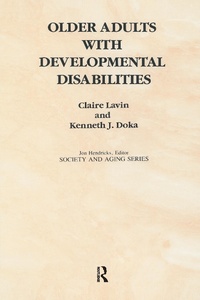
Older Adults with Developmental Disabilities
1st Edition
Published on 25. November 2020
152 pages
978-1-351-84259-4 (ISBN)
Description

Assesses the needs and lives of the first generation of people with developmental disabilities who have survived into later life. Describes the challenges facing practitioners in gerontology and developmental disabilities to modify programs designed for mid-life adults, and notes that senior services will need to incorporate the needs of the new po
More details
Series
Edition
1. Auflage
Language
English
Place of publication
London
United Kingdom
Publishing group
Taylor & Francis Ltd
Target group
Professional and scholarly
ISBN-13
978-1-351-84259-4 (9781351842594)
Copyright in bibliographic data and cover images is held by Nielsen Book Services Limited or by the publishers or by their respective licensors: all rights reserved.
Schweitzer Classification
Other editions
Additional editions
Claire Lavin | Kenneth J. Doka
Older Adults with Developmental Disabilities
Book
06/1999
1st Edition
Baywood Publishing Company Inc
€195.70
Shipment within 3-4 weeks
Persons
Claire Lavin (Author) , Kenneth J Doka (Author)
Content
Chapter I Introduction-This chapter provides a brief overview of the issues, needs, and challenges that are presented by this new population of older adults.
Chapter II The Emergence of the Elderly with Developmental Disabilities: A Historical Review -This chapter further explores factors that have affected the emergence of this cohort. Theirs is one of the first groups to move from institutionalization to the normalization of life experiences. As they move through the life cycle, they experience significant changes and pose a challenge to caregivers.
Chapter III Characteristics of Older Adults with Developmental Disabilities-A basic overview of the specific disabilities that characterize this population is presented. The discussion includes both impact of these disabilities on physical, social, cognitive, and psychological development and the supports needed to help individuals function.
Chapter IV Transitions in Later Life-As persons age, they need to cope with numerous transitions in later life such as illness, aging, retirement, relocation, and grief. This chapter explores these changes, and challenges caregivers to develop ways to empower persons with developmental disabilities to cope themselves.
Chapter V Social Life and Family Relationships-Family and friendship relationships of older adults with developmental disabilities change over the life cycle. This chapter explores changes that occur in later life in housing, income, employment and religious and spiritual orientation that impact the social lives of older adults with developmental disabilities.
Chapter VI Psychological Aspects of Aging-This chapter considers the ways that psychological changes in cognitive and personal development affect older adults with developmental disabilities.
Chapter VII Which System? What Services? -One of the critical issues facing older persons with developmental disabilities is which system or network will best provide for them. The aging network has had long experience in assisting the elderly but scant training with persons with developmental disabilities. On the other hand, the mental retardation/development disabilities network historically has focused more on younger populations. This chapter identifies service needs of the population and addresses which are best served by each system.
Chapter VIII Public Policy and Older Adults with Developmental Disabilities-Older adults with developmental disabilities have lived through major policy changes which have led to their removal from institutions and placement in the community. This chapter explores issues facing policy makers charged with ensuring access and quality programs for this unique population.
Chapter IX Planning Guide for Parents and Siblings-Most individuals with developmental disabilities reside at home with aging family caregivers. This chapter offers guidance on planning for the future of older adults to ensure a smooth transition when family changes occur. Issues of guardianship, letters of intent, trusts, and wills are explored to assist families in the planning process. The chapter also includes a list of organizations which can serve as resources in this task.
Chapter X Counseling the Older Adult with Developmental Disabilities-Frequently the mental health needs of older adults with developmental disabilities are overlooked. This chapter analyzes both the mental health needs of this population and specific interventions to address deep seated problems.
Chapter II The Emergence of the Elderly with Developmental Disabilities: A Historical Review -This chapter further explores factors that have affected the emergence of this cohort. Theirs is one of the first groups to move from institutionalization to the normalization of life experiences. As they move through the life cycle, they experience significant changes and pose a challenge to caregivers.
Chapter III Characteristics of Older Adults with Developmental Disabilities-A basic overview of the specific disabilities that characterize this population is presented. The discussion includes both impact of these disabilities on physical, social, cognitive, and psychological development and the supports needed to help individuals function.
Chapter IV Transitions in Later Life-As persons age, they need to cope with numerous transitions in later life such as illness, aging, retirement, relocation, and grief. This chapter explores these changes, and challenges caregivers to develop ways to empower persons with developmental disabilities to cope themselves.
Chapter V Social Life and Family Relationships-Family and friendship relationships of older adults with developmental disabilities change over the life cycle. This chapter explores changes that occur in later life in housing, income, employment and religious and spiritual orientation that impact the social lives of older adults with developmental disabilities.
Chapter VI Psychological Aspects of Aging-This chapter considers the ways that psychological changes in cognitive and personal development affect older adults with developmental disabilities.
Chapter VII Which System? What Services? -One of the critical issues facing older persons with developmental disabilities is which system or network will best provide for them. The aging network has had long experience in assisting the elderly but scant training with persons with developmental disabilities. On the other hand, the mental retardation/development disabilities network historically has focused more on younger populations. This chapter identifies service needs of the population and addresses which are best served by each system.
Chapter VIII Public Policy and Older Adults with Developmental Disabilities-Older adults with developmental disabilities have lived through major policy changes which have led to their removal from institutions and placement in the community. This chapter explores issues facing policy makers charged with ensuring access and quality programs for this unique population.
Chapter IX Planning Guide for Parents and Siblings-Most individuals with developmental disabilities reside at home with aging family caregivers. This chapter offers guidance on planning for the future of older adults to ensure a smooth transition when family changes occur. Issues of guardianship, letters of intent, trusts, and wills are explored to assist families in the planning process. The chapter also includes a list of organizations which can serve as resources in this task.
Chapter X Counseling the Older Adult with Developmental Disabilities-Frequently the mental health needs of older adults with developmental disabilities are overlooked. This chapter analyzes both the mental health needs of this population and specific interventions to address deep seated problems.
