

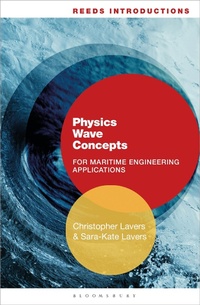
Reeds Introductions: Physics Wave Concepts for Marine Engineering Applications
1st Edition
Published on 9. March 2017
224 pages
978-1-4729-2217-5 (ISBN)
Description

Reeds Introductions: Physics Wave Concepts for Marine Engineering Applications covers the fundamental theoretical maritime physics concepts which underpin electromagnetic wave and sonar principles as developed in most maritime-related courses, whether Naval, Coastguard or Merchant Marine engineering. For these reasons it is vital that maritime users have a basic understanding of the concepts upon which many essential modern sea-going sensors and communications devices now operate.
Knowledge regarding electromagnetic waves and electromagnetic devices is an established merchant navy sea service requirement, particularly for the Standards in Training and Certification in Watchkeeping (STCW95) qualification in various Maritime Coastguard Agency exams, e.g. Marine Electrotechnology (as Chief Engineer and Second Engineer), as mandated by the UK Department for Transport. This short introductory book is written as simply as possible to support growing numbers of overseas students for whom English is not their first language.
This volume provides a comprehensive study of maritime physics principles and provides a firm foundation prior to reading and studying of the following Reeds Marine Engineering series: Vols 1, 3, 6, 7, 14 and 15. Students having read this easy-to-read volume will be better prepared for the more in depth study of the other volumes listed.
Knowledge regarding electromagnetic waves and electromagnetic devices is an established merchant navy sea service requirement, particularly for the Standards in Training and Certification in Watchkeeping (STCW95) qualification in various Maritime Coastguard Agency exams, e.g. Marine Electrotechnology (as Chief Engineer and Second Engineer), as mandated by the UK Department for Transport. This short introductory book is written as simply as possible to support growing numbers of overseas students for whom English is not their first language.
This volume provides a comprehensive study of maritime physics principles and provides a firm foundation prior to reading and studying of the following Reeds Marine Engineering series: Vols 1, 3, 6, 7, 14 and 15. Students having read this easy-to-read volume will be better prepared for the more in depth study of the other volumes listed.
More details
Series
Edition
1. Auflage
Language
English
Place of publication
London
United Kingdom
Publishing group
Bloomsbury Publishing PLC
Target group
College/higher education
Illustrations
1 x 8 page colour plate section
ISBN-13
978-1-4729-2217-5 (9781472922175)
Copyright in bibliographic data and cover images is held by Nielsen Book Services Limited or by the publishers or by their respective licensors: all rights reserved.
Schweitzer Classification
Other editions
Additional editions
Book
03/2017
Thomas Reed Publications
€51.00
Article exhausted; check different version
Person
Christopher Lavers is a lecturer in Marine Engineering and has taught Maritime and Remote Sensing topics at Britannia Royal Naval College since 1993. He is Subject Matter Expert (Radar and Telecommunications) at Britannia Royal Naval College, Dartmouth, UK.
Content
- Cover
- Half Title
- Series Information
- Title Page
- Imprint
- Dedication
- Contents
- Preface
- Introduction
- References
- 1 Basic Wave Concepts
- 1.1 What is a wave?
- 1.2 Wave parameters
- 1.3 Wave speed
- 1.4 Relation between speed, frequency and wavelength
- 1.5 Phase and phase difference
- 1.6 Self-.assessment questions
- References
- 2 Types of Waves
- 2.1 Different types of waves
- 2.2 Propagation of longitudinal sound waves
- 2.3 Standing waves and sound in pipes
- 2.3.1 Pipe open at both ends
- 2.3.2 Pipe closed at one end
- 2.4 Propagation of transverse mechanical waves
- 2.5 Simple harmonic motion
- 2.5.1 Velocity and acceleration
- 2.5.2 Angular velocity
- 2.6 Surface waves in deep and shallow water
- 2.6.1 Waves in deep water
- 2.6.2 Wavelength and phase velocity
- 2.6.3 Sub-.surface wave motion
- 2.7 Waves in shallow water
- 2.7.1 Dispersion
- 2.7.2 General summary equation covering both deep-. and shallow-.water wave types
- 2.7.3 Wave measurements and devices
- 2.7.4 Useful satellite sensing missions
- Argo Buoy Track Network
- 2.7.5 Short comment on seismic waves
- 2.8 Self-.assessment questions
- References
- 3 Electromagnetic waves
- 3.1 Background to electromagnetic wave motion
- 3.2 Electromagnetic spectrum
- 3.2.1 Wave energy
- 3.2.2 Radio waves
- 3.2.3 Microwaves
- 3.2.4 Infrared
- 3.2.5 Ultraviolet radiation
- 3.2.6 X-.rays
- 3.2.7 Gamma rays
- 3.3 Radioactive decay and half-.thickness
- 3.4 General electromagnetic wave properties
- 3.5 Self-.assessment questions
- References
- 4 Wave Properties
- 4.1 Polarisation
- 4.2 Reflection of waves
- 4.3 Refraction of waves
- 4.3.1 Refraction of waves between different media
- 4.3.2. A simple derivation of Snell's law
- 4.4 Total Internal Reflection (TIR) of a wave
- 4.4.1 Optical fibre
- 4.4.2 Ionospheric refraction
- 4.5 Self-.assessment questions
- References
- 5 Loss Mechanisms
- 5.1 The effect of geometric spreading
- 5.2 Underwater light attenuation
- 5.3 Absorption of underwater light
- 5.4 Scattering of underwater light
- 5.4.1 Rayleigh or molecular scattering
- 5.4.2 Mie scattering
- 5.5 Additional comments on the inverse square law regarding tides
- 5.6 Self-.assessment questions
- 6 Diffraction
- 6.1 The effect of an aperture
- 6.2 Optical diffraction
- 6.3 Diffraction at a slit
- 6.4 Diffraction gratings
- 6.5 Diffracted beam shape at a radar aperture
- 6.6 Arrays of multiple sources
- 6.7 Self-.assessment questions
- References
- 7 Interference
- 7.1 Principle of superposition
- 7.2 Same frequency interference
- 7.3 Interference-.based navigation-.related sensors
- 7.4 LORAN-.C
- 7.4.1 Limitations of LORAN-.C
- 7.5 Self-.assessment questions
- 8 Acoustic Waves, the Doppler Effect and Decibels
- 8.1 Acoustic pressure waves
- 8.2 The use of sound in the sea
- 8.3 Historic background of sonar
- 8.3.1 The sonar spectrum
- 8.3.2 History of sonar
- 8.4 The Doppler effect
- 8.5 Relative velocity
- 8.6 Doppler effect: A moving source
- 8.7 Doppler radar
- 8.8 Decibels
- 8.9 Acoustic waves
- 8.10 Ultrasound
- 8.11 Self-.assessment questions
- 9 Basic Mathematical and Calculator Operations
- Thomas Watson, Chairman of IBM, 1943
- 9.1 Basic mathematical operations
- 9.1.1 Expansion of brackets
- 9.1.2 Manipulation of indices
- 9.1.3 Rearrangement of equations
- 9.2 Graphs and graphical representation of experimental data
- 9.3 Logarithms
- 9.4 Useful trigonometry
- 9.4.1 Common values of sin . and cos .
- 9.4.2 Resolving vectors
- 9.5 Basic calculator operations
- 9.5.1 Accuracy
- 9.5.2 Adding, subtracting, multiplying and dividing
- 9.5.3 Use of standard form
- 9.5.4 Squares and square roots
- 9.5.5 Use of the xy key
- 9.5.6 Use of the x1/.y key
- 9.5.7 Logarithms and antilogarithms
- 9.5.8 Sine, cosine and tangent
- 9.6 Self-.assessment questions
- 10 Student Centred Study Skills for Further and Higher Education
- 10.1 Preparing for exams and general study support
- 10.2 General principles for written scientific work
- 10.2.1 The title
- 10.2.2 Background reading
- 10.2.3 Introduction
- 10.2.4 Main text
- 10.2.5 Subheadings
- 10.2.6 General mistakes
- 10.2.7 Conclusions
- 10.2.8 References
- 10.2.9 Checking the essay and post-.submission issues
- 10.3 Critical points to address to achieve the highest essay marks
- 10.3.1 Introduction
- 10.3.2 The essay
- 10.3.3 The good essay
- Presentation and overall layout
- Information content
- Range of materials and explanatory qualities
- Conclusions
- 10.3.4 The bad and the ugly essay
- Introduction
- Presentation and overall layout
- Information content
- Range of materials, technical accuracy and explanatory qualities
- Conclusions
- 10.4 Engineering and physics study tips for studying and exams
- 10.4.1 Modes of learning
- 10.5 Learning approaches
- 10.5.1 Planning your day
- 10.5.2 Spaced repetition
- 10.5.3 Tell a story
- 10.5.4 Location
- 10.5.5 Multiple maths tasking
- 10.5.6 Practising exams and testing yourself
- 10.5.7 Write it out!
- 10.5.8 Drawing
- 10.5.9 Reading aloud
- 10.5.10 Group work
- 10.5.11 Take a break!
- 10.5.12 Background music
- 10.5.13 You are what you eat
- 10.5.14 Timetable
- 10.5.15 Review your learning before you go to sleep
- 10.5.16 What actually works?
- The role of an educational mentor or tutor
- References
- Appendix A Useful data
- Appendix B Properties of Water
- Appendix C Differentiation
- Appendix D Natural Logarithms and the Exponential Function
- Solutions To Numerical Questions By Chapter
- Wave Motion Glossary
- Index
