

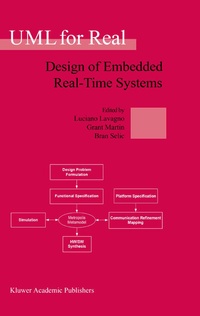
UML for Real
Design of Embedded Real-Time Systems
1st Edition
Published on 8. May 2007
XIII, 370 pages
978-0-306-48738-5 (ISBN)
Description

The complexity of most real-time and embedded systems often exceeds that of other types of systems since, in addition to the usual spectrum of problems inherent in software, they need to deal with the complexities of the physical world. That world-as the proverbial Mr. Murphy tells us-is an unpredictable and often unfriendly place. Consequently, there is a very strong motivation to investigate and apply advanced design methods and technologies that could simplify and improve the reliability of real-time software design and implementation. As a result, from the first versions of UML issued in the mid 1990's, designers of embedded and real-time systems have taken to UML with vigour and enthusiasm. However, the dream of a complete, model-driven design flow from specification through automated, optimised code generation, has been difficult to realise without some key improvements in UML semantics and syntax, specifically targeted to the real-time systems problem. With the enhancements in UML that have been proposed and are near standardisation with UML 2. 0, many of these improvements have been made. In the Spring of 2003, adoption of a formalised UML 2. 0 specification by the members of the Object Management Group (OMG) seems very close. It is therefore very appropriate to review the status of UML as a set of notations for embedded real-time systems - both the state of the art and best practices achieved up to this time with UML of previous generations - and where the changes embodied in the 2.
More details
Other editions
Additional editions
Book
12/2010
Springer
€160.49
Shipment within 15-20 days
Book
05/2003
Kluwer Academic Publishers
€160.49
Shipment within 15-20 days
Content
Models, Software Models and UML.- UML for Real-Time.- Structural Modeling with UML 2.0.- Message Sequence Charts.- UML and Platform-based Design.- UML for Hardware and Software Object Modeling.- Fine Grained Patterns for Real-Time Systems.- Architectural Patterns for Real-Time Systems.- Modeling Quality of Service with UML.- Modeling Metric Time.- Performance Analysis with UML.- Schedulability Analysis with UML.- Automotive UML.- Specifying Telecommunications Systems with UML.- Leveraging UML to Deliver Correct Telecom Applications.- Software Performance Engineering.
Chapter 13 Automotive UML
A (Meta) Model-Based Approach for Systems Development
Reconciling the Needs of Automotive Software Development with Model-Based Approaches (p.272-273)
Along with the evolution of the complexity of automotive embedded systems, the development processes of car manufacturers have been redefined to large degree. In the very beginning, electronic functions were developed in isolated development teams at the manufacturer's site. As long as these functions had to fulfill a truly isolated task, the corresponding development processes were localized, i.e. easy to control and to maintain. However, with the increasing number of functions and the increasing number of interactions resulting in complex communication protocols the integration task for these functions failed due to insufficient support provided by the actual local development process in use. As a result severe technical problems such as incorrect feature interactions and timing latencies emerged. This lead to the well known symptoms of the "software crisis": blown budgets, late delivery, and unfulfilled requirements.
To overcome these difficulties one has to take into account the specific needs of a distributed development of automotive systems leading to a truly delocalized development process. Accordingly, the obtained development artifacts have to be communicated properly across the different development teams on a regular basis in order to gain an understanding of mutual dependencies between subsystems. Unfortunately, most developed systems lack well defined documentation, so that typically just the source code of realized functions would be exchanged. However, this is not sufficient to achieve a deeper understanding of the system's functionality. Abstract models that could help to constitute an improvement were hardly ever used.
The complexities of a distributed development scenario were reinforced when third party suppliers took over the development of parts and components. In addition to the evolving deficiencies during the integration of those components into existing systems, car manufacturers complained about a progressive lack of knowledge of their own systems.
About 15 years ago, model-based techniques [17] were employed with great expectations to overcome the recognized difficulties of current development processes. Whereas in "traditional" engineering disciplines such as electrical and mechanical engineering, model-based techniques, like CAD (Computer Aided Design), FEM (Finite Element Method), and hardware design tools were employed with enormous success, a discipline called "software engineering" was hardly established. Since then various tools supporting visual modeling languages, configuration management tools, requirements management tools, and test tools were brought in, but the great diversity of model-based techniques, their abstract nature, and the strict focus of these tools on usually just one aspect of the development process limited their success and effectiveness within the actual development environment. As a consequence, car manufacturers started expensive integration projects to realize a model-based approach with the goal to achieve a seamless development process technically supported by a tailored tool chain.
Step by step car manufacturers developed a new perception of their systems' architectures [4]. Nowadays, the partitioning of the system's architecture into different abstraction levels, introducing a domain specific terminology, concepts for the formation of variants, and the understanding of model-based configurations seem to be potential steps towards a successful deployment of model-based techniques. In order to achieve a comprehensive and tightly-bound model-based paradigm for the automotive domain, only a well defined so called "metamodel-based" approach can be successful (cf. Section 1.3).
The AML includes abovementioned issues of a rigorous metamodelbased approach to simultaneously cover all different aspects of the heterogeneous system development needs within the automotive domain by providing a common conceptual framework.
A (Meta) Model-Based Approach for Systems Development
Reconciling the Needs of Automotive Software Development with Model-Based Approaches (p.272-273)
Along with the evolution of the complexity of automotive embedded systems, the development processes of car manufacturers have been redefined to large degree. In the very beginning, electronic functions were developed in isolated development teams at the manufacturer's site. As long as these functions had to fulfill a truly isolated task, the corresponding development processes were localized, i.e. easy to control and to maintain. However, with the increasing number of functions and the increasing number of interactions resulting in complex communication protocols the integration task for these functions failed due to insufficient support provided by the actual local development process in use. As a result severe technical problems such as incorrect feature interactions and timing latencies emerged. This lead to the well known symptoms of the "software crisis": blown budgets, late delivery, and unfulfilled requirements.
To overcome these difficulties one has to take into account the specific needs of a distributed development of automotive systems leading to a truly delocalized development process. Accordingly, the obtained development artifacts have to be communicated properly across the different development teams on a regular basis in order to gain an understanding of mutual dependencies between subsystems. Unfortunately, most developed systems lack well defined documentation, so that typically just the source code of realized functions would be exchanged. However, this is not sufficient to achieve a deeper understanding of the system's functionality. Abstract models that could help to constitute an improvement were hardly ever used.
The complexities of a distributed development scenario were reinforced when third party suppliers took over the development of parts and components. In addition to the evolving deficiencies during the integration of those components into existing systems, car manufacturers complained about a progressive lack of knowledge of their own systems.
About 15 years ago, model-based techniques [17] were employed with great expectations to overcome the recognized difficulties of current development processes. Whereas in "traditional" engineering disciplines such as electrical and mechanical engineering, model-based techniques, like CAD (Computer Aided Design), FEM (Finite Element Method), and hardware design tools were employed with enormous success, a discipline called "software engineering" was hardly established. Since then various tools supporting visual modeling languages, configuration management tools, requirements management tools, and test tools were brought in, but the great diversity of model-based techniques, their abstract nature, and the strict focus of these tools on usually just one aspect of the development process limited their success and effectiveness within the actual development environment. As a consequence, car manufacturers started expensive integration projects to realize a model-based approach with the goal to achieve a seamless development process technically supported by a tailored tool chain.
Step by step car manufacturers developed a new perception of their systems' architectures [4]. Nowadays, the partitioning of the system's architecture into different abstraction levels, introducing a domain specific terminology, concepts for the formation of variants, and the understanding of model-based configurations seem to be potential steps towards a successful deployment of model-based techniques. In order to achieve a comprehensive and tightly-bound model-based paradigm for the automotive domain, only a well defined so called "metamodel-based" approach can be successful (cf. Section 1.3).
The AML includes abovementioned issues of a rigorous metamodelbased approach to simultaneously cover all different aspects of the heterogeneous system development needs within the automotive domain by providing a common conceptual framework.
