

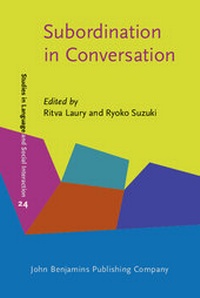
Subordination in Conversation
A cross-linguistic perspective
1st Edition
Published on 13. July 2011
VIII, 244 pages
978-90-272-8696-3 (ISBN)
Description

The articles in this volume examine the notion of clausal subordination based on English, Estonian, Finnish, French, German and Japanese conversational data. Some of the articles approach 'subordination' in terms of social action, taking into account what participants are doing with their talk, considering topics such as the use of clauses as projector phrases and as devices for organizing the participant structure of the conversation. Other articles focus on the emergence of clause combinations diachronically and synchronically, taking on topics such as the grammaticalization of clauses and conjunctions into discourse markers, and the continuum nature of syntactic subordination. In all of the articles, linguistic forms are considered to be emergent from recurrent practices engaged in by participants in conversation. The contributions critically examine central syntactic notions in interclausal relations and their relevance to the description of clause combining in conversational language, to the structure of conversation, and to the interactional functions of language.
More details
Other editions
Additional editions
Book
07/2011
John Benjamins Publishing Co
€100.70
Shipment within 10-15 days
Persons
Content
- Subordination in Conversation
- Editorial page
- Title page
- LCC data
- Table of contents
- List of contributors
- Introduction
- Functional explanations for language phenomena
- The focus of this book - 'Subordination'
- Contents of the volume
- Contribution to subordination research and future directions
- References
- N be that-constructions in everyday German conversation
- 1. Introduction
- 2. Uses of N be that-constructions in German
- 2.1 'die Sache ist/das Ding ist'-utterances followed by a subordinate clause introduced with the subjunctor 'dass'
- 2.2 'die Sache ist/das Ding ist'-utterances followed by a main clause
- 2.3. 'die Sache ist/das Ding ist'-utterances followed by a complex stretch of discourse
- 3. Conclusions
- References
- Appendix: Transcription conventions (based on GAT)
- Interrogative "complements" and question design in Estonian
- Introduction
- The data
- Projecting actions 1: The imperative of 'say'
- Projecting actions 2: The imperative of 'tell, talk'
- Marking intersubjective uncertainty: The negation of 'know'
- Marking topical continuity across sequences: The adjective 'interesting'
- Conclusion
- References
- Transcription and glossing conventions
- Syntactic and actional characteristics of Finnish että-clauses
- 1. Introduction
- 2. Data
- 3. The use of että with complement-taking predicates
- 4. Että as an utterance-initial particle
- 5. The turn-final että
- 6. Discussion
- 7. Conclusions
- References
- Appendix 1
- Appendix 2
- Clause-combining and the sequencing of actions
- 1. Introduction
- 2. Data, procedure and the grammatical patterns under discussion
- 3. Clause-combining, projection and the sequencing of actions
- 3.1 Projection
- 3.2 'Je veux dire'
- 3.3 'Il y a+NP' ('there is+NP')
- 3.4 Pseudocleft-like constructions
- 3.5 Summary and initial discussion of the findings
- 4. Projector constructions and the construction of complex turns
- 4.1. 'Je veux dire' projector constructions in complex turns
- 4.2 'Il y a NP' projector constructions in complex turns
- 4.3 'ce qui/ce que x' (wh-clause) projector constructions in complex turns
- 5. Discussion: Projector constructions and the temporal unfolding of talk-in-interaction
- 6. Conclusion
- References
- Symbols used in transcripts
- Symbols used in the gloss
- A note on the emergence of quotative constructions in Japanese conversation
- 1. Introduction
- 2. Background and hypothesis
- 3. Data
- 4. Observation of the early occurrences of tte in the 1800s
- 4.1 Tte clause as dependent clause: Quotative complement with tte, followed by a main clause
- 4.2 Tte clause as independent clause: Quotative tte in utterance-final positions
- 5. Final remarks
- Acknowledgements
- Abbreviations
- Text references
- References
- Clines of subordination - constructions with the German 'complement-taking predicate' glauben
- 1. Introduction
- 2. The data
- 3. From matrix clause to discourse marker
- 4. From matrix clause to increment
- 5. From matrix clause to modal particle
- 6. Clines of subordination: A discussion of the results
- 7. Phrases with glauben as instances of fragmentary language
- Literature
- Are kara 'because'-clauses causal subordinate clauses in present-day Japanese?
- 1. Introduction
- 2. Data
- 3. Background
- 3.1 Cline of clause-combining constructions in grammaticalization
- 3.2 Previous studies on the history of kara-clauses
- 3.3 Previous studies on kara-clauses in present-day Japanese
- 4. The diachronic process in kara-clauses
- 4.1. Clause combination
- 4.2 Interpretations of kara-clauses
- 4.3 Summary of the diachronic process of kara-clauses
- 5. Discussion
- 6. Conclusion
- Acknowledgements
- Abbreviations
- References
- Teyuuka and I mean as pragmatic parentheticals in Japanese and English
- 1. Introduction.
- 2. Data
- 3. The structure and function of I mean
- 3.1 The syntactic environments of I mean
- 3.2 The pragmatic function of I mean
- 4. Structure and Function of teyuuka
- 4. 1 The syntactic environments of teyuuka
- 4.2 Pragmatic functions of teyuuka
- 5. Discussion and conclusion
- References
- Name index
- Subject index
