

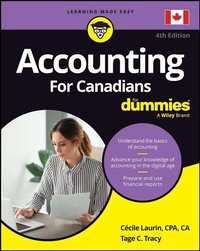
Accounting For Canadians For Dummies
Description

Accounting For Canadians For Dummies provides comprehensive coverage of all the auditing concepts, practices, and regulations Canadians need to know. This trusted guide is full of great information applicable to accountants and auditors who work throughout private industry and government, as well as salary accountants working for accounting, tax preparation, bookkeeping, and payroll services firms. Financial statements, financial reports, and business accounting are explained in terms anyone can understand. This new edition is revised to include accounting in the digital age, applying techniques from Wall Street, capitalizing a business, and beyond. This Dummies guide paves an easy-to-follow path to success for students and professionals alike.
* Understand the basics of general accounting procedures
* Learn the ins & outs of Canadian regulations
* Prepare and analyze financial reports, and create professional financial statements
* Discover how to track inventory and evaluate profit margins
Accounting For Canadians For Dummies is the ideal book for both accounting professionals and students working towards a degree in accounting or auditing.
More details
Other editions
Additional editions
Persons
Tage C. Tracy operates a financial consulting firm focused on offering CFO/executive-level support and planning services to private companies. He is the author of Business Financial Information Secrets and has coauthored several For Dummies books.
Content
Part 1: Opening the Books on Accounting 5
Chapter 1: Accounting in Today's Economy 7
Chapter 2: Introducing Financial Statements 25
Chapter 3: Bookkeeping and Accounting Systems 49
Chapter 4: Accounting in the Digital Age 71
Chapter 5: Deciding the Legal Structure for a Business 85
Part 2: Exploring Financial Statements 101
Chapter 6: Reporting Profit or Loss in the Income Statement 103
Chapter 7: Reporting Financial Condition on the Balance Sheet 125
Chapter 8: Reporting Cash Flows 149
Chapter 9: Choosing Accounting Methods 167
Part 3: Understanding Financial Reports, Financial Statements, and Financial Information 189
Chapter 10: Producing Financial Reports 191
Chapter 11: Deciphering a Financial Report 213
Chapter 12: Analyzing Financial Information with Ratios 227
Chapter 13: Generating Internal Financial Information for Management Use 249
Chapter 14: Applying Tricks and Treats to Engineer Financial Results 271
Part 4: Leveraging Accounting in Managing a Business 281
Chapter 15: Analyzing Profit 283
Chapter 16: Accounting for Costs 305
Chapter 17: Preparing Forecasts, Projections, and Budgets 329
Part 5: The Part of Tens 349
Chapter 18: Ten Tips for Managers 351
Chapter 19: Ten Tips for Reading a Financial Report 361
Index 371
Chapter 1
Accounting in Today's Economy
IN THIS CHAPTER
Recognizing how accounting is relevant to you
Grasping how all economic activity requires accounting
Understanding the accounting function's primary role
Following an accounting department in action
Shaking hands with business financial statements
Accounting is all about financial information - capturing it, recording it, configuring it, analyzing it, and reporting it to persons who use it. We don't say much about how accountants capture, record, and configure financial information in this book. But we talk a lot about how accountants communicate information in financial statements, and we explain the valuation methods or measurement methods accountants use - ranging from measuring profit and loss to putting values on a business's assets and liabilities.
As you go through life, you come face to face with accounting information more than you would ever imagine. Regrettably, much of this information is not self-explanatory or intuitive, and it does not come with a user's manual. Accounting information is presented with the assumption that you have a basic familiarity with the vocabulary of accounting and the accounting methods used to generate the information. In short, most of the accounting information you encounter is not transparent. The main reason for studying accounting is to understand its vocabulary and its valuation and measurement methods so you can make more intelligent use of the information.
People who use accounting information should know the basic rules of play and how the financial score is kept, much like spectators at a hockey or baseball game. The purpose of this book is to make you a knowledgeable spectator of and sometimes a participant in the accounting game.
You should know accounting basics for another reason, too - we call it the defensive reason. Some people in the financial world might take advantage of you, not necessarily by illegal means but by withholding key information and by diverting your attention from unfavourable aspects of certain financial decisions. The best defence against such tactics is to know some accounting, which can help you ask the right questions and understand the financial points that those who are trying to sway or convince you don't want you to know.
Knowing That Accounting Is Not Just for Accountants
One main source of accounting information is in the form of financial statements packaged with other information in a financial report. Accountants keep the books and record the financial activities of an entity (such as a business). From these detailed records, the accountant prepares financial statements that summarize the results of the activities.
Financial statements are sent to people who have a stake in the outcomes of the activities. If you own shares in BCE, for example, or you have money in a mutual fund, you receive regular financial reports. If you invest your hard-earned money in a private business or a real estate venture, or you save money in a bank, you receive regular financial reports. If you're a member of a not-for-profit association or organization, you're entitled to receive regular financial reports.
One important reason for studying accounting is to make sense of the financial statements in the financial reports you get. We guarantee that Warren Buffett knows accounting and how to read financial statements.
Affecting both insiders and outsiders
People who need to know accounting fall into two broad groups: insiders and outsiders. Business managers are insiders; they have the authority and responsibility to run a business. They need a good understanding of accounting terms and the methods used to measure profit and put values on assets and liabilities. Accounting information is indispensable for planning and controlling the business's financial performance and condition. Likewise, administrators of not-for-profit and governmental entities need to understand the accounting terminology and measurement methods in their financial statements.
The rest of us are outsiders. We are not privy to the day-to-day details of a business or an organization. We have to rely on financial reports from the entity to know what's going on. Therefore, we need to have a good grip on the financial statements included in the financial reports. For all practical purposes, financial reports are the only source of financial information we get directly from a business or other organization.
By the way, the business's employees - even though they obviously have a stake in the business's success - do not necessarily receive its financial reports. Only the investors in the business and its lenders are entitled to receive the financial reports. Of course, a business could provide this information to those of its employees who are not shareowners, but generally speaking most businesses do not. The financial reports of public businesses are in the public domain, so their employees can easily view them on the Internet.
In our personal financial lives, a little accounting knowledge is a big help for understanding investing in general and how investment performance is measured, as well as many other important financial topics. With some basic accounting knowledge, you'll sound more sophisticated when speaking with your banker or broker. We can't promise that understanding accounting will save you big bucks on your income taxes, but it can't hurt and will definitely help you know what your tax preparer is talking about.
Keep in mind that this is not a book on bookkeeping and recordkeeping systems. We offer a brief explanation of procedures for capturing, processing, and storing accounting information in Chapter 3. Even experienced bookkeepers and accountants should find some nuggets in that chapter. However, this book is directed to users of accounting information. We focus on the end products of accounting, particularly financial statements, and not how information is accumulated. When buying a new car, you're interested in the finished product, not details of the manufacturing process that produced it.
Overcoming the stereotypes of accountants
A cartoon showed the young son of clowns standing in a circus tent dressed as a clown but holding a business briefcase. He is telling his clown parents that he is running away to join a CPA firm. Why is this funny? Because it plays off the stereotype of the CPA (Chartered Professional Accountant) as a "bean counter" who wears a green eyeshade and has the personality of an undertaker (no offence to morticians). Maybe you've heard the joke that an accountant with a personality is one who looks at your shoes when they are talking to you, instead of their own shoes.
Like most stereotypes, an element of truth exists in the preconceived image of accountants. We have met and known a large number of accountants, and most are not as gregarious as used-car sales people. Accountants certainly are more detail-oriented than your average person. However, you don't have to be good at mathematics to be a good accountant, because they use very little math (no calculus and only simple algebra). Accountants are very good at one thing: They want to see both sides of financial transactions - the give and take. They know better than anyone that, as economists are fond of saying, there's no such thing as a free lunch.
If you walked down a busy street in Vancouver, Toronto, or Montreal, we doubt that you could pick out the accountants. We have no idea whether accountants have higher or lower divorce rates than others, whether they go to church more frequently, or whether they generally sleep well at night. We do think that accountants are more honest in paying their income taxes than other people, although we have no proof of this.
CHARTERED PROFESSIONAL ACCOUNTANTS (CPA)
What is a Chartered Professional Accountant (CPA) and what does it take to obtain the CPA designation?
The CPA designation is a widely recognized and respected badge of a professional accountant. A person must meet ongoing educational and experience requirements and pass a national uniform exam to qualify to practice as a CPA.
Most CPAs are not in public practice; they work for business organizations, government agencies, and not-for-profit organizations, or they teach accounting (a plug for educators here, if you don't mind!). CPAs in public practice are licenced to do audits of financial reports, and they also provide tax, management, and financial consulting services.
Relating accounting to your personal financial life
We're sure you know the value of understanding personal finance and investing fundamentals. Well, a great deal of the information you use in making personal finance and investing decisions is accounting information. One knock we have on books in these areas is that they often don't make clear that you need a basic understanding of accounting terminology and valuation methods to make good use of the financial information.
We recommend reading Eric Tyson and Tony Martin's two books: Personal Finance For Canadians For Dummies, 6th Edition (John Wiley & Sons, Inc., 2018), and Investing For Canadians For Dummies, 4th Edition (John Wiley & Sons,...
