

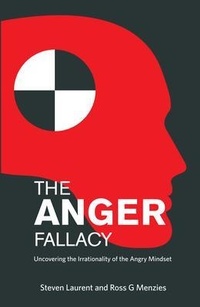
The Anger Fallacy
Description

Featuring the wisdom and wit of: Confucius, The Bible, Yoda, Billy Connolly, George Bernard Shaw, Jerry Seinfeld, Dale Carnegie, Ricky Gervais, Larry David, and many more.
Back in 2013, this ground-breaking, best-selling book told us the inconvenient truth that anger is such a toxic human emotion that we should try to avoid it at all times - even when we think it might be helpful!
Today, this book's message is as vital and relevant as ever.
Anger and division on matters such as health, sex, gender, politics, climate, race, religion, and culture are expressed so freely across social media that we can feel swept up in the emotion, compelled to take our own stand and join our angry voice with others. After all, how else do we create the change we want to see? It is our right, is it not, to state our claims with force, use anger to drive action and strongly oppose those who disagree?
Well, actually, all anger does is hurt both your mental health and the health and wellbeing of those around you. It is rarely ever helpful to one's own benefit, let alone any discussion, debate, argument or conversation. Its destructive effects are much more toxic than previously acknowledged. In fact, when we are angry, we hold an irrational mindset that blinds us to self-righteous judgements propelling our behaviour in the wrong ways.
But it isn't always easy to avoid getting angry. We need to learn a lot more about anger, its uses, its origins, and how we might substitute empathy and understanding in its place. We need to learn why we get angry and how to try and remove our anger. And you can do that right now by simply reading this book.
And that's no hollow advertising pitch by the way. The Anger Fallacy was written by clinical psychologists Ross Menzies and Steven Laurent and has been successfully used in therapy.
More details
Other editions
Additional editions
Persons
Ross G. Menzies has been providing cognitive-behaviour therapy for anxiety, depression, couples conflict and related issues for over two decades and is currently Associate Professor in Health Sciences at the University of Sydney. He is an active researcher and currently holds over $5 million in national competitive research grants. He has produced four books, over 140 international journal manuscripts and book chapters and is regularly invited to speak at conferences and leading universities and institutions around the world. He continues to attract patients from across metropolitan Sydney, rural NSW, interstate and from overseas, with many individuals and families travelling thousands of kilometres to receive treatment at his private practice. The present book is his first major work on anger.
Content
- cover
- Anger is everywhere
- But anger gets results .
- But anger motivates me .
- But anger is part of my image .
- Shoulding: The cognitive basis of anger
- What are really angry about?
- Anger Treatment 101: Get your facts straight!
- Anger Treatment 102: The arbitrariness of 'shoulds'
- Anger Treatment 103: Seeing the machine
- Anger Treatment 104: The empathy solution
- Getting past unfairness
- Recap and conclusion
