

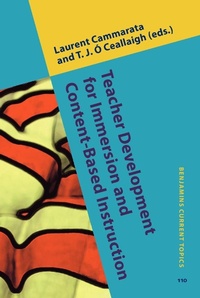
Teacher Development for Immersion and Content-Based Instruction
1st Edition
Published on 17. September 2020
207 pages
978-90-272-6080-2 (ISBN)
Description

Teacher preparation and professional development endeavors are key drivers of successful immersion/bilingual (I/B) and content-based language education (CBLE) programs across a variety of models. However, research in this critical area is scant and has not to date received the academic attention it deserves. Aimed at a broad audience, this timely volume is essential reading for anyone interested in knowing what research has to say about teacher development in the I/B and CBLE field. Its primary aim is to inform teacher education practice and stimulate additional research in the field by showcasing ground-breaking research on teacher preparation and professional development programs from around the globe as well as teacher educators' experience in these varied educational contexts. The contributions illustrate several points of access into classroom research and pedagogy and add insight into the complexity of teacher preparation and professional development in this dynamic and constantly evolving sector. The depth of scholarship and breadth of experience represented by the contributors promises a productive and rewarding read. Originally published as special issue of Journal of Immersion and Content-Based Language Education 6:2 (2018).
More details
Other editions
Additional editions
Laurent Cammarata | T.J. O Ceallaigh
Teacher Development for Immersion and Content-Based Instruction
Book
09/2020
John Benjamins Publishing Co
€108.04
Shipment within 10-15 days
Content
- Intro
- Teacher Development for Immersion and Content-Based Instruction
- Editorial page
- Title page
- Copyright page
- Table of contents
- Teacher education and professional development for immersion and content-based instructionResearch on programs, practices, and teacher educators
- 1.Introduction
- 2.What has already been done and what is still missing?
- 3.Overview of this volume
- Acknowledgements
- References
- Becoming a "language-aware" content teacherContent and language integrated learning (CLIL) teacher professional development as a collaborative, dynamic, and dialogic process
- 1.Introduction
- 2.CLIL TLA development in boundary-crossing communities of practice (COP)
- 3.Research design
- 3.1Context of the study
- 3.2Data collection and analysis
- 4.Findings
- 4.1Pre-collaboration stage: A content teacher and science language user
- 4.2Early collaboration: A content teacher and language analyst
- 4.3Mid-term collaborations: A CLIL teacher with emerging TLA
- 4.4Later collaborations: A CLIL teacher with advanced TLA
- 5.Discussion
- 6.Conclusion: A lens for conceptualising CLIL teacher education as a collaborative, dynamic, and dialogic process (CDDP)
- References
- In search of immersion teacher educators' knowledge baseExploring their readiness to foster an integrated approach to teaching
- 1.Introduction
- 2.Background to the study
- 2.1Content and language integration in immersion: A call for adapted teacher education preparation
- 2.2Teacher knowledge matters
- 2.3What do we know about what teachers need to know to integrate effectively?
- 2.4Why a focus on ITEs' knowledge? A call to explore the missing variable
- 3.A framework and analytical tool to capture ITEs' knowledge for integration
- 4.Methodology
- 4.1Context
- 4.2Participants
- 4.3Data collection
- 4.4Data analysis
- 5.Findings
- 5.1Marie's knowledge depth and distribution as it relates to the work of integration
- 5.2Significant patterns in ITEs' understandings
- 5.2.1Lack of conceptual clarity
- 5.2.2No evidence of an awareness of the importance of language and literacy in disciplinary learning/teaching when ITEs were not directly probed about it
- 5.2.3More elaborated understanding of the literacy-content relationship
- 5.2.4Non-existent or faint awareness of connection between literacy and language
- 6.Discussion and implications
- 6.1The importance of knowledge base mapping when considering pedagogical integration
- 6.2The need for a curriculum dedicated to immersion teacher educators
- 7.Conclusion
- References
- Appendix A.Interconnected Knowledge for Integration (IKI) Analytical Tool
- Unpacking dimensions of immersion teacher educator identity
- 1.Introduction
- 2.A focus on the teacher educator
- 2.1Teacher educator identity
- 2.2Ways of developing teacher educator identity
- 3.Immersion education and immersion teacher education in the Republic of Ireland: Issues and tensions
- 4.Context of our study
- 5.Methodology
- 5.1Participants and procedure
- 5.2Data collection
- 5.3Data analysis
- 6.Findings
- 6.1Defending content as priority
- 6.2Negotiating an integrated space
- 6.3Becoming immersion-responsive
- 7.Discussion
- 8.Conclusion
- References
- Teacher adaptations to support students with special education needs in French immersionAn observational study
- 1.Framework
- 2.Context of the study
- 2.1Context as defined in policy documents
- 2.1.1Universal design for learning and differentiated instruction
- 2.2Practical context of the study
- 3.Methodology
- 3.1Observation scheme
- 3.2Participants
- 4.Findings
- 4.1Classroom observations
- 4.1.1Description of classes
- 4.1.2Adaptations observed
- 5.Discussion
- 6.Conclusion
- References
- Teacher perceptions of immersion professional development experiences emphasizing language-focused content instruction
- 1.Introduction: The case for a focus on language in immersion teaching
- 2.Background to the study
- 3.Theoretical framework
- 3.1Defining communities of practice
- 3.2CoP-informed research on teacher learning
- 4.The study
- 4.1Context
- 4.2Research questions
- 4.3Participants
- 4.4Data sources
- 4.4.1Online survey
- 4.4.2Focus groups
- 4.5Data analysis
- 5.Results
- 5.1RQ(a) - High-impact assignments
- 5.2RQ(b) Features of high impact assignments and experiences
- 5.2.1Practice - learning as doing
- 5.2.2Meaning - learning as experience
- 5.2.3Identity - learning as becoming
- 6.Discussion, implications, and conclusion
- 6.1Discussion and reflection on the CoP social theory of learning
- 6.2Limitations
- 6.3Implications for future inquiry and teacher professional development and conclusion
- References
- Appendix.Certificate courses with description of main topics and assignments
- "It was two hours [.] the same old thing and nothing came of it"Continuing professional development among teachers in Gaeltacht post-primary schools
- 1.Continuing professional development among teachers in Irish-medium Gaeltacht post-primary schools
- 2.Defining the Gaeltacht and Gaeltacht education: From geographical to linguistic criteria
- 3.Continuing professional development (CPD) in the Republic of Ireland
- 4.Teacher professional development
- 5.Methodology
- 5.1Design
- 5.2Participant selection
- 5.3Interviews
- 5.4Data analysis
- 6.Findings
- 6.1Post-primary Gaeltacht teachers' participation in professional development
- 6.2Medium of CPD delivery
- 6.3Models of CPD delivery
- 6.4Barriers to participation
- 6.4.1Time and family commitments
- 6.4.2Location
- 7.Discussion
- 7.1Participation dependent on curriculum changes
- 7.2Professional learning communities as models for CPD
- 7.3The role of the professional experience of teachers in CPD design and delivery
- 8.Conclusion
- Funding
- References
- The Common European Framework of Reference (CEFR) in French immersion teacher educationA focus on the language portfolio
- 1.Introduction
- 2.Relevant literature
- 2.1CEFR implementation in Canadian ITE programs
- 2.2FSL ITE student-teachers' perceived proficiency development
- 3.The portfolio project
- 3.1Context
- 3.2Portfolio adaptation
- 3.3Research questions
- 4.Methodology
- 4.1Participants
- 4.2Procedure
- 5.Findings
- 5.1ITE student-teacher perspectives
- 5.2Instructor perspective
- 6.Discussion
- 6.1Points of convergence
- 6.2Points of divergence
- 7.Conclusion
- References
- Contributors
- Index
