

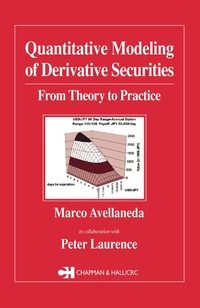
Quantitative Modeling of Derivative Securities
From Theory To Practice
Published on 22. November 2017
336 pages
978-1-351-42046-4 (ISBN)
Description

Quantitative Modeling of Derivative Securities demonstrates how to take the basic ideas of arbitrage theory and apply them - in a very concrete way - to the design and analysis of financial products. Based primarily (but not exclusively) on the analysis of derivatives, the book emphasizes relative-value and hedging ideas applied to different financial instruments. Using a ""financial engineering approach,"" the theory is developed progressively, focusing on specific aspects of pricing and hedging and with problems that the technical analyst or trader has to consider in practice.
More than just an introductory text, the reader who has mastered the contents of this one book will have breached the gap separating the novice from the technical and research literature.
More than just an introductory text, the reader who has mastered the contents of this one book will have breached the gap separating the novice from the technical and research literature.
Reviews / Votes
"This fine treatment of the arbitrage pricing of derivatives will become a standard. Avellaneda and Laurence have brought their extensive combined knowledge in [a treatment] mathematics that financial analysts will find both concrete and authoritative."-Darrell Duffie, Professor of Finance, Graduate School of Business, Stanford University
"I learned a great deal of what I know of mathematics finance from Marco Avellaneda - and I know I will learn a lot more. Not only is he a great scholar, but he is a superb pedagogue, capable to cut to the chase and avoid needless complications - with the ease and simplicity of those who truly master the subject. I am glad this book by Avellaneda and Laurence is out so more people can share his knowledge."
-Nassim Taleb, Trader, Paribas Capital Markets
"Written by two of the field's leading experts, this book stands out from the crowd of recent books on derivatives pricing theory. I recommend it to anyone interested in this fascinating field."
-Peter Carr, Principal, Bank of America Securities
"This is a textbook, though it contains no exercises, on the theory underlying the modeling and risk management of financial derivatives. The authors attempt to link theory with practice, not flinching from pointing out that the theory does no have all the answers. The mathematical style is informal, assuming an understanding of linear algebra and elementary probability, but not requiring a grasp of measure theory. It introduces stochastic calculus.
"Despite the recent publicity concerning how physics PhDs can find highly remunerative employment in this area, the authors point out that "financial modeling is very different from modeling in the natural sciences. Unlike physics, where we deal with reproducible experiments with well-defined initial conditions, the models and ideas presented in this book deal with phenomena for which we have only limited information and that are not necessarily reproducible
More details
Language
English
Place of publication
London
United Kingdom
Publishing group
Taylor & Francis Ltd
Target group
Professional and scholarly
Product notice
Reflowable
File size
49,40 MB
ISBN-13
978-1-351-42046-4 (9781351420464)
Copyright in bibliographic data and cover images is held by Nielsen Book Services Limited or by the publishers or by their respective licensors: all rights reserved.
Schweitzer Classification
Other editions
Additional editions
Book
06/2020
1st Edition
Routledge
€59.46
Shipment within 15-20 days
Book
09/1999
1st Edition
Chapman & Hall/CRC
€215.62
Shipment within 15-20 days
Person
Marco Avellaneda, Peter Laurence
Content
Arbitrage Pricing Theory: The One-Period Model. Binomial Option Pricing Model. Analysis of the Black-Scholes Formula. Refinements of the Binomial Model. American-Style Options and Time-Optionality. Trinomial Trees and Finite-Difference Schemes. Brownian Motion and Ito Calculus. An Introduction to Exotic Options. Ito Processes, Continuous-Time Martingales, and Girsanov's Theorem. Continuous-Time Finance: An Introduction. Valuation of Derivative Securities. Fixed-Income Securities and the Term-Structure of Interest Rates.. The Heath-Jarrow-Morton Theorem and Multidimensional Term-Structure Model. Exponential-Affine Models. Interest-Rate Options. Appendix: The Intertemporal Discrete Model.
