

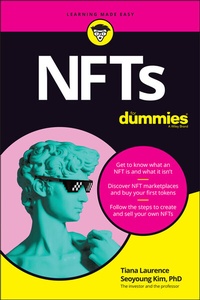
NFTs For Dummies
Description

It's not often that a brand-new investment comes along that revolutionizes how we buy and sell digital assets. But that's what non-fungible tokens (NFTs) did. Built on blockchain tech, NFTs are shaking up the world of digital commodity investing. And you can get your slice of the pie before everyone jumps into the arena.
In NFTs For Dummies, you'll find straightforward answers to critical aspects of the NFT phenomenon. You'll learn exactly what non-fungible tokens really are, how you can find them, and even how to create your own valuable NFTs. You'll also discover:
* How to find reliable and safe NFT marketplaces where you can be sure you're dealing with reputable buyers and sellers
* A peek behind the NFT curtain to see how NFTs work and what, exactly, you own when you buy or make an NFT
* Discussions of the kinds of digital properties that can be converted into an NFT
Perfect for anyone who wants to learn about the market for buying, selling, and creating crypto collectibles, NFTs For Dummies is the only resource you'll need to get a handle on this cutting-edge tech and start making it work for you.
More details
Other editions
Additional editions
Persons
Seoyoung Kim, PhD, is an Associate Professor of Finance and Business Analytics at Santa Clara University where she teaches FinTech and Financial Engineering in the graduate business program.
Content
Chapter 1
Introducing Non-Fungible Tokens
IN THIS CHAPTER
Defining non-fungible tokens
Introducing NFT use cases
Understanding how NFTs work
Learning about NFTs as an investment
It all starts with Bitcoin: the original blockchain-based cryptoasset. With the latest run-up in Bitcoin prices (see Figure 1-1), the Internet is buzzing about crypto again. In fact, Google search trends within the US show that Googlers are now as curious about Bitcoin as they are about the country's new president (see Figure 1-2), and interest in NFTs has naturally surged with the Bitcoin tide (see Figure 1-3).
With wild and exciting accounts of art-burning ceremonies and million-dollar NFTs, a mix of amazement, confusion, and even disdain surrounds this mostly "normal" but misunderstood digital creature.
In this chapter, we walk you through the basics of NFTs - what they are, how they work, and what they're used for. The purpose is to provide you with a roadmap to decide which aspects of NFTs you would like to learn more about so that you can customize your reading selections in the chapters that follow.
From https://coincap.io/assets/bitcoin.
FIGURE 1-1: Bitcoin price chart.
FIGURE 1-2: Google Trends comparison of searches for bitcoin versus Biden.
FIGURE 1-3: Google Trends comparison of searches for nft over time.
Beginning at the Beginning: What Is a Non-Fungible Good?
As you've likely learned from friends or Google searches before even purchasing this book, NFT stands for non-fungible token. Although tokens themselves are a relatively new development, the idea of grouping fungible and non-fungible goods is not.
Think of dollar bills, shares of Microsoft stock, and Bitcoin - each represent a defined set where items within the set are fungible. Put simply, we don't care which dollar bills we receive as long as we receive the right quantity, since each dollar bill fulfills the same purpose and obligations as another.
Non-fungible goods are also a regular and far more prevalent part of our lives. Apples at the grocery store, orchids from the florist, and tickets to an upcoming concert - we inspect our fruit and our flowers to select the ones that are less wilted or bruised. With concerts, each ticket represents a different seat, and a front-row seat is not happily exchanged for a seat that's far removed.
By their nature, non-fungible goods are more difficult to systematically record and track. For one, they require more information to be stored to denote their unique differences. While we can't digitalize the world, there are many instances where we would greatly benefit from a reliable, transparent, and automated system designed to group, organize, and digitally track non-fungible things that are important to us. Here's where NFTs come into play!
A non-fungible token (NFT) is a unique digital identifier that's secured and stored on a public blockchain. One token is not interchangeable for another, and a token cannot be further divided.
What an NFT actually represents depends on the intent of the developers. Much like how a cryptocurrency - or a fungible token - can represent a global medium of exchange (Bitcoin), a utility token used to fuel smart contracts (Ether), or a financial security linked to shares in a fund (BCAP), NFTs also differ in their current and potential uses.
Although general interest in NFTs has been minimal to nonexistent until recently, the development community has been teeming with fungible token activity for years. Following the successful launchings of Bitcoin (2009), Litecoin (2011), and Dogecoin (2013), a surge of projects followed, each spawning their own fungible tokens. Amidst this crypto-wave, developers began to envision a world of digital collectibles - the crypto-analogue of beanie babies and baseball cards. These projects required a different type of token standard to ensure the uniqueness and non-divisibility of each crypto-baby or crypto-card.
Finally, with the overwhelming success of CryptoKitties, a non-fungible token on Ethereum that debuted in 2017, the ERC-721 Non-Fungible Token Standard soon followed to serve as a blueprint for the development community. (Read more about CryptoKitties in Chapter 2.) Since then, there's been an explosion of NFT projects, with more than 15,000 NFTs deployed on Ethereum alone. (See Figure 1-4.)
FIGURE 1-4: The five most active NFTs.
Exploring Uses for NFTs
The NFT space is still in its infancy, but already the development community is teeming with ideas on how to put them to good use. The most natural use case - the one currently dominating the marketplace - is in tracking digital collectibles. From there, gaming items and digital media were natural extensions. However, despite the recent explosion of NFTs, the current implementations are still rather limited in their scope, and mostly surround monetization of collectibles. The industry has also been hampered by the get-rich-quick mentality that has plagued crypto-space in general and has also attracted many unscrupulous players.
Still, we see many interesting use cases for NFTs on the horizon. Some of these could truly disrupt the way we validate, track, and assign ownership of unique and esoteric items or work to effectively democratize content creation and distribution. Imagine taking the costly detective work out of verifying the ownership history of a rare collectible. Or imagine a world where expensive eBay auctions include proof of ownership on the Ethereum blockchain. Much attention is centered on speculation right now, but the potential value added by these exciting possibilities far overshadow the headlines announcing the latest NFT millionaires and NFT scam artists.
The cryptocurrency world was also met with a similar breadth of reactions, ranging from deep skepticism to enthusiastic acceptance. But as governments and major financial institutions began to accept Bitcoin and Ether, the promise of the underlying technology came to the forefront of discussions. Although NFTs have the benefit of following their crypto-frontrunners (who themselves are still quite young), we need much more time to see how the NFT ecosystem will evolve and what it will spawn next.
Finding Out How an NFT Works
People often confuse the NFT itself with what the NFT was built to represent. An NFT is a cryptographically secure digital record that verifies your ownership of or access to, say, a piece of digital art - sort of like how your car title verifies ownership of your vehicle. You don't really own the car in your possession without the title, and you don't really own the CryptoKitty in your collection of jpegs without the corresponding NFT.
For example, consider the cryptocollectible known as Mutant Ape Yacht Club (MAYC). This strange new collection of mutant apes (who may or may not be part of a yacht club?) is the latest rage among NFT collectors and is now the most active ERC-721 token out there. (See Figure 1-5.) But what exactly does it mean to own a particular MAYC?
FIGURE 1-5: MAYCs listed for public sale on OpenSea.
When browsing MAYCs for sale on OpenSea (one of the NFT marketplaces you can discover in Chapter 4 and Chapter 12), you notice provocative graphics and characteristics presented on the marketplace platform. (Refer to Figure 1-5.) What you're seeing are the visual representations of each individual MAYC - but the NFT itself is the unique digital code that's secured on the Ethereum blockchain.
For instance, consider MAYC #7632 in the upper left corner of Figure 1-5. Purchasing this NFT means that you're now the rightful owner of record of TokenID 7632, which is in storage in the contract account 0x60e4d786628fea6478f785a6d7e704777c86a7c6 on the Ethereum blockchain. All transfers of ownership will be memorialized on the blockchain so that provenance of MAYC #7632 and its current rightful owner can always be known, as shown in Figure 1-6.
FIGURE 1-6: MAYC #7632.
As of this writing, 14,688 MAYCs exist across 7,709 holders. You can check out the individual details and ownership of each unique MAYC at https://etherscan.io/token/0x60e4d786628fea6478f785a6d7e704777c86a7c6.
The digital art you purchase is easy to duplicate. (Pressing the PrintScreen key on the keyboard requires little to no training.) However, because the NFT is secured on a public blockchain, it's far more difficult to illegally transfer, duplicate, or otherwise hack. The beauty of NFTs lies in the underlying technology - a nexus of smart contracts and distributed network of validators - that allows you to reliably and automatically verify who truly owns each of the 14,688 mutant ape NFTs.
Thus, our mutant apes are part of a greater decentralized ecosystem where records are kept in a public and trustless manner, which means that we don't need a trusted central party, such as Bank of America, to maintain a reliable and secure system to track our mutant apes...
