

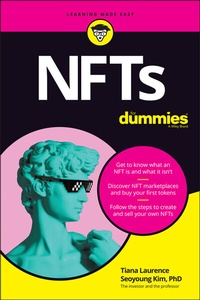
NFTs For Dummies
1st Edition
Published on 3. November 2021
272 pages
978-1-119-84332-0 (ISBN)
Description

Get a grip on NFTs and learn how to get in the game
It's not often that a brand-new investment comes along that revolutionizes how we buy and sell digital assets. But that's what non-fungible tokens (NFTs) did. Built on blockchain tech, NFTs are shaking up the world of digital commodity investing. And you can get your slice of the pie before everyone jumps into the arena.
In NFTs For Dummies, you'll find straightforward answers to critical aspects of the NFT phenomenon. You'll learn exactly what non-fungible tokens really are, how you can find them, and even how to create your own valuable NFTs. You'll also discover:
* How to find reliable and safe NFT marketplaces where you can be sure you're dealing with reputable buyers and sellers
* A peek behind the NFT curtain to see how NFTs work and what, exactly, you own when you buy or make an NFT
* Discussions of the kinds of digital properties that can be converted into an NFT
Perfect for anyone who wants to learn about the market for buying, selling, and creating crypto collectibles, NFTs For Dummies is the only resource you'll need to get a handle on this cutting-edge tech and start making it work for you.
It's not often that a brand-new investment comes along that revolutionizes how we buy and sell digital assets. But that's what non-fungible tokens (NFTs) did. Built on blockchain tech, NFTs are shaking up the world of digital commodity investing. And you can get your slice of the pie before everyone jumps into the arena.
In NFTs For Dummies, you'll find straightforward answers to critical aspects of the NFT phenomenon. You'll learn exactly what non-fungible tokens really are, how you can find them, and even how to create your own valuable NFTs. You'll also discover:
* How to find reliable and safe NFT marketplaces where you can be sure you're dealing with reputable buyers and sellers
* A peek behind the NFT curtain to see how NFTs work and what, exactly, you own when you buy or make an NFT
* Discussions of the kinds of digital properties that can be converted into an NFT
Perfect for anyone who wants to learn about the market for buying, selling, and creating crypto collectibles, NFTs For Dummies is the only resource you'll need to get a handle on this cutting-edge tech and start making it work for you.
More details
Other editions
Additional editions
Tiana Laurence | Seoyoung Kim
NFTs For Dummies
Book
02/2022
1st Edition
Wiley
€22.00
Shipment within 15-20 days
Persons
Tiana Laurence has been at the forefront of blockchain, cryptocurrency, and cryptocollectibles for her entire career. She is the author of Blockchain For Dummies and is the head of Laurence Innovation, a venture capital group.
Seoyoung Kim, PhD, is an Associate Professor of Finance and Business Analytics at Santa Clara University where she teaches FinTech and Financial Engineering in the graduate business program.
Seoyoung Kim, PhD, is an Associate Professor of Finance and Business Analytics at Santa Clara University where she teaches FinTech and Financial Engineering in the graduate business program.
Content
- Intro
- Title Page
- Copyright Page
- Table of Contents
- Introduction
- About This Book
- Foolish Assumptions
- Icons Used in This Book
- Beyond the Book
- Where to Go from Here
- Part 1 Getting Started with NFTs
- Chapter 1 Introducing Non-Fungible Tokens
- Beginning at the Beginning: What Is a Non-Fungible Good?
- Exploring Uses for NFTs
- Finding Out How an NFT Works
- Buying NFTs
- Why buy NFTs
- NFTs as investments
- Proceeding on Your NFT Journey
- Chapter 2 Owning Your Own NFT
- Where It All Began: Non-Fungible Kitties
- Blockchain for the masses
- Not just a passing fad
- The impact of NFTs
- The game mechanics of CryptoKitties
- What's In Your Wallet? Setting Up MetaMask
- Setting Up Coinbase
- Creating your Coinbase account
- Verifying your phone number
- Adding your personal information
- Verifying your identity and adding your bank account
- Adding funds to your wallet
- Collecting, Breeding, and Selling Your Very Own Non-Fungible (Crypto)Kitties
- Buying your first CryptoKitty
- Using the Offer function
- Breeding your kitties
- Chapter 3 The Future of NFTs
- Dissecting the Anatomy of a $69 Million NFT
- Redefining Property Rights (NFTs Are Not Just about Digital Art and Kitties!)
- NFTs and Digital Property
- Music, movies, and books
- Photos and other digital art
- Game assets
- NFTs and Real Property
- Homes, cars, and nondigital pets
- Art, jewelry, wine, and other collectibles
- Imagining the Possibilities
- Part 2 Buying and Selling NFTs
- Chapter 4 Getting In on the NFT Game
- Knowing the Ins and Outs of Buying NFTs
- Examining the success of early NFTs
- Thinking about NFTs as an investment
- Understanding the Risks of Hot Wallets like MetaMask
- Comparing hot wallets
- Weighing the pros and cons of hot wallets
- Uncovering Your MetaMask Wallet
- Installing MetaMask
- Securing your MetaMask wallet for Chrome and Firefox
- Buying Ether for Your MetaMask Wallet
- Exploring NFT Marketplaces
- Navigating the OpenSea of NFTs
- The Nifty Gateway
- Rarible's decentralized governance
- Chapter 5 Investing In NFTs
- Understanding NFTs Are Not Cryptocurrency
- Introducing NFT Investing
- Deciding Whether NFT Investing Is for You
- NFT Investing Strategies for Beginners
- Valuing your NFT
- Choosing your strategy
- Discovering the Best-Performing NFTs
- Exploring Popular NFT Types
- Digital art
- Collectibles
- Games
- Music
- Popular memes
- Reporting NFT Gains and Paying Taxes on NFTs
- Part 3 Developing Your Knowledge: A Step-by-Step Guide to Programming Your Own NFT
- Chapter 6 What Is Ethereum?
- Revealing the Ethereum Virtual Machine
- Ether: The Gas That Fuels Your Transactions
- The journey of a transaction
- Compensating the (proof-of-) workers: What's in it for the miners?
- From happy hour to surge pricing: Determining a reasonable gas price
- Setting your budget: Is the sky the (gas) limit?
- Transaction fees
- The Blockchain: Where It's All Stored and Secured
- Ethash and proof of work: What makes Ethereum tamper-proof?
- Miners and nonces and bears - oh, my!
- How many "confirmations" until I'm actually confirmed?
- Uncles and orphans
- Hard forks: Updates to the underlying protocol
- Smart Contracts Make the EVM Go Round
- The nascent life of a smart contract
- Exciting possibilities
- Notable limitations
- Oracles: How to Connect to the "Outside" World
- Shining a Light on Ethereum's Fundamental Structure
- The big picture
- Nuts-and-bolts of the blockchain
- Gas essentials
- Things that make the EVM an interesting place
- Chapter 7 Creating an Ethereum Account
- Understanding Externally Owned Accounts
- What it means to create an account
- Private versus public keys
- Digital signatures
- Discovering Contract Accounts
- Knowing the Difference Between Public Networks and Private Environments
- Local development environments
- Test networks
- Main network
- Preparing Your Accounts (on MetaMask)
- Renaming accounts on MetaMask
- Adding different ETH to different accounts
- Funding your testnet account
- Exploring the Ropsten testnet blockchain
- "Disappearing" balances
- Chapter 8 Setting Up a Development Environment
- Exploring Your Ethereum Solution Stack
- Elements of the Ethereum stack
- Here a stack, there a stack: Pre-made stacks
- Put On Your Hard Hat: Constructing Your Environment
- Setting up your local blockchain test environment
- Connecting a custom (Ganache) network to your MetaMask wallet
- Adding local (Ganache) accounts to your MetaMask wallet
- Synching the Remix IDE to your MetaMask wallet
- Chapter 9 Deploying Your First Smart Contract
- Working with Smart Contract Languages
- Starting with the Solidity version pragma
- Going from source code to bytecode
- Key Elements of a Smart Contract
- Data
- Functions
- Event logs
- No Need to Reinvent the Wheel: Using Smart Contract Libraries
- Ready for Takeoff: Launching Your Smart Contract
- Beginning with a simple template
- Compiling before takeoff
- Deploying
- Chapter 10 Discovering Token Standards
- Introducing Ethereum Development Standards
- Ensuring interoperability and composability
- Learning the ABCs of EIPs and ERCs
- Understanding Standard Token Interfaces
- ERC-20 token standard
- ERC-721 non-fungible token standard
- Other token standards on Ethereum
- Chapter 11 Building an ERC-721 Token
- Writing and Compiling Your NFT
- The code
- The play-by-play
- Deploying Your NFT
- Deploying on Ganache
- Deploying on Ropsten
- Deploying on Mainnet
- Nurturing Your NFT
- Following your NFT on the blockchain
- Interacting with your NFT
- Part 4 The Part of Tens
- Chapter 12 Ten Marketplaces for Your NFTs
- The OpenSea Marketplace
- The Axie Infinity Marketplace
- The CryptoPunks Marketplace
- The NBA Top Shot Marketplace
- The Rarible Marketplace
- SuperRare Marketplace
- The Alcor NFT Marketplace
- The Binance NFT Marketplace
- The Foundation NFT Marketplace
- The Crypto.com NFT Platform
- Chapter 13 The Ten Most Expensive NFTs
- EVERYDAYS: THE FIRST 5000 DAYS
- CryptoPunk #7523
- CryptoPunk #3100
- CryptoPunk #7804
- CROSSROAD
- OCEAN FRONT
- CryptoPunk #5217
- World Wide Web Source Code
- Stay Free
- CryptoPunk #7252
- Index
- EULA
