

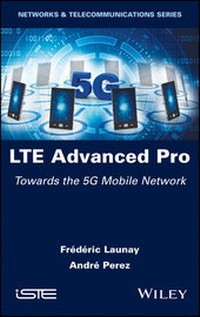
LTE Advanced Pro
Towards the 5G Mobile Network
1st Edition
Published on 3. June 2019
320 pages
978-1-119-62968-9 (ISBN)
Description

This book presents LTE evolution towards 5G mobile communication and the emergence of new requirements for MBB, MTC and LLC services.
As LTE technologies evolve, LTE Advanced Pro dramatically increases cell capacity and user data rates for the MBB unicast service. Such requirements are obtained using full-dimension MIMO, carrier aggregation (on either licensed or unlicensed frequency bands) and dual connectivity.
To improve the efficiency of same-content delivery to multiple users, 3GPP proposes a group communications service over LTE and defines mission critical push-to-talk (MCPTT) for dedicated public safety services.
Complementary low-cost and low-power modems with enhanced coverage and massive connectivity are emerging. Thus, this book also discusses the need for LTE to support low-rate transmission and high-latency communication for MTC services.
More details
Other editions
Additional editions
Frédéric Launay | Perez | Launay
Lte Advanced Pro: Towards the 5g Mobile Network
Towards the 5G Mobile Network
Book
06/2019
ISTE Ltd
€164.50
Shipment within 3-4 weeks
Content
- Cover
- Half-Title Page
- Title Page
- Copyright Page
- Contents
- List of Abbreviations
- Introduction
- I.1. LTE standard
- I.2. LTE Advanced standard
- I.3. LTE Advanced Pro standard
- I.3.1. MBB service
- I.3.2. LLC service
- I.3.3. MTC service
- I.4. Wi-Fi integration
- I.5. 5G integration
- 1. MBB Service - Network Architecture
- 1.1. Initial architecture
- 1.1.1. Functional architecture
- 1.1.2. Protocol architecture
- 1.2. CUPS architecture
- 1.3. Heterogeneous networks
- 1.3.1. HeNB station
- 1.3.2. Relay node
- 1.3.3. RRH module
- 1.3.4. Dual connectivity
- 2. MBB Service - Spatial Multiplexing
- 2.1. Multiplexing techniques
- 2.1.1. MIMO mechanism
- 2.1.2. Beamforming
- 2.1.3. Antenna configurations
- 2.2. Antenna ports
- 2.2.1. Downlink
- 2.2.2. Uplink
- 2.3. UCI
- 2.4. Transmission modes
- 2.4.1. Downlink
- 2.4.2. Uplink
- 2.5. FD-MIMO mechanism
- 2.6. eFD-MIMO mechanism
- 3. MBB Service - Carrier Aggregation
- 3.1. Functional architecture
- 3.2. LTE aggregation
- 3.2.1. Radio channels
- 3.2.2. PDCCH physical channel
- 3.2.3. MAC layer
- 3.2.4. Mobile categories
- 3.3. LAA aggregation
- 3.3.1. Frame structure
- 3.3.2. Access to the radio channel
- 3.3.3. Discovery reference signal (DRS)
- 3.4. LWA aggregation
- 3.4.1. Protocol architecture
- 3.4.2. Procedures
- 3.5. LWIP aggregation
- 3.5.1. Protocol architecture
- 3.5.2. Tunnel establishment
- 4. Wi-Fi Integration - Network Architecture
- 4.1. Functional architecture
- 4.1.1. Architecture based on the S2a interface
- 4.1.2. Architecture based on the S2b interface
- 4.1.3. Architecture based on the S2c interface
- 4.2. Tunnel establishment
- 4.2.1. Architecture based on the S2a interface
- 4.2.2. Architecture based on the S2b interface
- 4.2.3. Architecture based on the S2c interface
- 4.3. DIAMETER protocol
- 4.3.1. AAA server interfaces
- 4.3.2. PCRF interfaces
- 5. Wi-Fi Integration - Procedures
- 5.1. Mutual authentication
- 5.1.1. EAP-AKA method
- 5.1.2. Mutual authentication procedure
- 5.1.3. Procedure for rapid renewal of authentication
- 5.1.4. Application to the MIPv4 FA mechanism
- 5.2. SWu tunnel establishment
- 5.2.1. IPSec mechanism
- 5.2.2. SWu tunnel establishment procedure
- 5.2.3. Procedure for rapid renewal of authentication
- 5.3. S2a/S2b tunnel establishment
- 5.3.1. PMIPv6 mechanism
- 5.3.2. GTPv2 mechanism
- 5.3.3. MIPv4 FA mechanism
- 5.4. S2c tunnel establishment
- 5.4.1. Trusted Wi-Fi access
- 5.4.2. Untrusted Wi-Fi access
- 6. Wi-Fi Integration - Network Discovery and Selection
- 6.1. Mechanisms defined by 3GPP organization
- 6.1.1. ANDSF function
- 6.1.2. RAN assistance
- 6.2. Mechanisms defined by IEEE and WFA organizations
- 6.2.1. Information elements provided by the beacon
- 6.2.2. Information elements provided by the ANQP server
- 7. LLC Service - Proximity Communications
- 7.1. Introduction
- 7.2. Functional architecture
- 7.2.1. D2D communication
- 7.2.2. V2X communication
- 7.3. Direct discovery
- 7.4. Radio interface
- 7.4.1. Radio interface structure
- 7.4.2. Physical resources
- 8. LLC Service - Group Communications
- 8.1. Introduction
- 8.2. Transport architecture
- 8.2.1. Functional architecture
- 8.2.2. Protocol architecture
- 8.3. Service architecture
- 8.3.1. Functional architecture
- 8.3.2. Protocol architecture
- 8.4. Radio interface
- 8.4.1. MBSFN-RS
- 8.4.2. PMCH
- 8.4.3. RRC messages
- 8.5. Procedures
- 8.5.1. Mutual authentication
- 8.5.2. Mobile registration
- 8.5.3. Multicast bearer establishment
- 9. LLC Service - GCSE and MCPTT Functions
- 9.1. Introduction
- 9.2. GCSE function
- 9.2.1. Functional architecture
- 9.2.2. Protocol architecture
- 9.3. MCPTT function
- 9.3.1. Functional architecture
- 9.3.2. Protocol architecture
- 9.4. Procedures
- 9.4.1. Group creation
- 9.4.2. Group affiliation
- 9.4.3. Session pre-establishment
- 9.4.4. Group call
- 9.4.5. Private call
- 9.4.6. Floor
- 10. MTC Service - Network Architecture
- 10.1. Functional architecture
- 10.1.1. MTC-IWF entity
- 10.1.2. MTC-AAA entity
- 10.1.3. SCEF entity
- 10.1.4. IWF-SCEF entity
- 10.2. Network optimization
- 10.2.1. RRC state Suspend
- 10.2.2. RRC state Resume
- 10.3. Congestion control
- 10.4. Procedures
- 10.4.1. Triggering procedure
- 10.4.2. Group message delivery
- 10.4.3. Event monitoring configuration
- 10.4.4. NIDD transfer
- 11. MTC Service - Radio Interfaces
- 11.1. Introduction
- 11.2. Special features
- 11.2.1. PSM feature
- 11.2.2. eDRX feature
- 11.2.3. Coverage extension
- 11.3. LTE-M interface
- 11.3.1. Radio channel
- 11.3.2. Guard time
- 11.3.3. Physical channels
- 11.4. NB-IoT interface
- 11.4.1. Radio channel
- 11.4.2. Resource block
- 11.4.3. Physical signals and channels
- 12. MBB Service - 5G Integration
- 12.1. Deployment options
- 12.2. Functional architecture
- 12.3. Protocol architecture
- 12.3.1. Radio interface
- 12.3.2. F1 interface
- 12.4. Procedures
- 12.4.1. Adding a secondary node
- 12.4.2. Changing a secondary node
- 12.4.3. Removing a secondary node
- 12.5. Transmission chain
- 12.5.1. Frequency bands
- 12.5.2. Waveform
- 12.5.3. Time frame
- 12.5.4. Error correction codes
- 12.5.5. Reference signals
- 12.5.6. PSS, SSS and PBCH
- References
- General documentation
- Radio interface specifications for LTE, LTE Advanced and LTE Advanced Pro
- Chapter 1: MBB Service - Network Architecture
- Chapter 2: MBB Service - Spatial Multiplexing
- Chapter 3: MBB Service - Carrier Aggregation
- Chapter 4: Wi-Fi Integration - Network Architecture
- Chapter 5: Wi-Fi Integration - Procedures
- Chapter 6: Wi-Fi Integration - Network Discovery and Selection
- Chapter 7: LLC Service - Proximity Communications
- Chapter 8: LLC Service - Group Communications
- Chapter 9: LLC Service - GCSE and MCPTT Functions
- Chapter 10: MTC Service - Network Architecture
- Chapter 11: MTC Service - Radio Interfaces
- Chapter 12: MBB Service - 5G Integration
- Index
- Other titles from iSTE in Networks and Telecommunications
- EULA
List of Abbreviations
- 3GPP:
- 3rd Generation Partnership Project
- 5GC:
- 5G Core
- 5G NR:
- 5G New Radio
A
- AA:
- Antenna Array
- AAA:
- Authentication, Authorization and Accounting
- AAA:
- Authenticate-Authorize-Answer
- AAR:
- Authenticate-Authorize-Request
- AAS:
- Active Antenna System
- ADM:
- Activation/Deactivation MAC
- AES:
- Advanced Encryption Standard
- AESE:
- Architecture Enhancements for Service capability Exposure
- AF:
- Application Function
- AH:
- Authentication Header
- AIA:
- Authentication-Information-Answer
- AIR:
- Authentication-Information-Request
- AKA:
- Authentication and Key Agreement
- AM:
- Acknowledged Mode
- AMBR:
- Aggregate Maximum Bit Rate
- ANDI:
- Access Network Discovery Information
- ANDSF:
- Access Network Discovery and Selection Function
- ANQP:
- Access Network Query Protocol
- AP:
- Access Point
- AP:
- Application Part
- API:
- Application Programming Interface
- APN:
- Access Point Name
- ARP:
- Allocation and Retention Priority
- ARQ:
- Automatic Repeat reQuest
- AS:
- Application Server
- ASA:
- Abort-Session-Answer
- ASR:
- Abort-Session-Request
- AUTN:
- Authentication Network
B
- BBU:
- Base Band Unit
- BCE:
- Binding Cache Entry
- BIA:
- Bootstrapping-Info-Answer
- BIR:
- Bootstrapping-Info-Request
- BM-SC:
- Broadcast/Multicast Service Center
- BSF:
- Bootstrapping Server Function
- BSSID:
- Basic Service Set Identifier
- B-TID:
- Bootstrapping Transaction Identifier
- BWP:
- Bandwidth Part
C
- CA:
- Carrier Aggregation
- CC:
- Component Carrier
- CCA:
- Clear Channel Assessment
- CCA:
- Credit-Control-Answer
- CCR:
- Credit-Control-Request
- CDD:
- Cyclic Delay Diversity
- CE:
- Coverage Extension
- CIA:
- Configuration-Information-Answer
- CIoT:
- Cellular Internet of Things
- CIR:
- Configuration-Information-Request
- CK:
- Cipher Key
- CMA:
- Connection-Management-Answer
- CMR:
- Connection-Management-Request
- CN:
- Correspondent Node
- CNA:
- Correspondent Node Address
- CoA:
- Care of Address
- CoMP:
- Coordinated Multi Point
- CP:
- Control Plane
- CPRI:
- Common Public Radio Interface
- CQI:
- Channel Quality Indicator
- CRC:
- Cyclic Redundancy Check
- CRI:
- CSI Resource Index
- CRS:
- Cell-specific Reference Signal
- CS:
- Circuit-Switched
- CSFB:
- Circuit-Switched Fallback
- CSI:
- Channel State Information
- CSMA/CA:
- Carrier Sense Multiple Access/Collision Avoidance
- CU:
- Centralized Unit
- CUPS:
- Control and User Plane Separation
D
- D2D:
- Device to Device
- DAA:
- Device-Action-Answer
- DAR:
- Device-Action-Request
- DC:
- Dual Connectivity
- DCI:
- Downlink Control Information
- DEA:
- Diameter-EAP-Answer
- DeNB:
- Donor eNB
- DER:
- Diameter-EAP-Request
- DFT-S-OFDM:
- Discrete Fourier Transform Spread OFDM
- D-H:
- Diffie-Hellman
- DHCP:
- Dynamic Host Configuration Protocol
- DL:
- Downlink
- DL-SCH:
- Downlink Shared Channel
- DMRS:
- Demodulation Reference Signal
- DMTC:
- Discovery Measurement Timing Configuration
- DNA:
- Device-Notification-Answer
- DNR:
- Device-Notification-Request
- DNS:
- Domain Name System
- DoA:
- Direction of Arrivals
- DRA:
- Device-Report-Answer
- DRB:
- Data Radio Bearer
- DRR:
- Device-Report-Request
- DRS:
- Discovery Reference Signal
- DSCP:
- DiffServ Code Point
- DSMIPv6:
- Dual-Stack Mobile IP version 6
- DTA:
- Device-Trigger-Answer
- DTR:
- Device-Trigger-Request
- DU:
- Distributed Unit
- DwPTS:
- Downlink Pilot Time Slot
E
- EAP:
- Extensible Authentication Protocol
- EAPOL:
- EAP Over LAN
- EBF:
- Elevation Beamforming
- ECGI:
- E-UTRAN Cell Global Identifier
- eCPRI:
- enhanced Common Public Radio Interface
- eDRX:
- extended Discontinuous Reception
- EHSP:
- Equivalent Home Service Providers
- eICIC:
- enhanced Inter-Cell Interference Coordination
- eLAA:
- enhanced LAA
- eMBMS:
- evolved Multimedia Broadcast/Multicast Service
- EMSK:
- Extended Master Session Key
- eNB:
- evolved Node Base station
- en-gNB:
- E-UTRA-NR DC next generation Node B
- EPC:
- Evolved Packet Core
- ePDCCH:
- enhanced PDCCH
- ePDG:
- evolved Packet Data Gateway
- EPS:
- Evolved Packet System
- E-RAB:
- EPS Radio Access Bearer
- ESP:
- Encapsulating Security Payload
- E-UTRAN:
- Evolved Universal Terrestrial Radio Access Network
F
- FA:
- Foreign Agent
- FAA:
- Foreign Agent Address
- FBE:
- Frame-Based Equipment
- FDD:
- Frequency-Division Duplex
- FD-MIMO:
- Full-Dimension MIMO
- FEC:
- Forward Error Correction
- FFT:
- Fast Fourier Transform
- FLUTE:
- File Delivery over Unidirectional Transport
- FQDN:
- Full Qualified Domain Name
- FR:
- Frequency Range
- FSTD:
- Frequency Shift Transmit Diversity
G
- GAA:
- GCS-Action-Answer
- GAR:
- GCS-Action-Request
- GAS:
- Generic Advertisement Service
- GBA:
- Generic Bootstrapping Architecture
- GCSE:
- Group Communication System Enablers
- GNA:
- GCS-Notification-Answer
- gNB:
- next generation Node Base station
- GNR:
- GCS-Notification-Request
- GNSS:
- Global Navigation Satellite System
- GP:
- Gap Period
- GRE:
- Generic Routing Encapsulation
- GTP-U:
- GPRS Tunneling Protocol User
- GTPv2-C:
- GPRS Tunneling Protocol Control
- GUTI:
- Globally Unique Temporary Identity
H
- HA:
- Home Agent
- HARQ:
- Hybrid Automatic Repeat reQuest
- HeNB:
- Home eNB
- HESSID:
- Homogeneous Extended Service Set Identifier
- HI:
- HARQ Indicator
- HNP:
- Home Network Prefix
- HoA:
- Home Address
- HSS:
- Home Subscriber Server
- HTTP:
- Hypertext Transfer Protocol
I
- IARP:
- Inter-APN Routing Policy
- ICE:
- Interactive Connectivity Establishment
- IDA:
- Insert-Subscriber-Data-Answer
- IDR:
- Insert-Subscriber-Data-Request
- IEEE:
- Institute of Electrical and Electronics Engineers
- IFFT:
- Inverse Fast Fourier Transform
- IFOM:
- IP Flow Mobility
- IGMP:
- Internet Group Management...
