

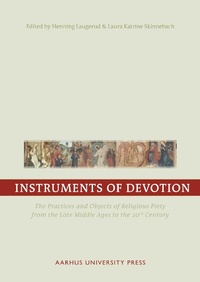
Instruments of Devotion
The Practices and Objects of Religious Piety from the Late Middle Ages to the 20th Century
Published on 22. November 2007
223 pages
978-87-7934-961-2 (ISBN)
Description

Redigeret af Henning Laugerud og Laura Katrine Skinnebach.Sekulariseringen af den vestlige kultur er om ikke en myte, sa betydeligt overvurderet. I dagens aktuelle debatter om religiositet, anerkender langt de fleste kristendommens indflydelse pa Europas historie, filosofi og kultur.Instruments of Devotion er en tvAerfaglig antologi skrevet af internationalt anerkendte forskere fra The European Network on the Instruments of Devotion, ENID, og i 11 artikler fokuseres specifikt pa de instrumentielle aspekter af andagt og fromhedspraksis i perioden fra det 14. arhundrede og frem til i dag. Artiklerne diskuterer relationen mellem den materielle kultur og det religiose liv; hvordan musik, bonneboger, litteratur og billeder har udtrykt og intensiveret fromhed og pietet i den kristne kultur i et historisk perspektiv.Antologiens mange forskelligartede indgangsvinkler spAender fra middelalderens visuelle teorier til postmodernismens perspektiver pa katolicismen og illustrerer saledes det komplekse monster af Aendringer, kontinuitet og sammenhAenge i den europAeiske kultur- og pietetshistorie.
More details
Other editions
Additional editions
Henning Laugerud | Laura Katrine Skinnebach
Instruments of Devotion
The Practices & Objects of Religious Piety from the Late Middle Ages to the 20th Century
Book
04/2008
Aarhus University Press
€45.98
Shipment within 10-20 days
Content
- Front Matter
- Front Cover
- Title Page
- Copyright Page
- Table of Contents
- Preface
- Introduction
- The outwardness of belief
- What is the European Network on the Instruments of Devotion?
- Traditions of Devotion
- The anthology
- 1st section
- Piety, Practise and Process
- Piety
- Practice
- The process of conversion
- The human heart
- Illuminating the story of conversion
- Cor Iesv amanti sacrvm
- Concluding remarks
- The Cultural Turn of Catholicism
- Cultural Identity of Catholicism
- Ritual Feeling
- Manual Labour as praxis pietatis:
- I. Background
- II. Manual labour in La Trappe
- Conclusion
- The Great Silence of Saint Joseph:
- Mysticism and devotion to Saint Joseph
- Jean-Joseph Surin S.J. and devotion to Saint Joseph
- The Jesuits and the crisis of mysticism - described by Michel de Certeau
- Jean-Joseph Surin's interpretation of the crisis
- The core of the question: the indwelling of Christ in the human person
- Conclusion
- The Medical Market Compared with the Pastoral Market:
- Introduction
- Lay preaching and quackery
- Once more the two professions
- The medical and pastoral markets
- Conclusion
- 2nd section
- Weapons of Redemption:
- Looking at the Mystery of the Incarnated God:
- The Resurrection Icon Lends Itself to Contemplation of God's Universal Will for Salvation
- The Isenheimer Altar Lends Itself to Contemplation of the Significance of Salvation History
- Conclusion
- Sepolcro:
- I. The sepolcro: a general introduction
- II. La Vita nella morte: Life in Death
- III. Salzburg traditions and Wolfgang Amadeus Mozart
- 19th Century Devotional Medals
- Religious medals and devotional medalets
- Historical forerunners and similar objects
- The origin of medals
- The 19th century
- The functions and use of devotional medals
- Conclusion
- Visuality and Devotion in the Middle Ages
- Introduction
- Theories of vision
- Sight as Knowledge
- Images and Visions
- Modes of vision and the familiarity of Images
- 'the solace of his image':
- Introduction
- Images as presence: the Veronica-legend as an introductory case
- Real presence: Eucharistic vision
- Physical presence: close encounters with the Holy
- In the presence of the divine: relations between man and the Holy in late medieval donator images
- Concluding remarks: representations versus experiences of presence
- Bibliography
- Notes on contributors
