

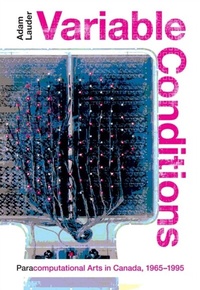
Variable Conditions
Para-computational Arts in Canada, 1965-1995
1st Edition
Published on 15. November 2023
393 pages
978-0-2280-1974-9 (ISBN)
Description

Variable Conditions recovers and explores early Canadian encounters between computational media and contemporary art in the late twentieth century, charting a network of developments linking meteorology, computation, and the arts that arose long before the age of cloud computing.
Essays uncover the material conditions that shaped the emergence of computational arts in Canada, from projects executed by mainframe to digital paintings and analog synthesizer performances. A surprising number of institutional circumstances granted access to early computer hardware - government nuclear and hydroelectric infrastructure, agencies as diverse as the National Film Board and the National Research Council, and a myriad of university settings across the country - and creative conditions varied from benign administrative neglect to the artistic exploration of randomness or a distinct emphasis on thematizing transformation as a motor for graphic visualization and auditory exploration. Interviews featuring leading artists give first-hand insight into artistic practices and the historical moment in which they occurred. The book provides valuable new perspectives on computer art pioneers such as Leslie Mezei, Robert Adrian X, Suzanne Duquet, Roger Vilder, and Vera Frenkel, as well as new contexts for understanding Michael Snow and IAIN BAXTER&. Not limiting their explorations to art generated using computers, contributors outline the integration of computational techniques and concepts into artistic methods across disciplines and trace computation's emergence as a matter of interest and concern for a range of contemporary cultural producers.
Combining historical analyses with theoretical approaches to computation and its entanglement with contemporary cultural discourses and social movements, Variable Conditions excavates the origins of computational arts and, in the process, sketches a new landscape of interdisciplinary creation and surprising connections between scientific and artistic institutions.
Essays uncover the material conditions that shaped the emergence of computational arts in Canada, from projects executed by mainframe to digital paintings and analog synthesizer performances. A surprising number of institutional circumstances granted access to early computer hardware - government nuclear and hydroelectric infrastructure, agencies as diverse as the National Film Board and the National Research Council, and a myriad of university settings across the country - and creative conditions varied from benign administrative neglect to the artistic exploration of randomness or a distinct emphasis on thematizing transformation as a motor for graphic visualization and auditory exploration. Interviews featuring leading artists give first-hand insight into artistic practices and the historical moment in which they occurred. The book provides valuable new perspectives on computer art pioneers such as Leslie Mezei, Robert Adrian X, Suzanne Duquet, Roger Vilder, and Vera Frenkel, as well as new contexts for understanding Michael Snow and IAIN BAXTER&. Not limiting their explorations to art generated using computers, contributors outline the integration of computational techniques and concepts into artistic methods across disciplines and trace computation's emergence as a matter of interest and concern for a range of contemporary cultural producers.
Combining historical analyses with theoretical approaches to computation and its entanglement with contemporary cultural discourses and social movements, Variable Conditions excavates the origins of computational arts and, in the process, sketches a new landscape of interdisciplinary creation and surprising connections between scientific and artistic institutions.
Reviews / Votes
"By celebrating and reminding readers of artists who are well-known but underappreciated - such as Michael Snow, Robert Adrian X, David Rokeby, and Les Levine - as well as introducing unknown artists who deserve recognition, Variable Conditions shows how early developments in computational arts in Canada were of global significance. It will appeal to anyone interested in the history of contemporary art, especially given how artists working in this area in the 1960s and onwards did so much to anticipate our current digital cultural condition." Charlie Gere, author of Digital Culture "Variable Conditions demonstrate(s) what artists and art historians have to offer this material history of computers as both medium and metaphor. The strongest contributions vividly invoke the institutional and social worlds that catalyzed these artistic experiments. This comes across most compellingly in the artist interviews, which elaborate the complexities of agency, innovation, and influence." Technology & CultureMore details
Series
Language
English
Place of publication
Montreal, QC
Canada
Target group
Professional and scholarly
Edition type
Digital original
Illustrations
50 photos
50 photos
File size
8,18 MB
ISBN-13
978-0-2280-1974-9 (9780228019749)
Copyright in bibliographic data and cover images is held by Nielsen Book Services Limited or by the publishers or by their respective licensors: all rights reserved.
Schweitzer Classification
Other editions
Additional editions
Book
11/2023
McGill-Queen's University Press
€114.09
Shipment within 15-20 days
Person
Adam Lauder is an art historian, curator, and writer based in 8entaronk / Toronto and the author of Out of School: Information Art and the Toronto School of Communication.
Content
- Cover
- Variable Conditions
- Title
- Copyright
- Contents
- Figures
- Acknowledgments
- Introduction
- Part One Early Days
- 1 Controlled Randomness
- 2 Excavating the Origins of Network Art in Canada: Leslie Mezei, Peter Milojevic, and Computer Art Journalism of the 1960s and 1970s
- 3 The First Live Performances on the Moog Synthesizer and Intersystems' Electrosonic Concert at the Art Gallery of Ontario in 1968
- 4 The Montreal Milieux of Suzanne Duquet and Suzy Lake
- 5 Circling the Computational: Jean-François Lyotard and Michael Snow's La Région Centrale
- Part Two Towards Personal Computing
- 6 New Media Art and Industry, a Critical Relationship
- 7 The Complex Digital Utopianism of Robert Adrian X
- 8 Beyond Electronics: Pimatsiwin and Computing Arts in Manitoba
- Part Three Interviews
- 9 Interview with Leslie Mezei
- 10 Interview with Roger Vilder
- 11 Interview with Gilles Gheerbrant
- 12 Interview with Mick Dawdy
- 13 Cybernetic Selfie: Interview with Les Levine
- 14 Vera Frenkel in Conversation with Dot Tuer: String Games, Then and Now
- 15 Interview with Norman White
- 16 Interview with IAIN BAXTER&
- 17 Zainub Verjee in Conversation with Julia Polyck-O'Neill
- Glossary
- Bibliography
- Contributors
- Index
