

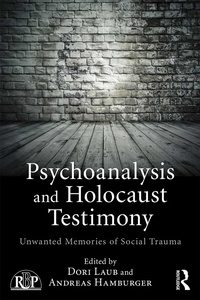
Psychoanalysis and Holocaust Testimony
Unwanted Memories of Social Trauma
Published on 31. March 2017
340 pages
978-1-317-51004-8 (ISBN)
Description

Psychoanalytic work with socially traumatised patients is an increasingly popular vocation, but remains extremely demanding and little covered in the literature. In Psychoanalysis and Holocaust Testimony, a range of contributors draw upon their own clinical work, and on research findings from work with seriously disturbed Holocaust survivors, to illuminate how best to conduct clinical work with such patients in order to maximise the chances of a positive outcome, and to reflect transferred trauma for the clinician.
Psychoanalysis and Holocaust Testimony closely examines the phenomenology of destruction inherent in the discourse of extreme traumatization, focusing on a particular case study: the recording of video testimonies from a group of extremely traumatized, chronically hospitalized Holocaust survivors in psychiatric institutions in Israel. This case study demonstrates how society reacts to unwanted memories, in media, history, and psychoanalysis - but it also shows how psychotherapists and researchers try to approach the buried memories of the survivors, through being receptive to shattered life narratives.
Questions of bearing witness, testimony, the role of denial, and the impact of traumatic narrative on society and subsequent generations are explored. A central thread of this book is the unconscious countertransference resistance to the trauma discourse, which manifests itself in arenas that are widely apart, such as genocide denial, the "disappearance" of the hospitalized Holocaust survivors and of their life stories, mishearing their testimonies and ultimately refusing them the diagnosis of "traumatic psychosis".
Psychoanalysis and Holocaust Testimony provides an essential, multidisciplinary guide to working psychoanalytically with severely traumatised patients. It will appeal to psychoanalysts, psychoanalytic psychotherapists and trauma studies therapists.
Psychoanalysis and Holocaust Testimony closely examines the phenomenology of destruction inherent in the discourse of extreme traumatization, focusing on a particular case study: the recording of video testimonies from a group of extremely traumatized, chronically hospitalized Holocaust survivors in psychiatric institutions in Israel. This case study demonstrates how society reacts to unwanted memories, in media, history, and psychoanalysis - but it also shows how psychotherapists and researchers try to approach the buried memories of the survivors, through being receptive to shattered life narratives.
Questions of bearing witness, testimony, the role of denial, and the impact of traumatic narrative on society and subsequent generations are explored. A central thread of this book is the unconscious countertransference resistance to the trauma discourse, which manifests itself in arenas that are widely apart, such as genocide denial, the "disappearance" of the hospitalized Holocaust survivors and of their life stories, mishearing their testimonies and ultimately refusing them the diagnosis of "traumatic psychosis".
Psychoanalysis and Holocaust Testimony provides an essential, multidisciplinary guide to working psychoanalytically with severely traumatised patients. It will appeal to psychoanalysts, psychoanalytic psychotherapists and trauma studies therapists.
Reviews / Votes
'Psychoanalysis and Holocaust Testimony superbly enlightens us about the complexity of Holocaust trauma and subsequent memory distortions, the effects of the unspeakable "collapse of civilization in the midst of civilization." It elaborates on the various ways that external trauma destroys the internal Other. Laub and Hamburger highlight the transference and particularly the counter transference resistance with Holocaust survivors with intellectual rigor and emotional evocation. Poignant testimonials of survivors of survivors and videos of those in Israeli hospitals are presented. An original tapestry of language such as "traumatic signature," "shards of memory," "traumatic erasure," and "proximity to the abyss," impacts the reader's emotional response. It combines great sophistication and scholarship with immediate and direct involvement of the reader.' - Bruce H. Sklarew M.D.'Dori Laub and Andreas Hamburger have brought together a powerful collection of papers that open new perspectives on the process of collecting testimony from Holocaust survivors. Their searching questions about the impact of both interviewers and interviewees on each other and on what is inevitably stirred in both takes their earlier work to new levels and reveals the complexity of what is involved in creating a record of "unbearable trauma" and "unwanted memory." Each contributing author adds to the richness of this collection.
This important new book also brings attention to Holocaust survivors who have been hospitalized for psychiatric illness for years and the chilling realization that the impact of their Holocaust history was often not even recognized or appreciated by those treating them.' -Darlene Bregman Ehrenberg, Ph.D., ABPP
More details
Series
Language
English
Place of publication
London
United Kingdom
Publishing group
Taylor & Francis Ltd
Target group
College/higher education
Professional and scholarly
File size
1,62 MB
ISBN-13
978-1-317-51004-8 (9781317510048)
Copyright in bibliographic data and cover images is held by Nielsen Book Services Limited or by the publishers or by their respective licensors: all rights reserved.
Schweitzer Classification
Other editions
Additional editions
Dori Laub | Andreas Hamburger
Psychoanalysis and Holocaust Testimony
Unwanted Memories of Social Trauma
Book
04/2017
1st Edition
Routledge
€222.84
Shipment within 10-20 days
Dori Laub | Andreas Hamburger
Psychoanalysis and Holocaust Testimony
Unwanted Memories of Social Trauma
Book
04/2017
1st Edition
Routledge
€56.00
Shipment within 10-20 days
Persons
Dori Laub, MD, himself a child survivor of the Holocaust, is clinical Professor of psychiatry at the Yale University School of Medicine and a psychoanalyst in private practice. He has worked for decades with victims of genocidal, childhood sexual abuse, and combat trauma. Laub is a cofounder of the Fortunoff video archive for Holocaust testimonies at Yale and has written extensively on the topic of testimony and bearing witness, and on the relationship between testimony and psychoanalysis. Working with the testimonies of chronically hospitalized survivors in Israeli psychiatric institutions is a pioneering step in that direction.
Andreas Hamburger is Professor of Clinical Psychology at the International Psychoanalytic University of Berlin, Germany.
Andreas Hamburger is Professor of Clinical Psychology at the International Psychoanalytic University of Berlin, Germany.
Content
Introduction Part I Social Trauma in Psychoanalytic Practice and Research, Media and History Preface to first section 1. Treatment, Trauma, and Catastrophic Reality: A Double Understanding of the "Too Much" Experience and Its Implications for Treatment 2. Knowing and not Knowing - Forms of Traumatic Memory 3. Traumatic shutdown of Narrative and Symbolization - a Failed Empathy Derivative. Implications for Therapeutic Interventions 4. Genocidal Trauma - Individual and Social Consequences of Assault on the Mental and Physical Life of a Group 5. The Psychoanalysis of Psychosis at the Crossroads of Individual Stories and of History 6. The Developmental Psychology of Social Trauma and Violence - The Case of the Rwanda Genocide Part II Perspectives on Testimony 7. The Question of My German Heritage 8. Visible Witness. Recognition, validation and visibilty in Four Video Testimonies of Shoah Survivors 9. Reflections of voice and countenance in historiography. Methodological considerations on clinical video testimonies of traumatized Holocaust survivors in historical research 10. Scenic Narrative Microanalysis. Controlled psychoanalytic assessment of session videos or transcripts as a transparent qualitative research instrument Part III Exploration in the Social Void - The Israel Video testimony Project 11. The Psychiatrically Hospitalized Survivors in Israel - A Historical Overview 12. The Israel Project 13. The Israel Story: My Story 14. Video Testimony of Long-Term Hospitalized Psychiatrically Ill Holocaust Survivors 15. The Institutional Experience: Patients and staff responding to the testimony 16. Traumatic Psychosis: Narrative Forms of the Muted Witness 17. Counter-Testimony, Counter-Archive Part IV. Manifestations of Extreme Traumatization in the Testimonial Narration of Hospitalized and Non-Hospitalized Holocaust Survivors. Two Case Studies Introduction 18. Parapraxis in Mother-Daughter Testimony: Unconscious Fantasy and Maternal Function 19. Narrative Fissures, Historical Context: When Traumatic Memory is Compromised 20. Refracted Attunement, Affective Resonance: Scenic-Narrative Microanalysis of Entangled Presences In A Holocaust Survivor's Video testimony 21. Discussion of Bodenstab, Knopp and Hamburger Part V Conclusions 22. Summary and discussion of the book Epilogue Notes on Contrubitors
