

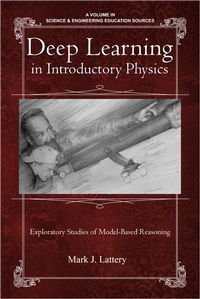
Deep Learning in Introductory Physics
Exploratory Studies of Model-Based Reasoning
1st Edition
Published on 10. January 2016
277 pages
978-1-68123-630-8 (ISBN)
Description

Deep Learning in Introductory Physics: Exploratory Studies of Model?Based Reasoning is concerned with the broad question of how students learn physics in a model-centered classroom. The diverse, creative, and sometimes unexpected ways students construct models, and deal with intellectual conflict, provide valuable insights into student learning and cast a new vision for physics teaching. This book is the first publication in several years to thoroughly address the "coherence versus fragmentation" debate in science education, and the first to advance and explore the hypothesis that deep science learning is regressive and revolutionary. Deep Learning in Introductory Physics also contributes to a growing literature on the use of history and philosophy of science to confront difficult theoretical and practical issues in science teaching, and addresses current international concern over the state of science education and appropriate standards for science teaching and learning.
The book is divided into three parts. Part I introduces the framework, agenda, and educational context of the book. An initial study of student modeling raises a number of questions about the nature and goals of physics education. Part II presents the results of four exploratory case studies. These studies reproduce the results of Part I with a more diverse sample of students; under new conditions (a public debate, peer discussions, and group interviews); and with new research prompts (model?building software, bridging tasks, and elicitation strategies). Part III significantly advances the emergent themes of Parts I and II through historical analysis and a review of physics education research.
ENDORSEMENTS:
""In Deep Learning in Introductory Physics, Lattery describes his extremely innovative course in which students' ideas about motion are elicited, evaluated with peers, and revised through experiment and discussion. The reader can see the students' deep engagement in constructive scientific modeling, while students deal with counter-intuitive ideas about motion that challenged Galileo in many of the same ways. Lattery captures students engaging in scientific thinking skills, and building difficult conceptual understandings at the same time. This is the 'double outcome' that many science educators have been searching for. The case studies provide inspiring examples of innovative course design, student sensemaking and reasoning, and deep conceptual change.
John Clement, University of Massachusetts-Amherst, Scientific Reasoning Research Institute
""Deep Learning in Introductory Physics is an extraordinary book and an important intellectual achievement in many senses. It offers new perspectives on science education that will be of interest to practitioners, to education researchers, as well as to philosophers and historians of science. Lattery combines insights into model-based thinking with instructive examples from the history of science, such as Galileo's struggles with understanding accelerated motion, to introduce new ways of teaching science. The book is based on first-hand experiences with innovative teaching methods, reporting student's ideas and discussions about motion as an illustration of how modeling and model-building can help understanding science. Its lively descriptions of these experiences and its concise presentations of insights backed by a rich literature on education, cognitive science, and the history and philosophy of science make it a great read for everybody interested in how models shape thinking processes.
The book is divided into three parts. Part I introduces the framework, agenda, and educational context of the book. An initial study of student modeling raises a number of questions about the nature and goals of physics education. Part II presents the results of four exploratory case studies. These studies reproduce the results of Part I with a more diverse sample of students; under new conditions (a public debate, peer discussions, and group interviews); and with new research prompts (model?building software, bridging tasks, and elicitation strategies). Part III significantly advances the emergent themes of Parts I and II through historical analysis and a review of physics education research.
ENDORSEMENTS:
""In Deep Learning in Introductory Physics, Lattery describes his extremely innovative course in which students' ideas about motion are elicited, evaluated with peers, and revised through experiment and discussion. The reader can see the students' deep engagement in constructive scientific modeling, while students deal with counter-intuitive ideas about motion that challenged Galileo in many of the same ways. Lattery captures students engaging in scientific thinking skills, and building difficult conceptual understandings at the same time. This is the 'double outcome' that many science educators have been searching for. The case studies provide inspiring examples of innovative course design, student sensemaking and reasoning, and deep conceptual change.
John Clement, University of Massachusetts-Amherst, Scientific Reasoning Research Institute
""Deep Learning in Introductory Physics is an extraordinary book and an important intellectual achievement in many senses. It offers new perspectives on science education that will be of interest to practitioners, to education researchers, as well as to philosophers and historians of science. Lattery combines insights into model-based thinking with instructive examples from the history of science, such as Galileo's struggles with understanding accelerated motion, to introduce new ways of teaching science. The book is based on first-hand experiences with innovative teaching methods, reporting student's ideas and discussions about motion as an illustration of how modeling and model-building can help understanding science. Its lively descriptions of these experiences and its concise presentations of insights backed by a rich literature on education, cognitive science, and the history and philosophy of science make it a great read for everybody interested in how models shape thinking processes.
All prices
More details
Other editions
Additional editions
Book
10/2016
Information Age Publishing
€70.70
Shipment within 3-4 weeks

