

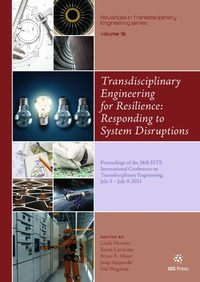
Transdisciplinary Engineering for Resilience: Responding to System Disruptions
Proceedings of the 28th ISTE International Conference on Transdisciplinary Engineering, July 5 - July 9, 2021
1st Edition
Published on 15. November 2021
608 pages
978-1-64368-209-9 (ISBN)
Description

No one discipline or person can encompass all the knowledge necessary to solve complex, ill-defined problems, or problems for which a solution is not immediately obvious. The concept of Concurrent Engineering (CE) - interdisciplinary, but with an engineering focus - was developed to increase the efficiency and effectiveness of the Product Creation Process (PCP) by conducting different phases of a product's life concurrently. Transdisciplinary Engineering has transcended CE, emphasizing the crucial importance of interdisciplinary openness and collaboration.
This book presents the proceedings of the 28th ISTE International Conference on Transdisciplinary Engineering (TE2021). Held online from 5 - 9 July 2021 and entitled 'Transdisciplinary Engineering for Resilience: Responding to System Disruptions', this is the second conference in the series held virtually due to the COVID-19 pandemic. The annual TE conference constitutes an important forum for international scientific exchange on transdisciplinary engineering research, advances, and applications, and is attended by researchers, industry experts and students, as well as government representatives. The book contains 58 peer-reviewed papers, selected from more than 80 submissions and ranging from the theoretical and conceptual to strongly pragmatic and addressing industrial best practice. The papers are grouped under 6 headings covering theory; education and training; PD methods and digital TE; industry and society; product systems; and individuals and teams.
Providing an overview of the latest research results and knowledge of product creation processes and related methodologies, the book will be of interest to all researchers, design practitioners, and educators working in the field of Transdisciplinary Engineering.
This book presents the proceedings of the 28th ISTE International Conference on Transdisciplinary Engineering (TE2021). Held online from 5 - 9 July 2021 and entitled 'Transdisciplinary Engineering for Resilience: Responding to System Disruptions', this is the second conference in the series held virtually due to the COVID-19 pandemic. The annual TE conference constitutes an important forum for international scientific exchange on transdisciplinary engineering research, advances, and applications, and is attended by researchers, industry experts and students, as well as government representatives. The book contains 58 peer-reviewed papers, selected from more than 80 submissions and ranging from the theoretical and conceptual to strongly pragmatic and addressing industrial best practice. The papers are grouped under 6 headings covering theory; education and training; PD methods and digital TE; industry and society; product systems; and individuals and teams.
Providing an overview of the latest research results and knowledge of product creation processes and related methodologies, the book will be of interest to all researchers, design practitioners, and educators working in the field of Transdisciplinary Engineering.
More details
Series
Language
English
Place of publication
London
Netherlands
Publishing group
IOS Press
Target group
Professional and scholarly
File size
37,45 MB
ISBN-13
978-1-64368-209-9 (9781643682099)
Copyright in bibliographic data and cover images is held by Nielsen Book Services Limited or by the publishers or by their respective licensors: all rights reserved.
Schweitzer Classification
Other editions
Additional editions

Susan Lattanzio | Bryan R. Moser | Nel Wognum
Transdisciplinary Engineering for Resilience: Responding to System Disruptions
Proceedings of the 28th ISTE International Conference on Transdisciplinary Engineering, July 5 - July 9, 2021
Book
11/2021
1st Edition
IOS Press,US
€168.14
Shipment within 10-20 days
Content
- Intro
- Title Page
- Preface
- Committees, Organizers and Sponsors
- Contents
- Part 1. Transdisciplinary Engineering Theory
- Towards a Transdisciplinary Approach to Systemic Risk Detection
- Infrastructuring Transdisciplinary Problem Solving in Translational Research
- Foraging for Transdisciplinary Challenges: Emergent Industrial Themes
- Transdisciplinary Engineering for Market Development
- The Transdisciplinary Engineering Index: Towards a Disciplinary Maturity Grid
- Part 2. Transdisciplinary Engineering Education and Training
- A Transdisciplinary Approach for the Design Optimization of Medical Simulations
- Fostering Design Thinking in Transdisciplinary Engineering Education
- Design and Production Automation for Mass Customisation - An Initial Framework Proposal Evaluated in Engineering Education and SME Contexts
- Part 3. PD Methods and Digital TE
- Incremental Update of a Digital Twin of a Production System by Using Scan and Object Recognition
- Automated Generation of a Digital Twin of a Process Plant by Using 3D Scan and Artificial Intelligence
- Logo Image Retrievals Using Deep Embedding Learning
- Concept of a Multi-Criteria and Multi-Disciplinary Design Activity Supporting Tool in the Design and Development Process of CPS
- Technology Mining for Intelligent Chatbot Development
- Towards an Uncertainty Management Framework for Model-Based Definition and Enterprise
- Using AutomationML to Generate Digital Twins of Tooling Machines for the Purpose of Developing Energy Efficient Production Systems
- A Preliminary Discussion of Digital Transformation and Semantic Interoperability to Support the Information Exchange in the Business Process
- Intelligent Product Quality Failure Prediction System in Smart Factories Based on Machine Learning Techniques
- Exploring the Transition from Preventive Maintenance to Predictive Maintenance Within ERP Systems by Utilising Digital Twins
- Digital Twin-Driven Framework for EV Batteries in Automobile Manufacturing
- Part 4. Industry and Society
- Flexible Hiring Personnel Models to Promote Human Satisfaction and Business Profit for Service Industries
- Study on Job Shop Scheduling for Keeping the Requested Shipping Sequence by Production System Modeling and Backward Simulation
- Product Lifecycle Management and Sustainable Development in the Context of Industry 4.0: A Systematic Literature Review
- Dynamic Modeling of Resource Allocation for Project Management in Multi-Project Environment
- Reference Model as Support for the Implementation of Agriculture 4.0
- Tracking Underground Metro Cars with Low-Cost Acceleration Sensors
- Aspects on a Digitalized Industrialization Process: Are There Challenges to Overcome?
- Critical Operations Capabilities and Reshoring Drivers in a High-Cost Environment
- Systems Dynamics and Empirical Studies of Innovation in the Automotive Industry
- Cause-Effect Modelling of the Risk Analysis in Objects Development: An Application to Civil Structures
- Lifecycle's Processes-Based Categories for the Risk Analysis in the Development of Engineering Solutions: An Application to Civil Structures Development
- Towards an Integrated MCDM and BSC Method to Support the Digital Transformation Strategy in Railway Companies
- Multi-Stage Fuzzy-Logic Model for Evaluation of Reshoring Decisions
- Adaptation Mechanisms and Service Quality Dimensions in Dynamic and Turbulent Environments: Empirical Results
- Product Platforms and Production - Current State and Future Research Directions Targeting Producibility and Production Preparation
- Part 5. Product Systems
- Benchmark on Human Simulation Tools: A Transdisciplinary Approach
- Design of a Wire Cut EDM End-Effector with Strict Robotic Constraints
- Method for Performance Analysis of Production Lines Based on Digital Models Powered by Real-Time Data
- Associative Data-Process Model in Manufacturing Systems: Application Case in Automotive Industry
- Advanced Planning and Scheduling (APS) Systems: A Systematic Literature Review
- Battery System Design for Electric Go-Kart
- Integration Across Knowledge Boundaries During New Product Introduction
- An Approach Based on Advanced Manufacturing for Replacement Parts in Equipment Maintenance Context
- Carbon Fiber Composites Application and Recycling in Kazakhstan and Neighboring Countries
- The Use of Generative Modelling to Automate the Design of Aerial Structural Assemblies
- Design of the Power Supply System for Vertical Take-Off and Landing Unmanned Aerial Vehicle
- GPU-Enabled Physics-Based Floor Plan Optimization Based on Work Place Analytical Data
- Analysis and Optimization of the Propeller Shape for a Stratospheric Drone Research Platform
- Part 6. Individual and Teams
- Virtual Tours to Promote the Remote Customer Experience
- Conceptual Design Study of a High-Altitude Mountain Rescue Rotorcraft
- Human Interaction in a Virtual Reality Environment
- Patent Portfolio Analysis Related to Advanced VR Technologies and Applications for Treating Driving Phobia
- Development Trend of Human-Cyber Physical System in Manufacturing: Mixed Reality Patent Analytics
- Enhancing Human Perspectives in CPS Models: Application to Collaborative Problem-Solving in Translational Medicine
- Development of Method for Visualizing Behavioral States of Teams
- Quantification of User's Preference on Product Shapes Using Automobile as a Case Study
- A Conceptual Framework for Designing Smart Domestic Health Enhancement Devices
- User Interface Design for Multi-Objective Decision Making
- Functional Approach for Summative Risk Management of Medical Products
- Subject Index
- Author Index
