

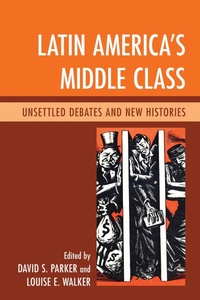
Latin America's Middle Class
Unsettled Debates and New Histories
Lexington Books (Publisher)
1st Edition
Published on 21. December 2012
236 pages
979-8-216-20960-7 (ISBN)
Description

As middle classes in developing countries grow in size and political power, do they foster stable democracies and prosperous, innovative economies? Or do they encourage crass materialism, bureaucratic corruption, unrealistic social demands, and ideological polarization? These questions have taken on a new urgency in recent years but they are not new, having first appeared in the mid twentieth century in debates about Latin America. At a moment when exploding middle classes in the global South increasingly capture the world's attention, these Latin American classics are ripe for revisiting.
Part One of the book introduces key debates from the 1950s and 1960s, when Cold War era scholars questioned whether or not the middle class would be a force for democracy and development, to safeguard Latin America against the perceived challenge of Revolutionary Cuba. While historian John J. Johnson placed tentative faith in the positive transformative power of the "middle sectors," others were skeptical. The striking disagreements that emerge from these texts lend themselves to discussion about the definition, character, and complexity of the middle classes, and about the assumptions that underpinned twentieth-century modernization theory.
Part Two brings together more recent case studies from Mexico, Peru, Brazil, Colombia, Chile, and Argentina, written by scholars influenced by contemporary trends in social and cultural history. These authors highlight issues of language, identity, gender, and the multiple faces and forms of power. Their studies bring flesh-and-blood Latin Americans to the forefront, reconstructing the daily lives of underpaid office workers, harried housewives and striving professionals, in order to revisit questions that the authors in Part One tended to approach abstractly. They also pay attention to changing cultural understandings and political constructions of who "the middle class" is and what it means to bemiddle class.
Designed with the classroom and non-specialist reader in mind, the book has a comprehensive critical introduction, and each selection is preceded by a short description setting the context and introducing key themes.
Part One of the book introduces key debates from the 1950s and 1960s, when Cold War era scholars questioned whether or not the middle class would be a force for democracy and development, to safeguard Latin America against the perceived challenge of Revolutionary Cuba. While historian John J. Johnson placed tentative faith in the positive transformative power of the "middle sectors," others were skeptical. The striking disagreements that emerge from these texts lend themselves to discussion about the definition, character, and complexity of the middle classes, and about the assumptions that underpinned twentieth-century modernization theory.
Part Two brings together more recent case studies from Mexico, Peru, Brazil, Colombia, Chile, and Argentina, written by scholars influenced by contemporary trends in social and cultural history. These authors highlight issues of language, identity, gender, and the multiple faces and forms of power. Their studies bring flesh-and-blood Latin Americans to the forefront, reconstructing the daily lives of underpaid office workers, harried housewives and striving professionals, in order to revisit questions that the authors in Part One tended to approach abstractly. They also pay attention to changing cultural understandings and political constructions of who "the middle class" is and what it means to bemiddle class.
Designed with the classroom and non-specialist reader in mind, the book has a comprehensive critical introduction, and each selection is preceded by a short description setting the context and introducing key themes.
More details
Edition
1. Auflage
Language
English
Place of publication
United States
Publishing group
Bloomsbury Publishing Plc
Target group
Professional and scholarly
ISBN-13
979-8-216-20960-7 (9798216209607)
Copyright in bibliographic data and cover images is held by Nielsen Book Services Limited or by the publishers or by their respective licensors: all rights reserved.
Schweitzer Classification
Other editions
Additional editions
Book
12/2012
Lexington Books
€133.00
Shipment within 10-20 days
Persons
David S. Parker is associate professor of history and former Chair of the History Department at Queen's University, Canada. He is author of The Idea of the Middle Class: White-Collar Workers and Peruvian Society, 1900-1950 (1998), and articles or book chapters on topics ranging from public health reform to images of social climbers in Chilean fiction to dueling among journalists and politicians in Uruguay.
Louise E. Walker is assistant professor of history at Northeastern University in Boston. She is the author of Waking from the Dream: Mexico's Middle Classes after 1968 (2012). She is currently coediting a special dossier on Mexico's recently declassified secret police archive for the Journal of Iberian and Latin American Research (2013, with Tanalís Padilla). Her research projects also include the history of conspiracy theories.
Louise E. Walker is assistant professor of history at Northeastern University in Boston. She is the author of Waking from the Dream: Mexico's Middle Classes after 1968 (2012). She is currently coediting a special dossier on Mexico's recently declassified secret police archive for the Journal of Iberian and Latin American Research (2013, with Tanalís Padilla). Her research projects also include the history of conspiracy theories.
Content
Introduction: The Making and Endless Remaking of the Middle Class
David S. Parker
Part 1: The Debates, 1947-1968
Chapter 1: Middle Groups in National Politics in Latin America
John J. Johnson
Chapter 2: Aspects of Class Relations in Chile, 1850-1960
Frederick B. Pike
Chapter 3: Community Pillars: The Middle Class
Andrew H. Whiteford
Chapter 4: The Budget
Mario Benedetti
Chapter 5: Middle-Class Rebels
Francisco López Cámara
Chapter 6: The Dilemma of the Latin American Middle Class
Charles Wagley
Part 2: New Histories
Chapter 7: Moralizing the Masses
William E. French
Chapter 8: White-Collar Lima, 1910-1929: Commercial Employees and the Rise of the Peruvian Middle Class
David S. Parker
Chapter 9: Domesticating Modernity: Markets, Home, and Morality in the Middle Class in Rio de Janeiro and São Paulo, 1930s and 1940s
Brian P. Owensby
Chapter 10: "It Is Not Something You Can Be or Come to Be Overnight": Empleados, Mujeres de Oficina, and Gendered Middle Class Identities in Bogotá, Colombia, 1930-55
A. Ricardo López-Pedreros
Chapter 11: Rethinking Aspects of Class Relations in Twentieth-Century Chile
J. Pablo Silva
Chapter 12: We Were the Middle Class
Rodolfo Barros
David S. Parker
Part 1: The Debates, 1947-1968
Chapter 1: Middle Groups in National Politics in Latin America
John J. Johnson
Chapter 2: Aspects of Class Relations in Chile, 1850-1960
Frederick B. Pike
Chapter 3: Community Pillars: The Middle Class
Andrew H. Whiteford
Chapter 4: The Budget
Mario Benedetti
Chapter 5: Middle-Class Rebels
Francisco López Cámara
Chapter 6: The Dilemma of the Latin American Middle Class
Charles Wagley
Part 2: New Histories
Chapter 7: Moralizing the Masses
William E. French
Chapter 8: White-Collar Lima, 1910-1929: Commercial Employees and the Rise of the Peruvian Middle Class
David S. Parker
Chapter 9: Domesticating Modernity: Markets, Home, and Morality in the Middle Class in Rio de Janeiro and São Paulo, 1930s and 1940s
Brian P. Owensby
Chapter 10: "It Is Not Something You Can Be or Come to Be Overnight": Empleados, Mujeres de Oficina, and Gendered Middle Class Identities in Bogotá, Colombia, 1930-55
A. Ricardo López-Pedreros
Chapter 11: Rethinking Aspects of Class Relations in Twentieth-Century Chile
J. Pablo Silva
Chapter 12: We Were the Middle Class
Rodolfo Barros
