

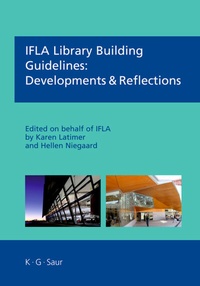
IFLA Library Building Guidelines: Developments & Reflections
Description

The information society and the information age are changing library services as well as library premises. This raises questions about what needs to be considered when planning and designing new library buildings in order to achieve attractive, efficient and future-oriented new library spaces.
This new publication provides information and guidelines for the building planning process, whether you are planning a new public or academic library building. It reflects on fundamental issues, on new development trends and on the planning process. The library building process is seen from both the library manager's perspective as well as that of the architect and designer. Issues covered include what to consider when investigating the need for space, library design from a marketing viewpoint, green management and sustainability relating to library buildings and a layman's guide to reading plans.
This publication and the IFLA guidelines provided are not seen as a traditional set of recommendations to be rigidly adhered to since this would be unrealistic in a fast-changing and global context. Rather, library managers and architects should read them in order to inform their thinking on key issues and establish a planning programme. They must then relate them to their own countries and circumstances by making the relevant local adjustments.
Reviews / Votes
"Der Band stellt eine durchaus lesenswerte Sammlung von Beiträgen zur Bibliotheksbauplanung dar."Robert Klaus Jopp in: B.I.T.-Online 372009More details
Other editions
Additional editions
Persons
Content
- Frontmatter
- CONTENTS
- PROLOGUE
- INTRODUCTION: A NEW TOOL FOR PLANNING LIBRARY BUILDINGS
- 1. THE TOP TEN QUALITIES OF GOOD LIBRARY SPACE
- 2. REINVENTING THE PHYSICAL LIBRARY: LIBRARIES IN A NEW CONTEXT
- 3. INVESTIGATING THE NEED FOR SPACE
- 4. UNLOCKING THE LIBRARY: LIBRARY DESIGN FROM A MARKETING PERSPECTIVE
- 5. USERS AND PUBLIC SPACE: WHAT TO CONSIDER WHEN PLANNING LIBRARY SPACE
- 6. CONFIGURING INTERNAL STAFF AREAS
- 7. HOW WAS IT FOR YOU? THE BUILDING PROCESS IN PRACTICE
- 8. THE BUILDING PROCESS INCLUDING HOW TO CHOOSE AN ARCHITECT
- 9. A PRACTICAL MEANS OF ESTIMATING LIBRARY SPACE NEEDS
- 10. INTERIOR DESIGN CONSIDERATIONS AND DEVELOPING THE BRIEF
- 11. A LIBRARY PROJECT FROM AN ARCHITECT'S POINT OF VIEW
- 12. GREEN BUILDING MANAGEMENT AND SUSTAINABLE MAINTENANCE
- 13. READING PLANS FOR LIBRARY PROFESSIONALS
- 14. RENOVATING HISTORIC BUILDINGS
- 15. SITE & LOCATION
- 16. WHAT TO LOOK FOR: A CHECK LIST FOR VISITING LIBRARY BUILDINGS
- Backmatter
