

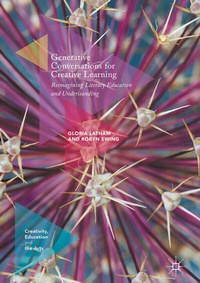
Generative Conversations for Creative Learning
Description

This book builds on conversations between the author educators and other experts in the field, including authors, illustrators and teachers, to explore the benefits of discussions around quality literature within a classroom context that exercises the imagination and generates new ideas and discoveries. The book focuses on a range of strategies that can be utilised to reimagine literacy learning in a 21st century context including parent and teacher talk; active listening; fostering student driven questions; building vocabulary and imagery; and metacognitive talk. These are argued to have a hugely beneficial impact on how children learn to solve problems, engage in complex thought processes, negotiate meaning, as well as learning how to wonder, explore, create and defend ideas. The book also defends the importance of parents, teachers and academics as 'storytellers', using their bodies and voices as instruments of engagement and power. It will make compelling reading for students, teachers and researchers working in the fields of education and sociology, particularly those with an interest in creative methods for improving literacy.
More details
Other editions
Additional editions
Persons
Gloria Latham is an Honorary Senior Lecturer at the University of Sydney, Australia. She has taught in primary schools and headed a children's theatre in education program. For the past 30 years Gloria taught reflective practice, integrated curriculum, drama, and literacy with both undergraduate and post graduate students in the School of Education at RMIT University, Australia.
Robyn Ewing AM was originally a primary teacher, and is now Professor of Teacher Education and the Arts at the University of Sydney, Australia. She teaches in the areas of curriculum, teaching and learning, English, drama and literacy working with both pre-service and postgraduate teachers. Robyn is passionate about the Arts and education and the role quality arts experiences and processes can and should play in pedagogy across the curriculum. She frequently works in classrooms alongside teachers interested in reforming their pedagogy.
