

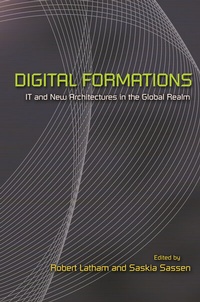
Digital Formations
IT and New Architectures in the Global Realm
1st Edition
Published on 19. September 2009
384 pages
978-1-4008-3161-6 (ISBN)
Description

Computer-centered networks and technologies are reshaping social relations and constituting new social domains on a global scale, from virtually borderless electronic markets and Internet-based large-scale conversations to worldwide open source software development communities, transnational corporate production systems, and the global knowledge-arenas associated with NGO networks. This book explores how such "digital formations" emerge from the ever-changing intersection of computer-centered technologies and the broad range of social contexts that underlie much of what happens in cyberspace.
While viewing technologies fundamentally in social rather than technical terms, Digital Formations nonetheless emphasizes the importance of recognizing the specific technical capacities of digital technologies. Importantly, it identifies digital formations as a new area of study in the social sciences and in thinking about globalization. The ten chapters, by leading scholars, examine key social, political, and economic developments associated with these new configurations of organization, space, and interaction. They address the operation of digital formations and their implications for the development of longstanding institutions and for their wider contexts and fields, and they consider the political, economic, and other forces shaping those formations and how the formations, in turn, are shaping such forces.
Following a conceptual introduction by the editors are chapters by Hayward Alker, Jonathan Bach and David Stark, Lars-Erik Cederman and Peter A. Kraus, Dieter Ernst, D. Linda Garcia, Doug Guthrie, Robert Latham, Warren Sack, Saskia Sassen, and Steven Weber.
While viewing technologies fundamentally in social rather than technical terms, Digital Formations nonetheless emphasizes the importance of recognizing the specific technical capacities of digital technologies. Importantly, it identifies digital formations as a new area of study in the social sciences and in thinking about globalization. The ten chapters, by leading scholars, examine key social, political, and economic developments associated with these new configurations of organization, space, and interaction. They address the operation of digital formations and their implications for the development of longstanding institutions and for their wider contexts and fields, and they consider the political, economic, and other forces shaping those formations and how the formations, in turn, are shaping such forces.
Following a conceptual introduction by the editors are chapters by Hayward Alker, Jonathan Bach and David Stark, Lars-Erik Cederman and Peter A. Kraus, Dieter Ernst, D. Linda Garcia, Doug Guthrie, Robert Latham, Warren Sack, Saskia Sassen, and Steven Weber.
More details
Edition
Course Book
Language
English
Place of publication
Princeton, NJ
United States
Publishing group
De Gruyter
Target group
Professional and scholarly
Edition type
Digital original
Illustrations
20 line illus. 4 tables.
File size
1,85 MB
ISBN-13
978-1-4008-3161-6 (9781400831616)
Schweitzer Classification
Other editions
Additional editions
Book
07/2005
Princeton University Press
€71.80
Article exhausted; check different version
Book
07/2005
Princeton University Press
€49.00
Shipment within 10-20 days
Persons
Robert Latham is Director of the Social Science Research Council Program on Information Technology and International Cooperation. He is the author of The Liberal Moment. Saskia Sassen is the Ralph Lewis Professor of Sociology at the University of Chicago and Centennial Visiting Professor at the London School of Economics. Her books include The Global City and the forthcoming Denationalization: Territory, Authority, and Rights in a Global Digital Age (both Princeton).
Content
List of Illustrations vii
Acknowledgments ix
Introduction
Digital Formations: Constructing an Object of Study by Robert Latham and Saskia Sassen 1
SPACES OF KNOWLEDGE 35
Recombinant Technology and New Geographies of Association by Jonathan Bach and David Stark 37
Electronic Markets and Activist Networks: The Weight of Social Logics in Digital Formations by Saskia Sassen 54
The New Mobility of Knowledge: Digital Information Systems and Global Flagship Networks by Dieter Ernst 89
NETWORKS OF COOPERATION 115
Cooperative Networks and the Rural-Urban Divide by D. Linda Garcia 117
Networks, Information, and the Rise of the Global Internet by Robert Latham 146
The Political Economy of Open Source Software and Why It Matters by Steven Weber 178
DESIGNS AND INSTITUTIONS 213
Designing Information Resources for Transboundary Conflict Early Warning Networks by Hayward R. Alker 215
Discourse Architecture and Very Large-scale Conversation by Warren Sack 242
Transnational Communication and the European Demos by Lars-Erik Cederman and Peter A. Kraus 283
Information Technology and State Capacity in China by Doug Guthrie 312
List of Contributors 339
Index 341
Acknowledgments ix
Introduction
Digital Formations: Constructing an Object of Study by Robert Latham and Saskia Sassen 1
SPACES OF KNOWLEDGE 35
Recombinant Technology and New Geographies of Association by Jonathan Bach and David Stark 37
Electronic Markets and Activist Networks: The Weight of Social Logics in Digital Formations by Saskia Sassen 54
The New Mobility of Knowledge: Digital Information Systems and Global Flagship Networks by Dieter Ernst 89
NETWORKS OF COOPERATION 115
Cooperative Networks and the Rural-Urban Divide by D. Linda Garcia 117
Networks, Information, and the Rise of the Global Internet by Robert Latham 146
The Political Economy of Open Source Software and Why It Matters by Steven Weber 178
DESIGNS AND INSTITUTIONS 213
Designing Information Resources for Transboundary Conflict Early Warning Networks by Hayward R. Alker 215
Discourse Architecture and Very Large-scale Conversation by Warren Sack 242
Transnational Communication and the European Demos by Lars-Erik Cederman and Peter A. Kraus 283
Information Technology and State Capacity in China by Doug Guthrie 312
List of Contributors 339
Index 341
