

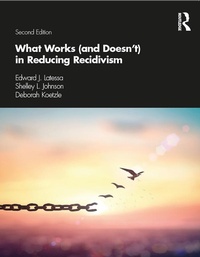
What Works (and Doesn't) in Reducing Recidivism
2nd Edition
Published on 8. June 2020
336 pages
978-1-000-07428-4 (ISBN)
Description

What Works (and Doesn't) in Reducing Recidivism offers criminologists and students an evidence-based discussion of the latest trends in corrections. Experts Latessa, Johnson, and Koetzle translate the research and findings about what works and doesn't work in reducing recidivism into understandable concepts and terms, presenting them in a way that illustrates the value of research to practice. Over the last several decades, research has clearly shown that rehabilitation efforts can be effective in reducing recidivism among criminal offenders, but it is clear that treatment is not a one-size-fits-all approach. Offenders vary by gender, age, crime type, and/or addictions, to name but a few ways, and these individual needs must be addressed by providers. Finally, issues such as leadership, quality of staff, and evaluation efforts affect the quality and delivery of treatment services.
While other texts have addressed issues regarding treatment in corrections, this text is unique in that it not only discusses the research on "what works" but also addresses the implementation issues faced as practitioners move from theory to practice, as well as the importance of staff, leadership, and evaluation efforts.
This book synthesizes the vast research for the student interested in correctional rehabilitation as well as for the practitioner working with offenders.
While other texts have addressed issues regarding treatment in corrections, this text is unique in that it not only discusses the research on "what works" but also addresses the implementation issues faced as practitioners move from theory to practice, as well as the importance of staff, leadership, and evaluation efforts.
This book synthesizes the vast research for the student interested in correctional rehabilitation as well as for the practitioner working with offenders.
Reviews / Votes
"Marshalling an impressive collection of applied research studies on correctional effectiveness, Latessa, Johnson, and Koetzle provide an analysis of the findings. Their conclusions clearly specifies what is effective and what is not in terms of reducing recidivism. Their work explodes myths concerning panaceas and 'common sense' political quick fixes to demonstrate how corrections can implement programs that work and re-establish the goal of rehabilitation. The book is a model to guide evidence-based practice in corrections."Gennaro F. Vito, Professor of Criminal Justice, University of Louisville
"Every year, millions of offenders will be released from our jails and prisons. Ensuring their successful re-entry into the community and encouraging their prosocial behavior and positive contributions to society are in everyone's best interest. Thus, it is imperative that we develop a deep understanding of what works-and what does not work-within correctional settings. This book does just that. Written by the leading figures in corrections and treatment, this is a how to guide for students, academics, practitioners, and policymakers that provides evidence-based guidance on helping transform people's lives."
Alex R. Piquero, Ashbel Smith Professor of Criminology, The University of Texas at Dallas & Professor of Criminology, Monash University
?"Correctional quackery has dominated correctional treatment for far too long. The authors provide a scientific pathway for effective correctional treatment."
Harry E. Allen, Professor Emeritus, Justice Studies Department, San Jose State University
More details
Edition
2nd edition
Language
English
Place of publication
London
United Kingdom
Publishing group
Taylor & Francis Ltd
Target group
College/higher education
Illustrations
39 Tables, black and white; 83 Illustrations, black and white
ISBN-13
978-1-000-07428-4 (9781000074284)
Copyright in bibliographic data and cover images is held by Nielsen Book Services Limited or by the publishers or by their respective licensors: all rights reserved.
Schweitzer Classification
Other editions
Additional editions
Edward J. Latessa | Shelley Johnson | Deborah Koetzle
What Works (and Doesn't) in Reducing Recidivism
Book
07/2020
2nd Edition
Routledge
€243.70
Shipment within 15-20 days
Edward J. Latessa | Shelley Johnson | Deborah Koetzle
What Works (and Doesn't) in Reducing Recidivism
Book
07/2020
2nd Edition
Routledge
€75.60
Shipment within 15-20 days
Persons
Edward J. Latessa received his PhD from The Ohio State University and is Director and Professor of the School of Criminal Justice at the University of Cincinnati. Dr. Latessa has published over 175 works in the area of criminal justice, corrections, and juvenile justice and has directed over 195 funded research projects, including studies of day reporting centers, juvenile justice programs, drug courts, prison programs, and intensive supervision programs, and he has received numerous awards. In 2013 Latessa was identified as one of the most innovative people in criminal justice by a national survey conducted by the Center for Court Innovation in partnership with the Bureau of Justice Assistance and the U.S. Department of Justice.
Shelley L. Johnson (formerly Listwan) is Professor in the Department of Criminal Justice and Criminology at the University of North Carolina at Charlotte. She received her PhD in Criminal Justice from the University of Cincinnati in 2001. She has also served on the faculty at the University of Nevada, Las Vegas and Kent State University. She has extensive experience with evaluation research and best practices in corrections with both adults and youth.
Deborah Koetzle is Associate Professor in the Department of Criminal Justice and Executive Officer of the Doctoral Program in Criminal Justice at John Jay College of Criminal Justice/The Graduate Center, City University of New York. She received her PhD in Criminal Justice from the University of Cincinnati in 2006. Her research interests center on effective interventions, risk assessment, program implementation and fidelity, and cross-cultural comparisons of prison-based programs and practices.
Shelley L. Johnson (formerly Listwan) is Professor in the Department of Criminal Justice and Criminology at the University of North Carolina at Charlotte. She received her PhD in Criminal Justice from the University of Cincinnati in 2001. She has also served on the faculty at the University of Nevada, Las Vegas and Kent State University. She has extensive experience with evaluation research and best practices in corrections with both adults and youth.
Deborah Koetzle is Associate Professor in the Department of Criminal Justice and Executive Officer of the Doctoral Program in Criminal Justice at John Jay College of Criminal Justice/The Graduate Center, City University of New York. She received her PhD in Criminal Justice from the University of Cincinnati in 2006. Her research interests center on effective interventions, risk assessment, program implementation and fidelity, and cross-cultural comparisons of prison-based programs and practices.
Content
1. Nothing Works" to "What Works": The History and Social Context of Rehabilitation; 2. Understanding Risk and Need: The Importance of Assessment; 3. Barriers to Treatment: Understanding Specific Responsivity; 4. What Doesn't' Work: Ineffective Approaches and Correctional Quackery; 5. Putting Theory into Practice: Approaches That Work in Reducing Recidivism; 6. Changing Behavior Long Term: Implementing Behavioral Management Systems; 7. Delivering Effective Substance Abuse Treatment; 8. Delivering Effective Treatment for Sex Offending Behaviors; 9. Delivering Effective Programs for Women; 10. Delivering Effective Programs in Institutional Settings; 11. What Works in Reentry: Transitioning Back to the Community; 12. The Importance of Quality: How to Ensure Program Fidelity
