

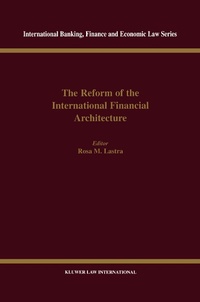
The Reform of the International Financial Architecture
Published on 1. December 2000
400 pages
978-90-411-7298-3 (ISBN)
Description

The current institutional framework for economic co-operation was designed in the 1940s, in the context of war, to promote the peaceful coexistence of nations. Many of the institutions, such as the International Monetary Fund and the International Bank for Reconstruction and Development, have served the international community well over the years. However, changes in the quantity and quality of capital flows, and in particular, criticism of the manner in which these institutions handled the East Asian and Russian financial crises, have triggered a debate about the need for reform of the international financial and monetary system.
This work offers an incisive and comprehensive legal overview of various aspects of the reform debate, analysing the proposed parameters of the new financial architecture, the legal infrastructure in emerging economies, and the challenges that the international institutions face in the 21st century. The three main parts of the book focus on the reform of the international institutional framework, the prevention and resolution of liquidity crises, and the approaches taken by European Union institutions.
The Reform of the International Financial Architecture brings together a distinguished panel of experts from practice and academia, and is essential reading for academics, policy-makers and practitioners in the financial world. This volume is one of a number of works containing the results of a global series of high level conferences held in 1999 on the topic of 'Financial Crises and the New International Financial Architecture'.
This work offers an incisive and comprehensive legal overview of various aspects of the reform debate, analysing the proposed parameters of the new financial architecture, the legal infrastructure in emerging economies, and the challenges that the international institutions face in the 21st century. The three main parts of the book focus on the reform of the international institutional framework, the prevention and resolution of liquidity crises, and the approaches taken by European Union institutions.
The Reform of the International Financial Architecture brings together a distinguished panel of experts from practice and academia, and is essential reading for academics, policy-makers and practitioners in the financial world. This volume is one of a number of works containing the results of a global series of high level conferences held in 1999 on the topic of 'Financial Crises and the New International Financial Architecture'.
More details
Other editions
Additional editions
Book
12/2000
1st Edition
Kluwer Law International
€147.66
Shipment within 10-20 days
Content
- Cover
- Half Title Page
- Editorial Board
- Title Page
- Copyright Page
- Table of Contents
- Editor's Note
- List of Contributors
- Foreword
- Preface
- Part I Introduction
- 1. Pondering the Parameters of the 'New International Financial Architecture': A Legal Perspective
- 1 INTRODUCTION
- 2 SUBMERGED FRAGILITIES NECESSITATE A LAW-BASED APPROACH
- 3 COPING WITH FUTURE CRISES: A PRE-EMPTIVE MOVE TOWARD A LAW-BASED APPROACH
- 4 THEMATIC STRANDS TO THE NEW GLOBAL FINANCIAL LAW
- 5 THE UNFINISHED AGENDA
- 6 CONCLUDING OBSERVATIONS: IS THERE A 'NEW INTERNATIONAL FINANCIAL ARCHITECTURE'?
- 2. The Legal Architecture of Emerging Markets
- 1 INTRODUCTION
- 2 THIRD WORLD GOALS AND MODELS
- 3 THE ELEMENTS OF DEVELOPMENT MODEL I
- 4 IMPLICATIONS OF DEVELOPMENT MODEL I FOR THIRD WORLD LEGAL SYSTEMS
- 5 THE EMERGENCE OF DEVELOPMENT MODEL II
- 6 IMPLICATIONS OF DEVELOPMENT MODEL II FOR THIRD WORLD LEGAL SYSTEMS
- 7 CONCLUSION
- 3. The Bretton Woods Institutions in the XXIst Century
- 1 INTRODUCTION
- 2 THE BRETTON WOODS INSTITUTIONS IN HISTORICAL PERSPECTIVE: THE KEYNES AND WHITE PLANS
- 3 THE ROLE OF THE INTERNATIONAL MONETARY FUND
- 4 THE MAIN FUNCTIONS AND ACTIVITIES OF THE INTERNATIONAL MONETARY FUND
- 5 SHOULD THE IMF ADOPT AN INTERNATIONAL LENDER OF LAST RESORT ROLE?
- 6 WHICH DEVELOPMENT ROLE FOR THE IMF?
- 7 CONCLUDING RE MARKS
- Part II The International Institutional Framework
- 4. The Reform of the International Monetary Fund (Conditionality and Surveillance)
- 1 INTRODUCTION
- 2 OBJECTIVES OF THE REFORM
- 3 THE INSTRUMENTS
- 5. An International Financial Regulator?
- 1 INTRODUCTION
- 2 EXISTING SYSTEMS AND THEIR CRITICS
- 3 WHAT ARE THE REGULATORS DOING?
- 4 CONCLUSION
- 6. A New International Architecture and the Financial Stability Forum
- 1 INTRODUCTION
- 2 FINANCIAL STABILITY
- 3 THE FINANCIAL STABILITY FORUM
- 4 GENERAL ACTIVITIES
- 5 FINANCIAL STABILITY STANDARDS
- 6 COMMENT AND CONCLUSIONS
- 7 CLOSING COMMENT-POLICY CONTRIBUTION
- 7. Regulatory Aspects: Globalisation, Harmonisation, Legal Transplants and Law Reform-Preliminary Remarks
- 1 INTRODUCTION: BIRTHDAY CAKE AND GLOBALISATION
- 2 ESSENTIAL INGREDIENTS FOR SUCCESSFUL LAW REFORM
- 3 'PRIVILEGE' OF STANDARD SETTING AND ROLE OF TECHNICAL ASSISTANCE
- 4 RECEPTION OF FOREIGN LAW AND FUNCTION OF LEGAL TRANSPLANTS
- 5 MAIN ELEMENTS OF COMMERCIAL LAW REFORM
- 6 CONCLUSION AND DIGRESSION: EVERYTHING A MATTER OF TASTE?
- 8. Stock Markets and the Globalization of Retirement Savings-Implications of Privatization of Government Pensions for Securities Regulators
- 1 INTRODUCTION
- 2 EXPERIMENTS WITH AND DEBATES ABOUT PRIVATIZATION
- 3 REGULATION OF ISSUERS OF SECURITIES
- 4 SECURITIES MARKET STRUCTURE AND REGULATION
- 5 PRUDENT INVESTMENT AND CROSS-BORDER FLOWS
- 6 CONCLUSION
- Part III Liquidity Crises: Public and Private Sector Involvement
- 9. Liquidity Crises
- 1 INTRODUCTION
- 2 THE CHANGING MEANING OF MONETARY LIQUIDITY CRISES
- 3 LIQUIDITY TOOLS OF MODERN CENTRAL BANKS
- 4 APPLICATION: Y2K
- 10. A Lawyer's Perspective on the New Financial Architecture
- 1 INTRODUCTION
- 2 WHY THE NEED FOR A 'NEW' FINANCIAL ARCHITECTURE?
- 3 THE NEW POLICY DILEMMA
- 4 PREVENTION
- 5 CURE
- 6 CONCLUSION
- 11. Promoting Stability in International Finance Legislative and Regulatory Reform of Payment and Settlement Systems
- 1 INTRODUCTION
- 2 THE PAYMENT SYSTEM-COMPONENTS, ORGANIZATION, AND OVERSIGHT
- 3 LVTS PAYMENT SYSTEM RISKS-THE FAILURE TO COMPLETE SETTLEMENT ON PARTICIPANT'S DEFAULT
- 4 SETTLEMENT AND PAYMENT SYSTEM RISKS THE NEED FOR LEGAL CERTAINTY IN FINANCIAL TRANSACTIONS
- 5 CONCLUSION
- 12. Ten Years of Economic Reforms in Russia: Windows in a Wall
- 1 INTRODUCTION
- 2 POST-CRISIS DEMOCRATIC RUSSIA (1999-2000)
- 3 PRE-CRISIS DEMOCRATIC RUSSIA (1990-1998)
- 4 PRIVATE PROPERTY IN POST-COMMUNIST RUSSIA
- 5 CHRONOLOGY OF EVENTS
- 6 CORRUPTION
- 7 CONCLUSION
- Part IV Regional Responses
- 13. European Financial Regulation
- 1 INTRODUCTION
- 2 THE REGULATORY ROLE OF THE EUROPEAN CENTRAL BANK
- 3 THE ADVISORY ROLE OF THE EUROPEAN CENTRAL BANK
- 4 THE PROBLEM OF THE SOLE REGULATOR
- 5 CONCLUSION
- 14. The ESCB and its Role in Banking Supervision
- 1 INTRODUCTION
- 2 THE IMPACT OF MONETARY UNION IN THE CREDIT MARKET
- 3 THE IMPACT OF MONETARY UNION IN THE REGULATORY AND SUPERVISORY FRAMEWORK
- 4 PARAMETERS FOR A NEW FRAMEWORK
- 5 CRISIS MANAGEMENT
- 15. Implementation of International Standards: The EBRD's Approach to Strengthening Good Corporate Governance
- 1 INTRODUCTION
- 2 INCENTIVE FRAMEWORK FOR GOOD CORPORATE GOVERNANCE
- 3 INTERNATIONAL STANDARDS OF CORPORATE GOVERNANCE
- 4 SOUND BUSINESS STANDARDS AND CORPORATE PRACTICES-A SET OF GUIDELINES
- 5 RAISING AWARENESS OF REFORM NEEDS
- 6 PROVIDING LEGAL TECHNICAL ASSISTANCE
- 7 IMPROVING CORPORATE GOVERNANCE IN EQUITY AND DEBT TRANSACTIONS
- 8 IMPROVING CORPORATE GOVERNANCE IN WORK-OUTS
- 9 CONCLUSION: NEXT STEPS
- Selected Bibliography
- Index
- Back Cover
