

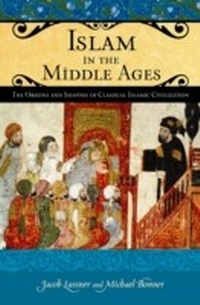
Islam in the Middle Ages
The Origins and Shaping of Classical Islamic Civilization
1st Edition
Published on 19. November 2009
368 pages
978-0-313-04709-1 (ISBN)
Description

In the Middle Ages, a varied and vibrant Islamic culture flourished in all its aspects, from religious institutions to legal and scientific endeavors. Lassner, Reisman, and Bonner detail how all three montheist traditions are linked to the same sacred history. They trace the most current scholarship on the Arabian background to Islam, the prophet's early religious message and its appeal. They the Qur'an and how it would have been understood by the earliest generations of Muslims. How much does historical memory come into play in current depictions of this early era? Beyond religious institutions, Muslim scholars and scientists were vital to both the transmission of knowledge from the Greek civilization and to the uninterrupted progress of science. The authors explore the role that non-Muslim minorities played within this culture and they detail the splits within the Muslim world that continue to this day.
More details
Series
Edition
1. Auflage
Language
English
Place of publication
New York
United States
Publishing group
Bloomsbury Publishing Plc
Target group
Children/juvenile
Interest Age: From 7 to 17 years
ISBN-13
978-0-313-04709-1 (9780313047091)
Copyright in bibliographic data and cover images is held by Nielsen Book Services Limited or by the publishers or by their respective licensors: all rights reserved.
Schweitzer Classification
Other editions
Additional editions
Jacob Lassner | Michael Bonner
Islam in the Middle Ages
The Origins and Shaping of Classical Islamic Civilization
Book
11/2009
Praeger Publishers Inc
€80.00
Shipment within 15-20 days
Persons
JACOB LASSNER is Philip M. and Ethel Klutznick Professor of Jewish Civilization at Northwestern University. He specializes in medieval Near Eastern History with an emphasis on urban structures, political culture, and the background to Jewish-Muslim relations.
Michael Bonner is professor of medieval Islamic history in the Department of Near Eastern Studies, University of Michigan, Ann Arbor, MI. He received his PhD in the Department of Near Eastern Studies, Princeton University, in 1987. His recent publications include Jihad in Islamic History: Doctrines and Practices (2006) and Poverty and Charity in Middle Eastern Contexts, co-edited with Amy Singer and Mine Ener (2003). He has been a Helmut S. Stern fellow at the University of Michigan Institute for the Humanities and professeur invité at the Institut d'Etudes de l'Islam et des Sociétés du Monde Musulman, École des Hautes Études en Sciences Sociales, Paris, France and of Chaire de l'Institut du Monde Arabe, also in Paris. He was director of the University of Michigan Center for Middle Eastern and North African Studies in 1997-2000 and 2001-2003, and acting chair of the Department of Near Eastern Studies in 2007-08.
Michael Bonner is professor of medieval Islamic history in the Department of Near Eastern Studies, University of Michigan, Ann Arbor, MI. He received his PhD in the Department of Near Eastern Studies, Princeton University, in 1987. His recent publications include Jihad in Islamic History: Doctrines and Practices (2006) and Poverty and Charity in Middle Eastern Contexts, co-edited with Amy Singer and Mine Ener (2003). He has been a Helmut S. Stern fellow at the University of Michigan Institute for the Humanities and professeur invité at the Institut d'Etudes de l'Islam et des Sociétés du Monde Musulman, École des Hautes Études en Sciences Sociales, Paris, France and of Chaire de l'Institut du Monde Arabe, also in Paris. He was director of the University of Michigan Center for Middle Eastern and North African Studies in 1997-2000 and 2001-2003, and acting chair of the Department of Near Eastern Studies in 2007-08.
Content
- Cover
- Contents
- I. Muhammad and the Origins of the Islamic Community (Ummah)
- 1. Arabia on the Eve of Islam
- 2. Muhammad Prophet of Islam: Origins
- 3. The Prophet's Mission: Mecca
- 4. The Prophet's Mission: Medina
- 5. The Meccan Response and the Triumph of the Ummah
- II. The Transformation of the Islamic Ummah
- 6. Succession, Conquest, and Expansion: The Ummah Becomes an ''Arab Kingdom''
- 7. The Hashimite Restoration: A Revolution Shaped by Images of an Idealized Past
- 8. The Split between the Hashimites: 'Alids versus Abbasids/ Shi'ites versus Sunnites
- 9. Centralizing Power: The Rise of a Universal Islamic Empire
- 10. Emerging Cracks within the Universal Islamic Empire
- 11. The Changing Political Climate: Heralding the End of the Formative Period of Medieval Islam
- III. Religious Scholarship and Piety
- 12. The Qur'an and Its Commentators
- 13. The Major Themes of Muslim Scripture
- 14. The Formation of Islamic Law and Legal Tradition
- 15. The Formation of Different Schools of Islamic Law
- 16. Islamic Theology and Popular Religion
- Appendix 1: Dynastic Orders
- Appendix 2: Glossary of Technical Terms
- Appendix 3: Chronology
- Appendix 4: Illustrations
- Selected Bibliography
- Index
