

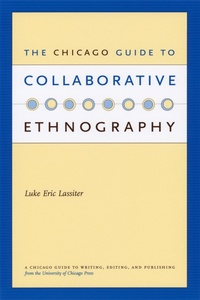
The Chicago Guide to Collaborative Ethnography
Published on 31. May 2024
197 pages
978-0-226-46701-6 (ISBN)
Description

Collaboration between ethnographers and subjects has long been a product of the close, intimate relationships that define ethnographic research. But increasingly, collaboration is no longer viewed as merely a consequence of fieldwork; instead collaboration now preconditions and shapes research design as well as its dissemination. As a result, ethnographic subjects are shifting from being informants to being consultants. The emergence of collaborative ethnography highlights this relationship between consultant and ethnographer, moving it to center stage as a calculated part not only of fieldwork but also of the writing process itself.
The Chicago Guide to Collaborative Ethnography presents a historical, theoretical, and practice-oriented road map for this shift from incidental collaboration to a more conscious and explicit collaborative strategy. Luke Eric Lassiter charts the history of collaborative ethnography from its earliest implementation to its contemporary emergence in fields such as feminism, humanistic anthropology, and critical ethnography. On this historical and theoretical base, Lassiter outlines concrete steps for achieving a more deliberate and overt collaborative practice throughout the processes of fieldwork and writing. As a participatory action situated in the ethical commitments between ethnographers and consultants and focused on the co-construction of texts, collaborative ethnography, argues Lassiter, is among the most powerful ways to press ethnographic fieldwork and writing into the service of an applied and public scholarship.
A comprehensive and highly accessible handbook for ethnographers of all stripes, The Chicago Guide to Collaborative Ethnography will become a fixture in the development of a critical practice of anthropology, invaluable to both undergraduates, graduate students, and faculty alike.
The Chicago Guide to Collaborative Ethnography presents a historical, theoretical, and practice-oriented road map for this shift from incidental collaboration to a more conscious and explicit collaborative strategy. Luke Eric Lassiter charts the history of collaborative ethnography from its earliest implementation to its contemporary emergence in fields such as feminism, humanistic anthropology, and critical ethnography. On this historical and theoretical base, Lassiter outlines concrete steps for achieving a more deliberate and overt collaborative practice throughout the processes of fieldwork and writing. As a participatory action situated in the ethical commitments between ethnographers and consultants and focused on the co-construction of texts, collaborative ethnography, argues Lassiter, is among the most powerful ways to press ethnographic fieldwork and writing into the service of an applied and public scholarship.
A comprehensive and highly accessible handbook for ethnographers of all stripes, The Chicago Guide to Collaborative Ethnography will become a fixture in the development of a critical practice of anthropology, invaluable to both undergraduates, graduate students, and faculty alike.
More details
Other editions
Additional editions
Luke Eric Lassiter
The Chicago Guide to Collaborative Ethnography
Book
09/2005
University of Chicago Press
€99.04
Shipment within 10-20 days
Person
Luke Eric Lassiter is professor and director of the graduate humanities program at Marshall University Graduate College. He is the author or coauthor of four previous books, including
Invitation to Anthropology.
Content
- Intro
- Contents
- Preface and Acknowledgments
- Part I. History and Theory
- 1. From "Reading over the Shoulders of Natives" to "Reading Alongside Natives," Literrally: Toward a Colloborative and Reciprocal Ethnography
- 2. Defining a Collaborative Ethnography
- 3. On the Roots of Ethnographic Collaboration
- 4. The New (Critical) Ethnography: On Feminist and Postmodern Approaches to Collaboration
- Part II. Practice
- 5. Ethics and Moral Responsibility
- 6. Ethnographic Honesty
- 7. Accessible Writing
- 8. Collaborative Reading, Writing, and Co-interpretation
- Notes
- References
- Index
