

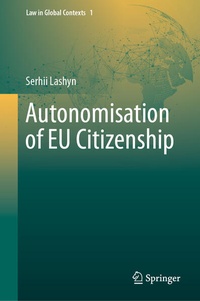
Autonomisation of EU Citizenship
Description

This book offers an analysis of Union citizenship, one of the key legal concepts of EU law. Introduced in the Maastricht Treaty, EU citizenship was initially seen as a beautiful but empty symbol. Yet, in the three decades of its existence, Union citizenship developed into one of the cornerstones of the modern-day constitutional structure of the EU. To understand the dynamics behind EU citizenship's ongoing development and appreciate its current role in Union law, this monograph analyses various facets of Union citizenship seen through the same theoretical lens of autonomisation. The book suggests that EU citizenship is currently undergoing autonomisation to a considerable extent. Being an open-ended concept, Union citizenship possesses significant intrinsic forces that drive its expansion and elaboration. Having already gone an impressive distance in its legal development, EU citizenship is likely to grow further, but its ultimate destiny will depend on the future of the European project.
More details
Other editions
Additional editions
Person
Serhii Lashyn, Postdoctoral Fellow, University of Hamburg
Content
Introduction.- 2. The Concept of EU Citizenship.- 3. History of EU Citizenship.- 4. Autonomisation of EU Citizenship.- 5. The Derivative Nature of EU Citizenship.- 6. Social Solidarity: Striking a Delicate Balance.- 7. EU Citizenship in Comparison.- 8. The Inevitable Widening of the Scope of EU Law.- 9. The Democratic Deficit in a Citizens' Union.- 10. Citizenship in a Global World.- 11. The Content of Union Citizenship.- 12. Protection by Diplomatic and Consular Authorities as the Nascent External Dimension of EU Citizenship.- 13. European Demoicracy, Identity, and Citizenship.- 14. Conclusions.
