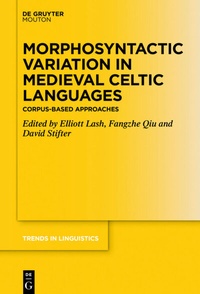
Morphosyntactic Variation in Medieval Celtic Languages
Description

This book showcases the state of the art in the corpus-based linguistics of medieval Celtic languages. Its chapters detail theoretical advances in analysing variation/change in the Celtic languages and computational tools necessary to process/analyse the data. Many contributions situate the Celtic material in the broader field of corpus-based diachronic linguistics. The application of computational methods to Celtic languages is in its infancy and this book is a first in medieval Celtic Studies, which has mainly concentrated on philological endeavours such as editorial and literary work. The Celtic languages represent a new frontier in the development of NLP tools because they pose special challenges, like complicated inflectional morphology with non-straightforward mappings between lemmata and attested forms, irregular orthography, and consonant mutations. With so much data available in non-electronic form and ongoing efforts to convert these data to computer-readable format, there is much room for the developing/testing of new tools. This books provides an overview of this process at a crucial time in the development of the field and aims to the data accessible to computational linguists with an interest in diachronic change.
More details
Other editions
Additional editions