

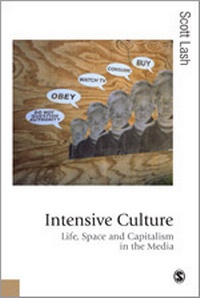
Intensive Culture
Social Theory, Religion & Contemporary Capitalism
1st Edition
Published on 14. June 2010
256 pages
978-0-85702-934-8 (ISBN)
Description

Contemporary culture, today's capitalism - our global information society - is ever expanding, is ever more extensive. And yet we seem to be experiencing a parallel phenomenon which can only be characterised as intensive. This thought provoking, innovative book is dedicated to the study of such intensive culture. Whilst extensive culture is a culture of the same: a culture of fixed equivalence; intensive culture is a culture of difference, of in-equivalence - the singular. Intensities generate what we encounter. They are virtuals or possibilities, always in process and always in movement.
We thus live in a culture that is both extensive and intensive. Indeed the more globally stretched and extensive social relations become the more they simultaneously seem to take on this intensity. Ours is a relational world where each intensity ? whether human, technological or biological ? provides a distinct, specific window onto the whole.
Lash tracks the emergence and pervasion of this intensive culture in society, religion, philosophy, language, communications, politics and the neo-liberal economy itself.
In so doing he redefines the work of Leibniz, Benjamin, Simmel, and Durkheim and inititates the reader into the ontological structures of our contemporary social relations. In the pursuit of intensive culture the reader is taken on an excursion from Karl Marx's Capital to the 'information theology' in the science fiction of Philip K. Dick.
Diverse, engaging and rich in detail the resulting book will be of interest to all those studying social and cultural theory, sociology, media and communication and cultural studies
We thus live in a culture that is both extensive and intensive. Indeed the more globally stretched and extensive social relations become the more they simultaneously seem to take on this intensity. Ours is a relational world where each intensity ? whether human, technological or biological ? provides a distinct, specific window onto the whole.
Lash tracks the emergence and pervasion of this intensive culture in society, religion, philosophy, language, communications, politics and the neo-liberal economy itself.
In so doing he redefines the work of Leibniz, Benjamin, Simmel, and Durkheim and inititates the reader into the ontological structures of our contemporary social relations. In the pursuit of intensive culture the reader is taken on an excursion from Karl Marx's Capital to the 'information theology' in the science fiction of Philip K. Dick.
Diverse, engaging and rich in detail the resulting book will be of interest to all those studying social and cultural theory, sociology, media and communication and cultural studies
Reviews / Votes
This book makes a vital contribution to our understanding of contemporary culture. It re-reads key thinkers such as Nietzsche, Leibniz, Simmel, Benjamin, Bergson in order to assert the primacy of the vital and the social against the closed mind of instrumental reason. It develops an innovative theoretical platform to account for the place of the informational, the intensive, and the religious for re-thinking the fundamental questions of life, and how to live today. It is a fitting summation of Scott Lash's challenging reorganization of critical and sociological theoryCouze Venn
Nottingham Trent University
This book is an engagement with the continuing dissolution of the symbolic in contemporary communication, in a critical reflection on thinkers ranging from Aristotle to Leibniz to Luhmann. It is a provocative archaeology of today's 'cultural capitalism' and of its metaphysical baggage. For Scott Lash the opposition between 'intensive' and the 'extensive', i.e. Leibniz's distinction between 'substance' and 'system', is eroded in the age of informational capitalism, as words become things and things become data. For Lash the future of capitalism is one in which this intensity takes over the logic - as 'intensive materialism' - of the economy itself. Yet this very process entails the dissolution of both intensity and with it of the singular. Lash pursues this compelling line of thought through encounters with Simmel, Benjamin, Durkheim and Philip K. Dick (!)
Bernard Stiegler
Director of the Department of Cultural Development at the Centre Georges-Pompidou
More details
Series
Language
English
Place of publication
London
United Kingdom
Target group
Professional and scholarly
Upper level undergraduate and postgraduate students, researchers and lecturers in social theory, cultural theory, sociology, and cultural studies.
ISBN-13
978-0-85702-934-8 (9780857029348)
Copyright in bibliographic data and cover images is held by Nielsen Book Services Limited or by the publishers or by their respective licensors: all rights reserved.
Schweitzer Classification
Other editions
Additional editions
Book
06/2010
1st Edition
SAGE Publications Inc
€111.50
Shipment within 10-20 days
Book
06/2010
1st Edition
SAGE Publications Inc
€280.78
Shipment within 10-20 days
Person
Professor Scott Lash is the Director of the Centre for Cultural Studies at Goldsmiths College, as well as a a project leader in the Goldsmiths Media Research Programme. He is a leading name within sociology and cultural studies, has written numerous books and articles over the last twenty years, and is currently the managing editor for the journal Theory, Culture and Society.
Content
Introduction
Culture: Extensive and Intensive
What is Intensive Culture?
Ontology and Religion
Overview
Social Theory
Intensive Sociology: Georg Simmel's Vitalism
Forms: From Cognitive a priori to Social a priori
Value: Nietzsche and Simmel
Social substance: from Labour to Life
Monadology: Simmel, Bergson, Metaphysics
Conclusions: Towards a Global Politics of Flux
Intensive Philosophy: Leibniz and the Ontology of Difference
Leibniz, Aristotle, Ontology
Sensation, Perception, Knowledge
Intensive Causation
Language: Intrinsic Predication
Substance and System: From Exchange of Equivalents to Exchange of Difference
Intensive Language: Benjamin, God and the Name
Leibniz and Benjamin: From the Monad to the Word
Intensive Method: From Epistemology to Truth
Language: Things, Man and God
Intensive Capitalism: Marxist Ontology
Introduction: From Commodity to Difference
Causation and value: Aristotle and Marx
Externalities: Intensive Capitalism and Neo-Liberalism
Financialization
The Intensive-material: Machines of Predication
Intensive Politics: Power after Hegemony
Language: Power becomes Ontological
Two Types of Power
From Norm to Fact
From Representation to Communication
Cultural Studies: First and Second Wave
Intensive Religion: Emile Durkheim's Elementary Forms
The Soul: From Rite and Totem to Myth and Ancestor
The Totem: Clan and Emblem
Alimentary Communion
Totemic Vitalism: Durkheim and Freud
Extensive Religion: Sociological Categories
The Social Fact: Metaphysical Things
Information Theology: Philip K. Dick's Will to Knowledge
Transmigration
(a) Faith versus knowledge
(b) Dick's St. Paul: Against Law and the Messianic
(c) Christ's mushroom: Salvation by Eating
(d) Vast Active Living Intelligence System
The Gnosticism of Philip K. Dick
Horselover Fat: Healing the Subject
Valis: The Movie
Conclusions
Intensity: Ontology and Religion
Intensity's Outside: Chinese Social Theory?
Culture: Extensive and Intensive
What is Intensive Culture?
Ontology and Religion
Overview
Social Theory
Intensive Sociology: Georg Simmel's Vitalism
Forms: From Cognitive a priori to Social a priori
Value: Nietzsche and Simmel
Social substance: from Labour to Life
Monadology: Simmel, Bergson, Metaphysics
Conclusions: Towards a Global Politics of Flux
Intensive Philosophy: Leibniz and the Ontology of Difference
Leibniz, Aristotle, Ontology
Sensation, Perception, Knowledge
Intensive Causation
Language: Intrinsic Predication
Substance and System: From Exchange of Equivalents to Exchange of Difference
Intensive Language: Benjamin, God and the Name
Leibniz and Benjamin: From the Monad to the Word
Intensive Method: From Epistemology to Truth
Language: Things, Man and God
Intensive Capitalism: Marxist Ontology
Introduction: From Commodity to Difference
Causation and value: Aristotle and Marx
Externalities: Intensive Capitalism and Neo-Liberalism
Financialization
The Intensive-material: Machines of Predication
Intensive Politics: Power after Hegemony
Language: Power becomes Ontological
Two Types of Power
From Norm to Fact
From Representation to Communication
Cultural Studies: First and Second Wave
Intensive Religion: Emile Durkheim's Elementary Forms
The Soul: From Rite and Totem to Myth and Ancestor
The Totem: Clan and Emblem
Alimentary Communion
Totemic Vitalism: Durkheim and Freud
Extensive Religion: Sociological Categories
The Social Fact: Metaphysical Things
Information Theology: Philip K. Dick's Will to Knowledge
Transmigration
(a) Faith versus knowledge
(b) Dick's St. Paul: Against Law and the Messianic
(c) Christ's mushroom: Salvation by Eating
(d) Vast Active Living Intelligence System
The Gnosticism of Philip K. Dick
Horselover Fat: Healing the Subject
Valis: The Movie
Conclusions
Intensity: Ontology and Religion
Intensity's Outside: Chinese Social Theory?
