

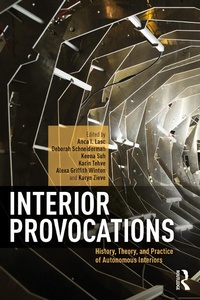
Interior Provocations
History, Theory, and Practice of Autonomous Interiors
1st Edition
Published on 17. December 2020
260 pages
978-1-000-20677-7 (ISBN)
Description

Interior Provocations: History, Theory, and Practice of Autonomous Interiors addresses the broad cultural, historical, and theoretical implications of interiors beyond their conventionally defined architectural boundaries. With provocative contributions from leading and emerging historians, theorists, and design practitioners, the book is rooted in new scholarship that expands traditional relationships between architecture and interiors and that reflects the latest theoretical developments in the fields of interior design history and practice.
This collection contains diverse case studies from the late eighteenth century to the twenty-first century including Alexander Pope's Memorial Garden, Design Indaba, and Robin Evans. It is an essential read for researchers, practitioners, and students of interior design at all levels.
This collection contains diverse case studies from the late eighteenth century to the twenty-first century including Alexander Pope's Memorial Garden, Design Indaba, and Robin Evans. It is an essential read for researchers, practitioners, and students of interior design at all levels.
Reviews / Votes
Interior Provocations repositions the interior as a convergence of phenomena flowing from technology, human and nonhuman behaviors, and corporality. Its contributors sustain the realm of the interior as a critical space of theory and practice while recognizing its elasticity - with the salubrious effect of freeing the interior from its architectural container.Susan Yelavich, Professor Emerita, Design Studies, Parsons School of Design, The New School; author, Thinking Design through Literature (Routledge, 2019)
Interior Provocations extends the academic analysis of interiors through eleven theoretically challenging case studies. The authors interrogate the relation of architecture and interiors in a variety of contexts including urbanism and outdoor rooms, landscapes and virtual reality. Collectively, they demonstrate the autonomy not only of interior design and interiors, but also of interior design discourse.
Grace Lees-Maffei, Professor of Design History, University of Hertfordshire, UK.
This volume provides an absorbing insight into the editors and authors expansive insights into unbounded interiorities. It compels the reader to interrogate their own assumptions regarding disciplinary distinctions, and instead requires them to recalibrate their position through their immersion in the exploration of the limitless ambiguities of what interiors can or might be.
Graeme Brooker, Professor of Interior Design at the Royal College of Art
Timely and ambitious, Interior Provocations challenges us to reconsider how interiors are generated, experienced, and enacted. No longer bound by architectural walls, the interiors examined in this impressive collection range from the technologically-mediated, virtual and immersive to the socially-imagined, ephemeral and subversive.
D.J. Huppatz, Associate Professor of Architecture and Design at Swinburne University of Technology, Australia
Mapping cultural sensibilities across media, material, technology and ritual, this collection argues persuasively for the interior as an autonomous entity worthy of sustained scholarly attention.
Charles Rice, University of Technology Sydney
This text presents a provocative examination of autonomy. The essays exploit this term to distinguish disciplinary, theoretical and practical distinctions between architecture and interior, across a broad range of contexts. Exploring interiors in this manner, offers a significant way to address the interior and its cultural effects.
Mark Taylor, Swinburne University of Technology, Australia
This fascinating book is an indispensable addition to recent scholarship on interior design history and theory. Exploring the roles of nature, technology and non-human agents in the creation of the interior, these thought-provoking essays move beyond the traditional focus on human inhabitation and invite readers to consider interiority as a post-human condition.
Joanna Merwood-Salisbury, Victoria University of Wellington
More details
Edition
1. Auflage
Language
English
Place of publication
London
United Kingdom
Publishing group
Taylor & Francis Ltd
Target group
College/higher education
Illustrations
6 Line drawings, black and white; 95 Halftones, black and white; 101 Illustrations, black and white
ISBN-13
978-1-000-20677-7 (9781000206777)
Copyright in bibliographic data and cover images is held by Nielsen Book Services Limited or by the publishers or by their respective licensors: all rights reserved.
Schweitzer Classification
Other editions
Additional editions
Anca I. Lasc | Deborah Schneiderman | Keena Suh
Interior Provocations
History, Theory, and Practice of Autonomous Interiors
Book
12/2020
1st Edition
Routledge
€47.03
Shipment within 15-20 days
Anca I. Lasc | Deborah Schneiderman | Keena Suh
Interior Provocations
History, Theory, and Practice of Autonomous Interiors
Book
12/2020
1st Edition
Routledge
€179.51
Shipment within 15-20 days
Interior Provocations
History, Theory, and Practice of Autonomous Interiors
Book
09/2020
Taylor & Francis
Unfortunately, price unknown
Available (delivery time upon request)
Persons
Anca I. Lasc is Associate Professor of Design History in the History of Art and Design Department at Pratt Institute. Her published work includes Interior Decorating in Nineteenth-Century France: The Visual Culture of a New Profession (2018), Architectures of Display: Department Stores and Modern Retail, co-edited with Patricia Lara-Betancourt and Margaret Maile Petty (Routledge, 2018), Visualizing the Nineteenth-Century Home: Modern Art and the Decorative Impulse (Routledge, 2016), and Designing the French Interior: The Modern Home and Mass Media, co-edited with Georgina Downey and Mark Taylor (2015).
Deborah Schneiderman is Professor of Interior Design at Pratt Institute and principal/founder of deSc: architecture/design/research. Her praxis explores the emerging fabricated interior environment and its materiality. Schneiderman's published research includes the books Inside Prefab: The Ready-Made Interior (2012), The Prefab Bathroom (2014), Textile, Technology and Design: From Interior Space to Outer Space (2016), and Interiors Beyond Architecture (2018).
Keena Suh is an Associate Professor in the Interior Design Department at Pratt Institute with over twenty years of active practice in architecture and interior design. Her interest is in developing pedagogical frameworks to foster cross-disciplinary collaborations and learning.
Karin Tehve is Associate Professor of Interior Design at Pratt Institute, where she coordinates the theory and undergraduate thesis curriculum. Her research and writing concentrates on taste, media, and identity and their intersection with the public realm. This includes teaching (and learning from) undergraduate studios examining the relationship between aesthetics and inclusivity in New York City's INT POPS, projects exploring social media and public realm, and an in-progress book about the history of taste. Her recent publications include "Interiors for and on Display" in Interiors Beyond Architecture (editors Deborah Schneiderman and Amy Campos, Routledge, 2018), as well as "POPS: Access, Appearance and Identity," published Spring 2020 in International Journal of Interior Architecture + Spatial Design 6, parallel territories.
Alexa Griffith Winton is a design historian and educator in New York City, where she is Manager of Content+Curriculum at Cooper Hewitt, Smithsonian Design Museum. Her research addresses issues of craft in the industrial and computer ages, the role of technology in modern domestic design, and the theorization of the domestic interior. Winton's work has been published in numerous scholarly and popular publications, including the Journal of Design History, Dwell, Journal of the Archives of American Art, and the Journal of Modern Craft. She edited Textile Technology and Design: From Interior Space to Outer Space with Deborah Schneiderman (2016).
Karyn Zieve is an Adjunct Assistant Professor in the History of Art and Design Department at Pratt Institute. Her work focuses on nineteenth-century French images of the Middle East and Northern Africa, particularly those by Eugene Delacroix, and questions of Orientalism, museum history, and historiography.
Deborah Schneiderman is Professor of Interior Design at Pratt Institute and principal/founder of deSc: architecture/design/research. Her praxis explores the emerging fabricated interior environment and its materiality. Schneiderman's published research includes the books Inside Prefab: The Ready-Made Interior (2012), The Prefab Bathroom (2014), Textile, Technology and Design: From Interior Space to Outer Space (2016), and Interiors Beyond Architecture (2018).
Keena Suh is an Associate Professor in the Interior Design Department at Pratt Institute with over twenty years of active practice in architecture and interior design. Her interest is in developing pedagogical frameworks to foster cross-disciplinary collaborations and learning.
Karin Tehve is Associate Professor of Interior Design at Pratt Institute, where she coordinates the theory and undergraduate thesis curriculum. Her research and writing concentrates on taste, media, and identity and their intersection with the public realm. This includes teaching (and learning from) undergraduate studios examining the relationship between aesthetics and inclusivity in New York City's INT POPS, projects exploring social media and public realm, and an in-progress book about the history of taste. Her recent publications include "Interiors for and on Display" in Interiors Beyond Architecture (editors Deborah Schneiderman and Amy Campos, Routledge, 2018), as well as "POPS: Access, Appearance and Identity," published Spring 2020 in International Journal of Interior Architecture + Spatial Design 6, parallel territories.
Alexa Griffith Winton is a design historian and educator in New York City, where she is Manager of Content+Curriculum at Cooper Hewitt, Smithsonian Design Museum. Her research addresses issues of craft in the industrial and computer ages, the role of technology in modern domestic design, and the theorization of the domestic interior. Winton's work has been published in numerous scholarly and popular publications, including the Journal of Design History, Dwell, Journal of the Archives of American Art, and the Journal of Modern Craft. She edited Textile Technology and Design: From Interior Space to Outer Space with Deborah Schneiderman (2016).
Karyn Zieve is an Adjunct Assistant Professor in the History of Art and Design Department at Pratt Institute. Her work focuses on nineteenth-century French images of the Middle East and Northern Africa, particularly those by Eugene Delacroix, and questions of Orientalism, museum history, and historiography.
Content
Introduction Karin Tehve Part 1: The Compressed Interior 1. The Uncanny Design of the Thorne Miniature Rooms K.L.H. Wells 2. Salon, an Autonomous Ludic Interior Alan Bruton Part 2: The Representational Interior 3. "A Better World Through Creativity": Interiors without Walls and Design Indaba, South Africa Harriet McKay 4. Furniture Thinking: Examining Robin Evans' "The Developed Surface" Through Practice Annie Coggan 5. The Post-Wall-Era Club Culture of Berlin as Cultural Heritage: "Where There Was Jag, There Is Art" Mark Nicholas Phillips and Yueksel Poeguen-Zander 6. The Immersive Interior: From Vuillard to VR Cindy Kang Part 3: The Un-Sited Interior 7. Outdoor Rooms: Domesticated Landscapes in the UAE Juan Roldan Martin 8. Immanent Interiors with(in) More-than-Human Worlds Virginia Black and Elsa Hoover 9. Turning Inward: Alexander Pope's Memorial Garden David C. C. Foley Part 4: The Technological Interior 10. The Telegraphic Interior: Networking Space for Capital Flows in the 1920s Paula Lupkin 11. Productions, Articulations, and the Elusive Clay Odom Interior Provocations: A Conclusion Penny Sparke Index
