

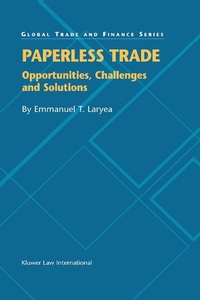
Paperless Trade
Opportunities, Challenges and Solutions
Published on 1. January 2003
226 pages
978-90-411-7902-9 (ISBN)
Description

A "digital divide" threatens the global trade regime. And it is not narrowing - it is rapidly becoming an unbridgeable chasm. Nor is this a problem merely for developing countries: the headlong trend toward dematerialisation of trade documents in the developed world will grind to a halt unless all trading countries without exception possess the legal and operational ability to participate in paperless trade.
This challenging work not only describes the obstacles to universal support for paperless trade, but also provides solutions that can be implemented if stakeholders make the collective effort to achieve this most desirable (and in fact necessary) goal. Dr. Laryea investigates such central issues as the following:
- legal problems and security risks not encountered in paper documentation;
- accommodating low-tech problems with electronic documentation; and
- funding the construction of information and communication technology infrastructure in developing countries.
The presentation focuses on each of the essential contract documents in turn, from the quotation to the documentary credit, explaining exactly how the electronic versions of each work (particularly in terms of security), and why each is desirable.
As the first comprehensive set of practical proposals, from a truly global perspective, for the speedy dematerialisation of trade documents, Paperless Trade is essential reading for traders, practitioners, academics, and national and international officials and policymakers engaged in facilitating world trade.
This challenging work not only describes the obstacles to universal support for paperless trade, but also provides solutions that can be implemented if stakeholders make the collective effort to achieve this most desirable (and in fact necessary) goal. Dr. Laryea investigates such central issues as the following:
- legal problems and security risks not encountered in paper documentation;
- accommodating low-tech problems with electronic documentation; and
- funding the construction of information and communication technology infrastructure in developing countries.
The presentation focuses on each of the essential contract documents in turn, from the quotation to the documentary credit, explaining exactly how the electronic versions of each work (particularly in terms of security), and why each is desirable.
As the first comprehensive set of practical proposals, from a truly global perspective, for the speedy dematerialisation of trade documents, Paperless Trade is essential reading for traders, practitioners, academics, and national and international officials and policymakers engaged in facilitating world trade.
More details
Other editions
Additional editions
Emmanuel Laryea
Paperless Trade:Oppertunities, Challenges and Solutions
Opportunities, Challenges and Solutions
Book
01/2003
1st Edition
Kluwer Law International
€107.00
Shipment within 10-20 days
Content
- Cover
- Half Title Page
- Editorial Board
- Title Page
- Copyright Page
- The Global Trade and Finance Series
- Table of Contents
- Foreword
- Acknowledgements
- 1. Opportunities and Challenges
- 1 THE OPPORTUNITIES
- 2 THE CHALLENGES
- 2.1 Legal Challenges
- 2.2 Operational Challenges
- 3 ORGANISATION OF CONTENTS
- 2. Legal Evidence Issues
- 1 INTRODUCTION
- 2 ADMISSIBILITY OF ELECTRONIC EVIDENCE
- 2.1 The Rule against Hearsay
- 2.2 Electronic Data and the Hearsay Rule
- 2.3 Legislative Exceptions to the Rule against Hearsay
- 2.3.1 Computer-specific Approach
- 2.3.2 Business Records Approach
- 2.3.3 Business Records Provisions other than those in the Evidence Act 1995 (Cth & NSW)
- 2.3.4 Business Records Provisions under the Evidence Act 1995 (Cth & NSW)
- 2.4 Electronic Data and the Rule Requiring Original Documents
- 2.5 Electronic Data and the Rule Excluding Opinion Evidence
- 2.6 Present State of the Law Relating to Admissibility of Electronic Data
- 3 RELIABILITY OF ELECTRONIC EVIDENCE
- 3.1 Non-Repudiation Services
- 3.2 Cryptography
- 3.3 Proof of Submission and Proof of Delivery
- 3.4 Passwords and Biometrics
- 4 PRIVATE INTERNATIONAL LAW ISSUES
- 5 CONCLUSION
- 3. Contract of Sale
- 1 INTRODUCTION
- 2 CREATION OF THE CONTRACT OF SALE
- 3 THE ROLE OF WRITING IN THE CREATION OF THE CONTRACT OF SALE
- 4 FUNCTIONS OF WRITING
- 4.1 Legal Requirement for Writing
- 4.2 Effects of Written Elements of the Contract
- 4.3 Electronic Replication of the Functions of the Contract Document
- 4.3.1 Formal Validity Requirements
- 4.3.2 Legal Evidence
- 4.3.3 Record Retention Requirements
- 4.3.4 Internal Business and Commercial Requirements
- 4.4 Desirability of Replicating the Functions of the Contract Document Electronically
- 5 TYPE OF WRITTEN DOCUMENT
- 5.1 The Quotation
- 5.1.1 Electronic Replication of Quotations
- 5.1.2 Desirability of Replicating the Functions of the Quotation Electronically
- 5.2 The Purchase Order
- 5.2.1 Electronic Replication of the Functions of the Purchase Order
- 5.2.2 Desirability of Replicating the Functions of the Purchase Order Electronically
- 5.3 The Sale or Commercial Invoice
- 5.3.1 Electronic Replication of the Functions of the Commercial Invoice
- 5.3.2 Desirability of Replicating the Functions of the Commercial Invoice Electronically
- 5.4 The Confirmation Slip
- 5.4.1 Electronic Replication of the Functions of the Confirmation Slip
- 5.4.2 Desirability of Replicating the Functions of the Confirmation Slip Electronically
- 5.5 The Countersigned Acceptance Form
- 5.5.1 Electronic Replication of the Functions of the Countersigned Acceptance Form
- 5.5.2 Desirability of Replicating the Functions of the Countersigned Acceptance Form Electronically
- 6 CONCLUSION
- 4. Carriage of Goods and Transport Documents
- 1 INTRODUCTION
- 2 CREATION OF THE CONTRACT OF CARRIAGE
- 3 DOCUMENTS GENERATED UNDER THE CARRIAGE CONTRACT
- 4 FUNCTIONS OF DOCUMENTS GENERATED UNDER SEA-CARRIAGE CONTRACT
- 4.1 The Law of Carriage of Goods by Sea
- 4.2 The Nature of the Documents
- 5 THE VARIOUS DOCUMENTS
- 5.1 Charterparty
- 5.1.1 Electronic Replication of the Functions of the Charterparty
- 5.1.2 Desirability of Replicating the Functions of the Charterparty Electronically
- 5.2 Booking Note
- 5.2.1 Electronic Replication of the Functions of the Booking Note
- 5.2.2 Desirability of Replicating the Functions of the Booking Note Electronically
- 5.3 Booking Confirmation Note
- 5.3.1 Electronic Replication of the Functions of the Booking Confirmation Note
- 5.3.2 Desirability of Replicating the Functions of the Booking Confirmation Note Electronically
- 5.4 Sea Waybill
- 5.4.1 Electronic Replication of the Functions of the Sea Waybill
- 5.4.2 Desirability of Replicating the Functions of the Sea Waybill Electronically
- 5.5 Bill of Lading
- 5.5.1 Bill of Lading as Acknowledgment of Receipt
- 5.5.2 Bill of Lading as Evidence of the Contract of Carriage
- 5.5.3 Bill of Lading as a Document of Title to Goods
- 5.5.4 Electronic Replication of the Negotiability Function of the Bill of Lading
- 5.5.5 Practical Problems to EBLs
- 5.5.5.1 Analysis of the SeaDocs System
- 5.5.5.2 Analysis of the CMI Rules
- 5.5.6 Current Systems
- 5.5.6.1 Bolero
- 5.5.6.2 @GlobalTrade
- 5.5.7 Bolero Compared with Previous EBLs Systems
- 5.5.7.1 Bolero v. SeaDocs
- 5.5.7.2 Bolero v. the CMI Rules
- 5.5.8 Future of EBLs
- 5.6 Delivery Order
- 5.6.1 Electronic Replication of the Functions of the Delivery Order
- 5.6.2 Desirability of Replicating the Functions of the Delivery Order Electronically
- 6 CONCLUSION
- 5. Insurance Documents
- 1 INTRODUCTION
- 2 FORMATION OF THE TRANSIT INSURANCE CONTRACT
- 3 THE SLIP
- 3.1 Functions of the Slip
- 3.2 Electronic Replication of the Functions of the Slip
- 3.3 Desirability of Replicating the Functions of the Slip Electronically
- 4 THE POLICY
- 4.1 Functions of the Policy
- 4.2 Electronic Replication of the Functions of the Insurance Policy
- 4.2.1 Valid of Electronic Insurance Policy
- 4.2.2 Assignment of a Policy
- 4.3 Desirability of Replicating the Functions of the Marine Insurance Policy Electronically
- 5 THE CERTIFICATE OF INSURANCE
- 5.1 Functions of the Certificate of Insurance
- 5.2 Electronic Replication of the Functions of the Certificate of Insurance
- 5.3 Desirability of Replicating the Functions of the Certificate of Insurance Electronically
- 6 THE BROKER'S COVER NOTE
- 6.1 Functions of the Broker's Cover Note
- 6.2 Electronic Replication of the Functions of the Broker's Cover Note
- 6.3 Desirability of Replicating the Functions of the Broker's Cover Note Electronically
- 7 THE LETTER OF INSURANCE
- 7.1 Functions of the Letter of Insurance
- 7.2 Electronic Replication of the Functions of the Letter of Insurance
- 7.3 Desirability of Replicating the Functions of the Letter of Insurance Electronically
- 8 LEGAL REFORM IN AUSTRALIA
- 9 CONCLUSION
- 6. Payment for Paperless Trade
- 1 INTRODUCTION
- 2 REASONS FOR THE DOCUMENTARY CREDIT'S POPULARITY
- 2.1 Cash in Advance or Prepayment
- 2.2 Payment on Account or Open Account
- 2.3 Documentary Collection
- 2.4 Documentary Letter of Credit
- 2.4.1 Advantages of Documentary Credits
- 2.4.1.1 Security
- 2.4.1.2 Liquidity
- 2.4.1.3 Proximity for Claims
- 2.4.2 Disadvantages of Documentary Credits
- 2.4.2.1 Delay
- 2.4.2.2 Cost
- 2.4.2.3 Fraud
- 2.5 International Factoring
- 2.6 Countertrade
- 2.6.1 Barter
- 2.6.2 Reciprocal Sales Agreements (or Counterpurchase)
- 2.6.3 Buy-back Agreement
- 2.6.4 Importance of Countertrade
- 2.6.5 Disadvantages of Countertrade
- 3 RELEVANCY OF DOCUMENTARY CREDITS IN PAPERLESS TRADE
- 3.1 Security for Payment and Paperless Documentation
- 3.2 Liquidity and Paperless Documentation
- 3.3 Proximity and the Paperless Era
- 4 ARE THERE ALTERNATIVE METHODS OF PROVIDING SECURITY, LIQUIDITY, AND PROXIMITY?
- 4.1 The Escrow Account
- 4.2 Bank Undertaking
- 4.2.1 Bank Guarantees
- 4.2.2 Performance Bonds
- 4.2.3 Standby Letters of Credit
- 4.2.4 Guarantees, Performance Bonds, and Standbys as Alternatives for the Documentary Credit
- 4.2.5 Documentary Credit Compared with Bank Undertaking Instruments
- 4.3 Emerging Electronic Payment Systems
- 4.3.1 Digital Cash
- 4.3.2 Electronic (Digital) Cheques
- 4.3.3 Smart Cards
- 4.3.4 International Electronic Credit Transfers
- 5 ELECTRONIC DOCUMENTARY CREDITS
- 5.1 Contract between the Buyer and the Issuing Bank
- 5.2 Arrangement between the Issuing Bank and the Correspondent Bank
- 5.3 Arrangement between the Correspondent Bank and Beneficiary
- 5.4 Arrangement between the Issuing Bank and Beneficiary
- 5.5 The Documentary Credit Mechanism and Electronic Systems
- 6 CONCLUSION
- 7. The Information and Communication Technologies Gap
- 1 INTRODUCTION
- 2 NATURE AND CAUSES OF THE ICT GAP
- 2.1 Government Departments and Paperless Documentation
- 2.1.1 Automated Systems for Customs Data
- 2.1.2 The ASYCUDA Programme and Implementation
- 2.1.3 Advanced Cargo Information System
- 2.2 Basic ICT Infrastructure
- 2.3 Commercial Parties and Paperless Documentation
- 2.4 Financial Institutions and Paperless Documentation
- 2.5 Prevalent Low-Tech Scenario in Developing Countries
- 3 IMPLICATIONS OF THE ICT GAP
- 4 CONCLUSION
- 8. Potential Solutions
- 1 INTRODUCTION
- 2 A DUAL SYSTEM
- 2.1 Necessary Features of a Dual System
- 2.1.1 PBLs and EBLs must be Obtainable on Shipment
- 2.1.2 EBLs must be Convertible to PBLs
- 2.1.2.1 Convertibility from EBL to PBL under the CMI Rules
- 2.1.2.2 Convertibility from EBL to PBL under Bolero
- 2.1.3 PBLs must be Convertible to EBLs
- 2.2 Practical Issues
- 2.2.1 Delays under the Dual System
- 2.2.2 Cost of Maintaining a Dual System
- 2.2.3 Possible Lack of Support by Hi-tech Entities
- 3 THIRD PARTY FACILITATORS
- 3.1 Function of a TPF in a Semi-LT Environment
- 3.1.1 Services to Importers in a Semi-LT Environment
- 3.1.2 Services to Exporters in a Semi-LT Environment
- 3.1.3 Services to Government Departments in a Semi-LT Environment
- 3.2 Function of a TPF in a Demi-LT Environment
- 3.2.1 Services to Exporters in a Demi-LT Environment
- 3.2.2 Services to Importers in a Demi-LT Environment
- 3.2.3 Services to Banks in a Demi-LT Environment
- 3.2.4 Relationship of Parties with TPFs in a Demi-LT Environment
- 3.3 Functions of A TPF in an Absolute-LT Environment
- 3.3.1 Services to Importers in an Absolute-LT Environment
- 3.3.2 Services to Exporters in an Absolute-LT Environment
- 3.3.3 Services to Government Departments in an Absolute-LT Environment
- 3.4 Legal Forms and Organisation of TPFs
- 3.4.1 Sole Proprietors as TPFs
- 3.4.2 Co-operatives as TPFs
- 3.4.3 Companies and Corporations as TPFs
- 3.4.3.1 Commercial Companies as TPFs
- 3.4.3.2 Not-For-Profit Corporations as TPFs
- 3.4.3.3 Banks as TPFs
- 3.5 Regulatory Regimes of TPFs
- 4 FACILITATING THE CONSTRUCTION OF THE ICT INFRASTRUCTURE
- 4.1 What is Needed
- 4.2 Sources and Forms of Funding
- 4.2.1 The World Bank as a Source of Funding Low-Tech Infrastructure Development
- 4.2.2 Other Multilateral Sources
- 4.2.3 Bilateral Sources
- 5 CONCLUSION
- Further Reading
- Index
- Back Cover
