

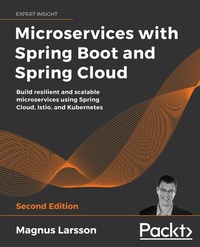
Microservices with Spring Boot and Spring Cloud
Build resilient and scalable microservices using Spring Cloud, Istio, and Kubernetes
2nd Edition
Published on 3. June 2024
774 pages
978-1-80107-915-0 (ISBN)
Description

THIS BOOK IS OUTDATED: A new and updated version of this book is available. You can find the link further down on this page.Key Features - Build cloud-native production-ready microservices with this comprehensively updated guide
- Understand the challenges of building large-scale microservice architectures
- Learn how to get the best out of Spring Cloud, Kubernetes, and Istio in combination
Book DescriptionWant to build and deploy microservices, but don't know where to start? Welcome to Microservices with Spring Boot and Spring Cloud. This edition features the most recent versions of Spring, Java, Kubernetes, and Istio, demonstrating faster and simpler handling of Spring Boot, local Kubernetes clusters, and Istio installation. The expanded scope includes native compilation of Spring-based microservices, support for Mac and Windows with WSL2, and an introduction to Helm 3 for packaging and deployment. A revamped security chapter now follows the OAuth 2.1 specification and makes use of the newly launched Spring Authorization Server from the Spring team. You'll start with a set of simple cooperating microservices, then add persistence and resilience, make your microservices reactive, and document their APIs using OpenAPI. Next, you'll learn how fundamental design patterns are applied to add important functionality, such as service discovery with Netflix Eureka and edge servers with Spring Cloud Gateway. You'll deploy your microservices using Kubernetes and adopt Istio, then explore centralized log management using the Elasticsearch, Fluentd, and Kibana (EFK) stack, and then monitor microservices using Prometheus and Grafana. By the end of this book, you'll be building scalable and robust microservices using Spring Boot and Spring Cloud.What you will learn - Build reactive microservices using Spring Boot
- Develop resilient and scalable microservices using Spring Cloud
- Use OAuth 2.1/OIDC and Spring Security to protect public APIs
- Implement Docker to bridge the gap between development, testing, and production
- Deploy and manage microservices with Kubernetes
- Apply Istio for improved security, observability, and traffic management
- Write and run automated microservice tests with JUnit, testcontainers, Gradle, and bash
Who this book is forIf you're a Java or Spring Boot developer learning how to build microservice landscapes from scratch, then this book is for you. You don't need any prior knowledge about microservices architecture to get started, but a solid grasp and enough experience in Java and Spring Boot to build apps autonomously is a must.
- Understand the challenges of building large-scale microservice architectures
- Learn how to get the best out of Spring Cloud, Kubernetes, and Istio in combination
Book DescriptionWant to build and deploy microservices, but don't know where to start? Welcome to Microservices with Spring Boot and Spring Cloud. This edition features the most recent versions of Spring, Java, Kubernetes, and Istio, demonstrating faster and simpler handling of Spring Boot, local Kubernetes clusters, and Istio installation. The expanded scope includes native compilation of Spring-based microservices, support for Mac and Windows with WSL2, and an introduction to Helm 3 for packaging and deployment. A revamped security chapter now follows the OAuth 2.1 specification and makes use of the newly launched Spring Authorization Server from the Spring team. You'll start with a set of simple cooperating microservices, then add persistence and resilience, make your microservices reactive, and document their APIs using OpenAPI. Next, you'll learn how fundamental design patterns are applied to add important functionality, such as service discovery with Netflix Eureka and edge servers with Spring Cloud Gateway. You'll deploy your microservices using Kubernetes and adopt Istio, then explore centralized log management using the Elasticsearch, Fluentd, and Kibana (EFK) stack, and then monitor microservices using Prometheus and Grafana. By the end of this book, you'll be building scalable and robust microservices using Spring Boot and Spring Cloud.What you will learn - Build reactive microservices using Spring Boot
- Develop resilient and scalable microservices using Spring Cloud
- Use OAuth 2.1/OIDC and Spring Security to protect public APIs
- Implement Docker to bridge the gap between development, testing, and production
- Deploy and manage microservices with Kubernetes
- Apply Istio for improved security, observability, and traffic management
- Write and run automated microservice tests with JUnit, testcontainers, Gradle, and bash
Who this book is forIf you're a Java or Spring Boot developer learning how to build microservice landscapes from scratch, then this book is for you. You don't need any prior knowledge about microservices architecture to get started, but a solid grasp and enough experience in Java and Spring Boot to build apps autonomously is a must.
All prices
More details
Other editions
Additional editions
Magnus Larsson
Microservices with Spring Boot and Spring Cloud
Build resilient and scalable microservices using Spring Cloud, Istio, and Kubernetes, 2nd Edition
Book
07/2021
2nd Edition
Packt Publishing
€59.80
Shipment within 3-4 weeks
Person
Larsson Magnus :
Magnus Larsson has been in the IT industry for 35 years, working as a consultant for large companies in Sweden such as Volvo, Ericsson, and AstraZeneca. In the past, he struggled with the challenges associated with distributed systems. Today, these challenges can be handled with open-source tools such as Spring Cloud, Kubernetes, and Istio. Over the last years, Magnus has been helping customers use these tools and has also done several presentations and blog posts on the subject.
Magnus Larsson has been in the IT industry for 35 years, working as a consultant for large companies in Sweden such as Volvo, Ericsson, and AstraZeneca. In the past, he struggled with the challenges associated with distributed systems. Today, these challenges can be handled with open-source tools such as Spring Cloud, Kubernetes, and Istio. Over the last years, Magnus has been helping customers use these tools and has also done several presentations and blog posts on the subject.
Content
Table of Contents - Introduction to Microservices
- Introduction to Spring Boot
- Creating a Set of Cooperating Microservices
- Deploying our Microservices using Docker
- Adding an API Description using OpenAPI
- Adding Persistence
- Developing Reactive Microservices
- Introduction to Spring Cloud
- Adding Service Discovery Using Netflix Eureka
- Using Spring Cloud Gateway to Hide Microservices Behind an Edge Server
- Securing Access to APIs
- Centralized Configuration
- Improving Resilience Using Resilience4j
- Understanding Distributed Tracing
- Introduction to Kubernetes
- Deploying Our Microservices to Kubernetes
- Implementing Kubernetes Features to Simplify the System Landscape
- Using a Service Mesh to Improve Observability and Management
- Centralized Logging with the EFK Stack
- Monitoring Microservices
- Installation instructions for macOS
- Installation Instructions for Microsoft Windows with WSL 2 and Ubuntu
- Native Compiled Java Microservices
- Introduction to Spring Boot
- Creating a Set of Cooperating Microservices
- Deploying our Microservices using Docker
- Adding an API Description using OpenAPI
- Adding Persistence
- Developing Reactive Microservices
- Introduction to Spring Cloud
- Adding Service Discovery Using Netflix Eureka
- Using Spring Cloud Gateway to Hide Microservices Behind an Edge Server
- Securing Access to APIs
- Centralized Configuration
- Improving Resilience Using Resilience4j
- Understanding Distributed Tracing
- Introduction to Kubernetes
- Deploying Our Microservices to Kubernetes
- Implementing Kubernetes Features to Simplify the System Landscape
- Using a Service Mesh to Improve Observability and Management
- Centralized Logging with the EFK Stack
- Monitoring Microservices
- Installation instructions for macOS
- Installation Instructions for Microsoft Windows with WSL 2 and Ubuntu
- Native Compiled Java Microservices
