

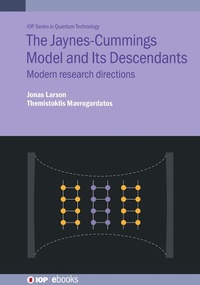
The Jaynes-Cummings Model and Its Descendants
Description

The Jaynes-Cummings Model (JCM) has recently received increased attention as one of the simplest, yet intricately nonlinear, models of quantum physics.
Using the physics of the JCM as a common denominator, this book links together various fields of modern physics, including cavity and circuit quantum electrodynamics, light-mediated Bose-Einstein condensation and related phenomena, optomechanics, quantum phase transitions out of equilibrium, quantum computation and manipulation, relating them to the underlying theoretical principles and experimental evidence gathered over the recent decades.
Emphasising the omnipresence of the JCM across a range of disciplines, this comprehensive review conveys to the reader the fundamental generality of its formalism, looking at a wide range of applications in specific physical systems and across disciplines including atomic physics, quantum optics, solid-state physics and quantum information sciences. Having presented a complete summary of the field, the book expands the existing literature by introducing the most recent interpretations and applications of the theory.
An ideal reference for researchers in quantum physics and quantum optics, the book also comprises an accessible introduction for students engaged with non-equilibrium quantum phase transitions, quantum computing and simulation, and quantum many-body physics.
More details
Other editions
Additional editions
Persons
Jonas Larson is an Associated Professor in the Section of Quantum Optics and Matter at Stockholm University. Today he pursues research in various topics of quantum optics, such as cavity/circuit QED, cold atomic gases, open quantum systems, and quantum critical models. He is a co-author of the book 'Conical Intersections in Physics: An Introduction to Synthetic Gauge Theories.'
Themistoklis Mavrogordatos received the BS and MS degrees in electrical engineering and computer science from the National Technical University of Athens, Greece, in 2009, and the PhD degree in emission properties of dye-doped liquid crystal resonators from the University of Cambridge, UK, in 2014. He is presently a PDRA with Jonas Larson at Stockholm University.
Content
Foreword
Introduction
1 Theoretical aspects
2 Cavity QED
3 Circuit QED
4 Trapped ions
5 Waveguide QED
6 Alternative physical systems
7 Extensions to many-body configurations and additional degrees of freedom 8 Conclusions - a projection for the coming decades
