

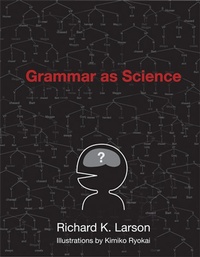
Grammar as Science
Description

This introductory text takes a novel approach to the study of syntax. Grammar as Science offers an introduction to syntax as an exercise in scientific theory construction. Syntax provides an excellent instrument for introducing students from a wide variety of backgrounds to the principles of scientific theorizing and scientific thought; it engages general intellectual themes present in all scientific theorizing as well as those arising specifically within the modern cognitive sciences. The book is intended for students majoring in linguistics as well as non-linguistics majors who are taking the course to fulfill undergraduate requirements. Grammar as Science covers such core topics in syntax as phrase structure, constituency, the lexicon, inaudible elements, movement rules, and transformational constraints, while emphasizing scientific reasoning skills. The individual units are organized thematically into sections that highlight important components of this enterprise, including choosing between theories, constructing explicit arguments for hypotheses, and the conflicting demands that push us toward expanding our technical toolkit on the one hand and constraining it on the other.
Grammar as Science is constructed as a "laboratory science” course in which students actively experiment with linguistic data. Syntactica, a software application tool that allows students to create and explore simple grammars in a graphical, interactive way, is available online in conjunction with the book. Students are encouraged to "try the rules out,” and build grammars rule-by-rule, checking the consequences at each stage.
More details
Other editions
Additional editions
Persons
Content
- Intro
- Title Page
- Copyright
- Dedication
- Contents
- Preface for Teachers
- Acknowledgments
- PART I: Setting Out
- Language as a Natural Object
- The Terrain Ahead
- UNIT 1: What Is Linguistics?
- Leading Questions
- Studying Knowledge of Language
- A Talking Analogy
- Universal Grammar
- UNIT 2: What Is Syntax About?
- Review
- Dividing Up the Problem Area
- Internal Structure
- Exercises
- PART II: Grammars as Theories
- UNIT 3: Introducing Phrase Structure Rules
- Review
- Generating Sentences
- Phrase Structure Rules
- Tree Diagrams and Derivations
- UNIT 4: Grammars
- Review
- Grammars as Theories
- The Data of Syntax
- Formulating a Grammar
- UNIT 5: Working with Grammars
- Review
- Testing a Grammar
- Revising a Grammar
- Extending a Grammar
- Exercises
- PART III: Choosing between Theories
- UNIT 6: Comparing Rules and Theories
- Review
- Comparing Alternative Rules
- Equivalent Theories
- Comparing Equivalent Theories
- UNIT 7: Constituency and Constituency Tests
- Review
- More on Conjunction
- Other Constituency Tests
- UNIT 8: Trees and Tree Relations
- Review
- More about Trees
- Some Distributional Facts
- C-Command Phenomena as Constituency Tests
- UNIT 9: Determining Category
- Review
- Determining Category
- The Category of Words
- The Category of Phrases
- UNIT 10: Revising, Refining, and Reconsidering
- Review
- Interpreting Test Results
- More on Revising Grammars
- Exercises
- PART IV: Arguing for a Theory
- UNIT 11: Constructing Arguments I
- Review
- Giving an Argument
- Four Steps of an Argument and Their Relations
- Convergent Evidence
- Nonconvergent Evidence
- Coming Up With the Parts of an Argument
- UNIT 12: Constructing Arguments II
- Review
- Choosing between Alternative Structures
- Missing Principle
- Missing Data Summary and Principle
- Missing Data Summary, Principle, and Conclusion I
- Missing Data Summary, Principle, and Conclusion II
- Exercises
- PART V: Searching for Explanation
- Structural Formulas
- Explaining Phrase Markers?
- UNIT 13: Introducing the Lexicon
- Review
- Categories and Subcategories
- The Lexicon
- UNIT 14: Features, Heads, and Phrases
- Review
- Expanding Our Feature Set
- Where Does a Phrase Get Its Features?
- Heads and Phrases
- UNIT 15: Verbal Complements and Adjuncts
- Review
- Complements
- Adjuncts
- UNIT 16: Distinguishing Complements and Adjuncts
- Review
- Complement or Adjunct?
- Three Diagnostics
- UNIT 17: Attaching Complements
- Review
- Complements and Constituency
- A Locality Constraint
- UNIT 18: Attaching Adjuncts
- Review
- An Apparent Contradiction
- Adjunction of Modifiers
- Exercises
- PART VI: Following the Consequences
- UNIT 19: Complement Sentences I
- Review
- Sentence Forms
- Sentences inside Sentences
- Selection for Sentence Type
- UNIT 20: Complement Sentences II
- Review
- Finite versus Nonfinite Clauses
- Selection for Finiteness
- UNIT 21: Invisible Lexical Items
- Review
- Subjectless Infinitives and PRO
- "Invisible Elements": Expect versus Persuade
- Summing Up
- UNIT 22: NP Structure
- Review
- Sentencelike NPs
- Complements of N
- Adjuncts in NP
- PRO in NP
- UNIT 23: X-Bar Theory
- Review
- More on NP - TP
- The Structure of PP
- Abstracting a Common Shape
- Powerful Implications!
- Simple Rules versus Complex Structures
- Exercises
- PART VII: Expanding and Constraining the Theory
- UNIT 24: Interrogatives and Movement
- Review
- The Problem of Constituent Interrogatives
- Wh-Movement
- Further Evidence for Movement
- UNIT 25: More on Wh-Movement
- Review
- Movement in General 383 Movement in CP
- Matrix Interrogatives
- UNIT 26: Constraints on Movement I
- Review
- "Long-Distance" Movement
- Stepwise Movement
- The Principle of the Strict Cycle
- UNIT 27: Constraints on Movement II
- Review
- NP Domains
- Movement and Complete Sentences
- Movement and Nominals
- The Phase Principle
- UNIT 28: Parametric Variation
- Review
- Crosslinguistic Variation in Movement
- "Parameterizing" Principles
- Exercises
- References
- Index
