

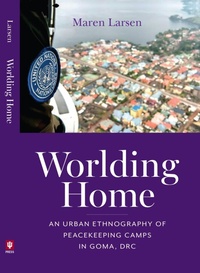
Worlding Home
Description

Worlding Home interrogates the social, spatial, and architectural lifeworlds of United Nations (UN) peacekeepers accommodated in contingent camps throughout Goma, the capital of North Kivu in the Democratic Republic of the Congo. From 2017 to 2019, more than twenty of these camps existed in and around the city, operating as sites of global outreach even as they generated new ways of being at home for peacekeepers and the peace-kept population.
Through multisited ethnography and deep engagement with anthropological and urban theory, author Maren Larsen explores the entanglements of camp and city. Pushing against readings of Goma's peacekeeping camps as either more privileged enclaves or as outliers in camp studies when compared to refugee camps, author Maren Larsen argues for an understanding of "camp" as a process and practice. Between dwelling and journeying, "here" and "there," the everyday lives and embodied practices of Goma's peacekeepers and Congolese civilians co-construct a "city as elsewhere" in which camping is a vital urban practice.
By offering a more expansive understanding of how UN peacekeeping camps fit within Goma's urban fabric, Worlding Home reveals the intertwined socio-spatial processes of making a home, building a city, and re-imagining the world.
More details
Other editions
Additional editions
Person
Maren Larsen is Senior Lecturer in Urban Studies at the University of Basel.
Content
Dedication
Acknowledgments
Acronyms
Introduction: The City as Elsewhere
1. Urbanization and Encampment: A Century in the City
2. Through the Gates
3. The (Extra-)Ordinary Spaces of Peacekeeping
4. At Home in the Camp
5. Being Global in Goma
Conclusion: Camping the City
Notes
Bibliography
Index
