

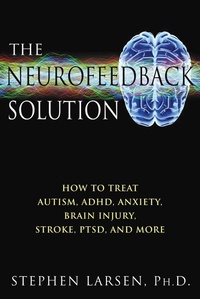
The Neurofeedback Solution
How to Treat Autism, ADHD, Anxiety, Brain Injury, Stroke, PTSD, and More
Published on 26. March 2012
424 pages
978-1-59477-810-0 (ISBN)
Description

A guide to neurofeedback for better physical and mental health as well as greater emotional balance, cognitive agility, and creativity
• Provides easy-to-understand explanations of different neurofeedback methods--from the LENS technique to Z-score training
• Explains the benefits of this therapy for anxiety, depression, autism, ADHD, post-traumatic stress disorder, obsessive-compulsive disorder, brain injuries, stroke, Alzheimer's, and many other ailments
• Explores how to combine neurofeedback with breathwork, mindfulness, meditation, and attention-control exercises such as Open Focus
What is neurofeedback? How does it work? And how can it help me or my family?
In this guide to neurofeedback, psychologist and neurofeedback clinician Stephen Larsen examines the countless benefits of neurofeedback for diagnosing and treating many of the most debilitating and now pervasive psychological and neurological ailments, including autism, ADHD, anxiety, depression, stroke, brain injury, obsessive-compulsive disorder, and post-traumatic stress disorder.
Surveying the work of neurofeedback pioneers, Larsen explains the techniques and advantages of different neurofeedback methods--from the LENS technique and HEG to Z-score training and Slow Cortical Potentials. He reveals evidence of neuroplasticity--the brain's ability to grow new neurons?and shows how neurofeedback can nourish the aging brain and help treat degenerative conditions such as Alzheimer's and strokes. Examining the different types of brain waves, he shows how to recognize our own dominant brainwave range and thus learn to exercise control over our mental states. He explains how to combine neurofeedback with breathwork, mindfulness, meditation, and attention-control exercises such as Open Focus. Sharing successful and almost miraculous case studies of neurofeedback patients from a broad range of backgrounds, including veterans and neglected children, this book shows how we can nurture our intimate relationship with the brain, improving emotional, cognitive, and creative flexibility as well as mental health.
• Provides easy-to-understand explanations of different neurofeedback methods--from the LENS technique to Z-score training
• Explains the benefits of this therapy for anxiety, depression, autism, ADHD, post-traumatic stress disorder, obsessive-compulsive disorder, brain injuries, stroke, Alzheimer's, and many other ailments
• Explores how to combine neurofeedback with breathwork, mindfulness, meditation, and attention-control exercises such as Open Focus
What is neurofeedback? How does it work? And how can it help me or my family?
In this guide to neurofeedback, psychologist and neurofeedback clinician Stephen Larsen examines the countless benefits of neurofeedback for diagnosing and treating many of the most debilitating and now pervasive psychological and neurological ailments, including autism, ADHD, anxiety, depression, stroke, brain injury, obsessive-compulsive disorder, and post-traumatic stress disorder.
Surveying the work of neurofeedback pioneers, Larsen explains the techniques and advantages of different neurofeedback methods--from the LENS technique and HEG to Z-score training and Slow Cortical Potentials. He reveals evidence of neuroplasticity--the brain's ability to grow new neurons?and shows how neurofeedback can nourish the aging brain and help treat degenerative conditions such as Alzheimer's and strokes. Examining the different types of brain waves, he shows how to recognize our own dominant brainwave range and thus learn to exercise control over our mental states. He explains how to combine neurofeedback with breathwork, mindfulness, meditation, and attention-control exercises such as Open Focus. Sharing successful and almost miraculous case studies of neurofeedback patients from a broad range of backgrounds, including veterans and neglected children, this book shows how we can nurture our intimate relationship with the brain, improving emotional, cognitive, and creative flexibility as well as mental health.
More details
Other editions
Additional editions
Stephen Larsen
Neurofeedback Solution
How to Effectively Treat Autism, ADHD, Anxiety, Brain Injury, Stroke, Ptsd, and More
Book
04/2012
Bindu Books
€28.50
Shipment within 10-20 days
Person
Stephen Larsen, Ph.D., LMHC, BCIA-eeg, is professor emeritus of psychology at SUNY Ulster, board-certified in EEG biofeedback, and the author of several books, including The Healing Power of Neurofeedback and The Fundamentalist Mind. He is the founder and director of Stone Mountain Center, offering biofeedback, neurofeedback, and psychotherapy treatments. He lives in New Paltz, New York.
Content
Foreword
By Nancy White, Ph.D., and Leonard Richards, Th.D.
Introduction
Why Another Book on Neurofeedback?
One What Is Neurofeedback?
Two The Changing Brain
Neuroplasticity and the Paradigm Shift
Three The Evolution of Neurofeedback
Brain Mapping and Scope of Treatment
With Joel Lubar, Ph.D., BCIA-EEG
Four The Compassionate Healer
Or, How Does a Person Become a Neurofeedback Provider?
With Nicholas Dogris, Ph.D., Mike Beasley, L.M.T., and Richard M. Smith, Ph.D.
Five The Adopted Child
Attachment Disorder and the Compromised Brain
With Sebern Fisher, M.A., M.S.W., L.M.H., BCIA
Six Autism and Asperger's Syndrome
With Mary Lee Esty, Ph.D., L.C.S.W., and Donald Magder, M.A.
Seven Attention Deficit Disorder and Its Cousins
With J. Lawrence Thomas, Ph.D.
Eight The Wonderful World of Anxiety
With Paul Botticelli, L.C.S.W.
Nine Neurofeedback Treatment of Obsessive-Compulsive Disorder
D. Corydon Hammond, Ph.D., ECNS, QEEG, BCIA-EEG
Ten Traumatic Brain Injury
With Harris McCarter, Ph.D., Michele Luster, Mary Lee Esty, Ph.D., L.C.S.W., and D. Corydon Hammond, Ph.D., ECNS, QEEG, BCIA-EEG
Eleven Head Games
Sports Injuries and Brain Trauma
With Elsa Baehr, Ph.D., and Lynn Brayton, Psy.D.
Twelve Stroke Family
With Barbara Dean Schacker, M.A., Victor Zelek, Ph.D., and Mary Lee Esty, Ph.D., L.C.S.W.
Thirteen New Directions in Neurofeedback
With Hershel Toomim, Ph.D., Jeffrey Carmen, Ph.D., Henry Mann, M.D., Nicholas Dogris, Ph.D., BCIA-EEG, Victor McGregor, Ph.D., A.N.P., N.P.P., Mark Smith, L.C.S.W., QEEG, Siegfried Othmer, Ph.D., Martin Wuttke, C.N.P., Michael Gismondi, M.A., L.M.H.C., and Thomas Collura, Ph.D.
Fourteen Consciousness
A Neurofeedback Perspective
With Jay Gunkelman, QEEG, and Juan Acosta-Urquidi, Ph.D., QEEG-T
Epilogue
Changing the World, Neuron by Neuron
Resources
Glossary of Neurofeedback Terms and Acronyms
Bibliography
About the Contributors
Index
