

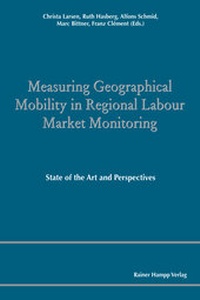
Measuring Geographical Mobility in Regional Labour Market Monitoring
State of the Art and Perspectives
1st Edition
Published on 30. September 2011
308 pages
978-3-86618-757-3 (ISBN)
Description

Geographical mobility in Europe is a chance and a challenge for regional labour markets. There is an unknown potential for the economy as foreign labour markets may provide qualified workers and the freedom of movement brings more flexibility. On the other hand, national and regional politics face the challenge of developing systematic approaches for enhancing mobility and managing its consequences. Transparency of migration flows, a sound database and substantiated knowledge about geographical mobility is the prerequisite for all actors. Therefore this anthology provides a synopsis of the current state of the art from different countries and regions, including best practice examples and solution approaches.
More details
Other editions
Additional editions
Christa Larsen | Ruth Hasberg | Alfons Schmid
Measuring Geographical Mobility in Regional Labour Market Monitoring
State of the Art and Perspectives
Book
09/2011
1st Edition
Edition Rainer Hampp
€34.80
Shipment within 5-7 days
Persons
Dr. Christa Larsen is a social scientist and Managing Director of the Institute for Economics, Labour and Culture (IWAK) at the Goethe-University in Frankfurt am Main. Her current work concentrates on regional labour market monitoring, regionalised analyses of labour markets for health workers, systems for information and diagnoses of labour markets and regional prognoses.
Ruth Hasberg is sociologist and scientist at the Institute for Economics, Labour and Culture (IWAK). Her current work is located in the fields of social structure analysis, social inequality and regional labour market monitoring on international and national level.
Prof. Dr. Alfons Schmid is Professor for Economics at the faculty of Social Sciences at the Goethe-University in Frankfurt am Main and scientific Director of the Institute for Economics, Labour and Culture (IWAK). His main areas of research are regional developments of employment and labour markets, regional competitiveness, regional forecasting, regional studies on poverty, wealth and attitudes towards the welfare state.
Marc Bittner is senior researcher at the Paul Lazarsfeld Society for Social Research (PLG) and at the Society for Studies of Social Science (SWS) in Vienna. His research focuses on statistical analysis, as well as quantitative and qualitative social research on various topics like labour market, migration, enlargement of the EU, South-East-Europe and elderly care.
Franz Clément, PhD, is social scientist working in the field of labour market policy, cross-border workers and social dialogue at the CEPS/INSTEAD research institute in Luxembourg. He is head of the REPREM unit (Relations Professionnelles et Emploi). In previous years he was responsible for the monitoring of several projects concerning the Greater Region's labour market, especially the EURES programme (European Employment Services).
Ruth Hasberg is sociologist and scientist at the Institute for Economics, Labour and Culture (IWAK). Her current work is located in the fields of social structure analysis, social inequality and regional labour market monitoring on international and national level.
Prof. Dr. Alfons Schmid is Professor for Economics at the faculty of Social Sciences at the Goethe-University in Frankfurt am Main and scientific Director of the Institute for Economics, Labour and Culture (IWAK). His main areas of research are regional developments of employment and labour markets, regional competitiveness, regional forecasting, regional studies on poverty, wealth and attitudes towards the welfare state.
Marc Bittner is senior researcher at the Paul Lazarsfeld Society for Social Research (PLG) and at the Society for Studies of Social Science (SWS) in Vienna. His research focuses on statistical analysis, as well as quantitative and qualitative social research on various topics like labour market, migration, enlargement of the EU, South-East-Europe and elderly care.
Franz Clément, PhD, is social scientist working in the field of labour market policy, cross-border workers and social dialogue at the CEPS/INSTEAD research institute in Luxembourg. He is head of the REPREM unit (Relations Professionnelles et Emploi). In previous years he was responsible for the monitoring of several projects concerning the Greater Region's labour market, especially the EURES programme (European Employment Services).
Content
1 - Contents [Seite 7]
2 - I Foreword [Seite 10]
3 - II Introduction Introduction Introduction [Seite 12]
4 - III State of the Art in Measuring Cross Border Mobility - Concepts, Measures, Data and Applications [Seite 20]
5 - IV State of the Art in Measuring Intra- and Interregional Mobility (within a Nation State) State) Concepts, Measures, Data and Applicatons Intra- regional and Inter- regional Geographical Mobility [Seite 157]
6 - V Conceptual and Practical Issues Issues Issues Issues Issues Issues Locality Locality Overview and Conceptual Framework [Seite 240]
7 - Bibliographical References [Seite 285]
8 - Conclusion [Seite 292]
9 - About the Authors [Seite 293]
10 - Abstract [Seite 309]
2 - I Foreword [Seite 10]
3 - II Introduction Introduction Introduction [Seite 12]
4 - III State of the Art in Measuring Cross Border Mobility - Concepts, Measures, Data and Applications [Seite 20]
5 - IV State of the Art in Measuring Intra- and Interregional Mobility (within a Nation State) State) Concepts, Measures, Data and Applicatons Intra- regional and Inter- regional Geographical Mobility [Seite 157]
6 - V Conceptual and Practical Issues Issues Issues Issues Issues Issues Locality Locality Overview and Conceptual Framework [Seite 240]
7 - Bibliographical References [Seite 285]
8 - Conclusion [Seite 292]
9 - About the Authors [Seite 293]
10 - Abstract [Seite 309]
V Conceptual and Practical Issues (S. 235-236)
Measuring „Job-Related? Multi-Locality – Overview and Conceptual Framework
Knut Petzold
Against the background of an increasing flexibility and the opening of the European labour market, a general intraregional and cross-border geographical mobilisation is often claimed (Urry 2000). Especially transnational migration is a continuous topic in the debates about globalisation (e.g. Massey et al. 2008). Therefore, a strong inverted methodological nationalism seems to be established, which gives most attention to the mobility between national states.
However, recent studies show that both cross-border mobility and migration as permanent change of the place of residence are empirically marginal phenomena. In Germany, for instance, the amount of intrastate migration has decreased by 40% between 1970 and 2000, whereas during the same time the amount of every day commuting has increased by 30% in Switzerland (Abraham & Nisic 2007, 69). Although meanwhile mobility is a very important part of labour and mobile persons travel more often and over long distances to do their job (Swarbrooke & Horner 2001), the fraction of highly extensive and, above all, international mobility is limited to a small group of persons occupied in special business sectors (Doyle & Nathan 2001).
The results of a very large study on contemporary job-related mobility in six European countries show that only the half of the population has experiences with at least one mobility form at all and the European society can be notedly characterised as settled. Beyond transnationality and permanent migration more complex forms of mobility have emerged. In particular, commuting over long distances is observed as the most important and common kind of mobility. This commuting is mostly combined with overnight stays outside of the =own‘ household (Schneider & Meil 2008). In fact, empirical results confirm Zelinsky‘s ?hypothesis of mobility transition? suggested 40 years ago.
It says that circular mobilities will prevail against permanent mobilities (Zelinsky 1971, 245). Several studies deal with the topic of the complexity and circularity or seasonality of mobility forms (e.g. McHugh 2000). It is often feasibly argued that circular mobility tends to be treated as a substitute for permanent forms (e.g. Green et al. 1999; McHugh 1990). For instance, a commuter partnership is more and more accepted as an alternative to the migration of the complete family. Hence, these dual-career households are extending (Van der Klis & Mulder 2008). Circular mobility does not only occur for job-related but also for leisure-time reasons, as an analysis of second homes makes clear (Gallent & Tewdwr-Jones 2000).
But obviously, labour market requirements are the main issue for such mobilisations as a strategy against unemployment. The willingness to commute is widely spread within the group of employees and often concerns highly qualified people. At the same time, the circularity or time limitation of mobility is not restricted to the local or regional level but is also a phenomenon that crosses national state borders, for example between Germany and Poland (Kalter 2010). These forms of circular, seasonal or temporary mobility are notably conceptualised and discussed under the term of multi-locality that, above all, takes into account a living and dwelling at at least two distinct places of residence (Hilit 2009a;b; Rolshoven 2008; Weichhart 2009; Weiske et al. 2008; Reuschke 2010a,b; Kley 2010; Petzold 2011).
Measuring „Job-Related? Multi-Locality – Overview and Conceptual Framework
Knut Petzold
Against the background of an increasing flexibility and the opening of the European labour market, a general intraregional and cross-border geographical mobilisation is often claimed (Urry 2000). Especially transnational migration is a continuous topic in the debates about globalisation (e.g. Massey et al. 2008). Therefore, a strong inverted methodological nationalism seems to be established, which gives most attention to the mobility between national states.
However, recent studies show that both cross-border mobility and migration as permanent change of the place of residence are empirically marginal phenomena. In Germany, for instance, the amount of intrastate migration has decreased by 40% between 1970 and 2000, whereas during the same time the amount of every day commuting has increased by 30% in Switzerland (Abraham & Nisic 2007, 69). Although meanwhile mobility is a very important part of labour and mobile persons travel more often and over long distances to do their job (Swarbrooke & Horner 2001), the fraction of highly extensive and, above all, international mobility is limited to a small group of persons occupied in special business sectors (Doyle & Nathan 2001).
The results of a very large study on contemporary job-related mobility in six European countries show that only the half of the population has experiences with at least one mobility form at all and the European society can be notedly characterised as settled. Beyond transnationality and permanent migration more complex forms of mobility have emerged. In particular, commuting over long distances is observed as the most important and common kind of mobility. This commuting is mostly combined with overnight stays outside of the =own‘ household (Schneider & Meil 2008). In fact, empirical results confirm Zelinsky‘s ?hypothesis of mobility transition? suggested 40 years ago.
It says that circular mobilities will prevail against permanent mobilities (Zelinsky 1971, 245). Several studies deal with the topic of the complexity and circularity or seasonality of mobility forms (e.g. McHugh 2000). It is often feasibly argued that circular mobility tends to be treated as a substitute for permanent forms (e.g. Green et al. 1999; McHugh 1990). For instance, a commuter partnership is more and more accepted as an alternative to the migration of the complete family. Hence, these dual-career households are extending (Van der Klis & Mulder 2008). Circular mobility does not only occur for job-related but also for leisure-time reasons, as an analysis of second homes makes clear (Gallent & Tewdwr-Jones 2000).
But obviously, labour market requirements are the main issue for such mobilisations as a strategy against unemployment. The willingness to commute is widely spread within the group of employees and often concerns highly qualified people. At the same time, the circularity or time limitation of mobility is not restricted to the local or regional level but is also a phenomenon that crosses national state borders, for example between Germany and Poland (Kalter 2010). These forms of circular, seasonal or temporary mobility are notably conceptualised and discussed under the term of multi-locality that, above all, takes into account a living and dwelling at at least two distinct places of residence (Hilit 2009a;b; Rolshoven 2008; Weichhart 2009; Weiske et al. 2008; Reuschke 2010a,b; Kley 2010; Petzold 2011).
