

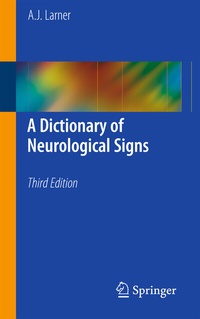
A Dictionary of Neurological Signs
3rd Edition
Published on 12. November 2010
XVI, 381 pages
978-1-4419-7095-4 (ISBN)
Description

The first two editions of the Dictionary of Neurological Signs were very well-received by readers and reviewers alike. Like those editions, this Third Edition, updated and expanded, can be almost as well described in terms of what the book is not, along with details about what it is. The Dictionary is not a handbook for treatment of neurological disorders. While many entries provide the latest treatment options, up-to-the-minute therapies are not discussed in bedside level detail. The Dictionary is not a board review book because it is not in Q&A format but could easily serve in that capacity since each entry is a fairly complete snapshot of a specific disorder or disease.
The Dictionary is an alphabetical listing of commonly presenting neurological signs designed to guide the physician toward the correct clinical diagnosis. The Dictionary is focused, problem-based, concise and practical. The structured entries in this practical, clinical resource provide a thumbnail of a wide range of neurological signs. Each entry includes:
A definition of the sign
A brief account of the clinical technique required to elicit the sign
A description of the other signs which may accompany the index sign
An explanation of pathyophysiological and/or pharmacological background
Differential diagnosis
Brief treatment details
Where known, these entries also include the neuroanatomical basis of the sign. The Dictionary of Neurological Signs, Third Edition, is an indispensable reference for all students, trainees, and clinicians who care for patients with neurological disorders.
More details
Series
Edition
3rd ed. 2011
Language
English
Place of publication
New York
United States
Publishing group
Springer US
Target group
Professional and scholarly
Product notice
Reflowable
Illustrations
XVI, 381 p.
File size
2,76 MB
ISBN-13
978-1-4419-7095-4 (9781441970954)
DOI
10.1007/978-1-4419-7095-4
Schweitzer Classification
Other editions
Additional editions
A.J. Larner
A Dictionary of Neurological Signs
Book
10/2010
3rd Edition
Springer
€56.70
Article exhausted; check for reprint
Previous edition
A.J. Larner
A Dictionary of Neurological Signs
E-Book
02/2006
2nd Edition
Springer
€39.99
Available for download
Person
Andrew J. Larner, MD practices at the Walton Centre for Neurology and Neurosurgery, Lower Lane, Fazakerley, Liverpool, United Kingdom
Content
1 - Foreword to the First Edition [Seite 7]
2 - Preface to Third Edition [Seite 8]
3 - Acknowledgements [Seite 9]
4 - Contents [Seite 10]
5 - A [Seite 12]
5.1 - Abadies Sign [Seite 12]
5.2 - Abdominal Paradox [Seite 12]
5.3 - Abdominal Reflexes [Seite 12]
5.4 - Abducens (VI) Nerve Palsy [Seite 13]
5.5 - Abductor Sign [Seite 13]
5.6 - Absence [Seite 13]
5.7 - Abulia [Seite 14]
5.8 - Acalculia [Seite 15]
5.9 - Accommodation Reflex [Seite 16]
5.10 - Achilles Reflex [Seite 16]
5.11 - Achromatopsia [Seite 16]
5.12 - Acousticopalpebral Reflex [Seite 17]
5.13 - Action Dystonia [Seite 17]
5.14 - Action Myoclonus [Seite 17]
5.15 - Adiadochokinesia [Seite 18]
5.16 - Adies Syndrome, Adies Tonic Pupil [Seite 18]
5.17 - Adsons Test [Seite 18]
5.18 - Adventitious Movements [Seite 18]
5.19 - Affective Agnosia [Seite 18]
5.20 - Afferent Pupillary Defect (APD) [Seite 18]
5.21 - Age-Related Signs [Seite 18]
5.22 - Ageusia [Seite 19]
5.23 - Agnosia [Seite 20]
5.24 - Agrammatism [Seite 21]
5.25 - Agraphaesthesia [Seite 22]
5.26 - Agraphia [Seite 22]
5.27 - Agraphognosia [Seite 23]
5.28 - Agrypnia [Seite 23]
5.29 - Akathisia [Seite 23]
5.30 - Akinesia [Seite 24]
5.31 - Akinetic Mutism [Seite 25]
5.32 - Akinetic-Rigid Syndrome [Seite 26]
5.33 - Akinetopsia [Seite 26]
5.34 - Alalia [Seite 26]
5.35 - Alexia [Seite 26]
5.36 - Alexithymia [Seite 28]
5.37 - Alice in Wonderland Syndrome [Seite 29]
5.38 - Alien Grasp Reflex [Seite 29]
5.39 - Alien Hand, Alien Limb [Seite 30]
5.40 - Alienation Du Mot [Seite 31]
5.41 - Alloacousia [Seite 31]
5.42 - Alloaesthesia [Seite 31]
5.43 - Allochiria [Seite 32]
5.44 - Allodynia [Seite 32]
5.45 - Allographia [Seite 33]
5.46 - Allokinesia, Allokinesis [Seite 33]
5.47 - Alternate Cover Test [Seite 33]
5.48 - Alternating Fist Closure Test [Seite 33]
5.49 - Alternating Sequences Test [Seite 33]
5.50 - Altitudinal Field Defect [Seite 33]
5.51 - Amaurosis [Seite 34]
5.52 - Amblyopia [Seite 34]
5.53 - Amimia [Seite 35]
5.54 - Amnesia [Seite 35]
5.55 - Amphigory [Seite 37]
5.56 - Amusia [Seite 37]
5.57 - Amyotrophy [Seite 38]
5.58 - Anaesthesia [Seite 38]
5.59 - Analgesia [Seite 38]
5.60 - Anal Reflex [Seite 39]
5.61 - Anarchic Hand [Seite 39]
5.62 - Anarithmetia [Seite 39]
5.63 - Anarthria [Seite 39]
5.64 - Angioscotoma [Seite 40]
5.65 - Angor Animi [Seite 40]
5.66 - Anhidrosis [Seite 40]
5.67 - Anismus [Seite 40]
5.68 - Anisocoria [Seite 41]
5.69 - Annular Scotoma [Seite 41]
5.70 - Anomia [Seite 42]
5.71 - Anosmia [Seite 42]
5.72 - Anosodiaphoria [Seite 43]
5.73 - Anosognosia [Seite 43]
5.74 - Anserina [Seite 44]
5.75 - Antecollis [Seite 44]
5.76 - Anteflexion [Seite 44]
5.77 - Antons Syndrome [Seite 45]
5.78 - Anwesenheit [Seite 45]
5.79 - Apallic Syndrome [Seite 45]
5.80 - Apathy [Seite 45]
5.81 - Aphasia [Seite 46]
5.82 - Aphemia [Seite 48]
5.83 - Aphonia [Seite 48]
5.84 - Applause Sign [Seite 49]
5.85 - Aposiopesis [Seite 49]
5.86 - Apraxia [Seite 49]
5.87 - Aprosexia [Seite 51]
5.88 - Aprosodia, Aprosody [Seite 51]
5.89 - Arc de Cercle [Seite 51]
5.90 - Arcuate Scotoma [Seite 52]
5.91 - Areflexia [Seite 52]
5.92 - Argyll Robertson Pupil (ARP) [Seite 52]
5.93 - Arm Drop [Seite 53]
5.94 - Around The Clock Paralysis [Seite 54]
5.95 - Arthrogryposis [Seite 54]
5.96 - Asemasia [Seite 54]
5.97 - Asomatognosia [Seite 54]
5.98 - Astasia [Seite 54]
5.99 - AstasiaAbasia [Seite 55]
5.100 - Astereognosis [Seite 55]
5.101 - Asterixis [Seite 55]
5.102 - Asthenopia [Seite 56]
5.103 - Asynergia [Seite 56]
5.104 - Ataxia [Seite 56]
5.105 - Ataxic Hemiparesis [Seite 58]
5.106 - Ataxic Nystagmus [Seite 59]
5.107 - Athetosis [Seite 59]
5.108 - Athymhormia [Seite 59]
5.109 - Atrophy [Seite 60]
5.110 - Attended Alone Sign [Seite 60]
5.111 - Attention [Seite 60]
5.112 - Auditory Agnosia [Seite 61]
5.113 - AuditoryVisual Synaesthesia [Seite 61]
5.114 - Augmentation [Seite 61]
5.115 - Aura [Seite 62]
5.116 - Automatic Obedience [Seite 63]
5.117 - Automatic Writing Behaviour [Seite 63]
5.118 - Automatism [Seite 63]
5.119 - Autophony [Seite 64]
5.120 - Autoscopy [Seite 64]
5.121 - Autotopagnosia [Seite 65]
6 - B [Seite 66]
6.1 - Babinskis Sign (1) [Seite 66]
6.2 - Babinskis Sign (2) [Seite 67]
6.3 - Babinskis TrunkThigh Test [Seite 67]
6.4 - Bag of Worms [Seite 67]
6.5 - Balaclava Helmet [Seite 67]
6.6 - Balints Syndrome [Seite 67]
6.7 - Ballism, Ballismus [Seite 68]
6.8 - Bathing Suit Sensory Loss [Seite 69]
6.9 - Battles Sign [Seite 69]
6.10 - Beevors Sign [Seite 69]
6.11 - Belle Indiffrence [Seite 69]
6.12 - Bells Palsy [Seite 70]
6.13 - Bells Phenomenon, Bells Sign [Seite 70]
6.14 - Benediction Hand [Seite 70]
6.15 - Bent Spine Syndrome [Seite 71]
6.16 - Bielschowskys Sign, Bielschowskys Test [Seite 71]
6.17 - Binasal Hemianopia [Seite 71]
6.18 - Bitemporal Hemianopia [Seite 71]
6.19 - Blepharoptosis [Seite 72]
6.20 - Blepharospasm [Seite 72]
6.21 - Blindsight [Seite 72]
6.22 - Blind Spot [Seite 73]
6.23 - Blinking [Seite 73]
6.24 - Blink Reflex [Seite 73]
6.25 - Body Part as Object [Seite 74]
6.26 - Bon-Bon Sign [Seite 75]
6.27 - Bouche de Tapir [Seite 75]
6.28 - Bovine Cough [Seite 75]
6.29 - Bradykinesia [Seite 75]
6.30 - Bradylalia [Seite 76]
6.31 - Bradyphrenia [Seite 76]
6.32 - Bragards Test [Seite 76]
6.33 - Brocas Aphasia [Seite 76]
6.34 - Brown-Squard Syndrome [Seite 77]
6.35 - Brudzinskis (Neck) Sign [Seite 78]
6.36 - Brueghels Syndrome [Seite 78]
6.37 - Bruit [Seite 78]
6.38 - Brushfield Spots [Seite 79]
6.39 - Bruxism [Seite 79]
6.40 - Buccofacial Dyspraxia [Seite 79]
6.41 - Buccolingual Syndrome [Seite 79]
6.42 - Bulbar Palsy [Seite 79]
6.43 - Bulbocavernosus Reflex [Seite 80]
6.44 - Buphthalmos [Seite 80]
6.45 - Butt-First Manoeuvre [Seite 80]
7 - C [Seite 81]
7.1 - Cacogeusia [Seite 81]
7.2 - Cacosmia [Seite 81]
7.3 - Calf Head Sign [Seite 81]
7.4 - Calf Hypertrophy [Seite 81]
7.5 - Caloric Testing [Seite 82]
7.6 - Camptocormia [Seite 82]
7.7 - Camptodactyly [Seite 83]
7.8 - Capgras Syndrome [Seite 83]
7.9 - Carphologia [Seite 84]
7.10 - Carpopedal Spasm [Seite 84]
7.11 - Catalepsy [Seite 84]
7.12 - Cataplexy [Seite 84]
7.13 - Catathrenia [Seite 85]
7.14 - Catatonia [Seite 85]
7.15 - Cauda Equina Syndrome [Seite 86]
7.16 - Central Scotoma, Centrocaecal Scotoma [Seite 87]
7.17 - Cerebellar Syndromes [Seite 88]
7.18 - Chaddocks Sign [Seite 88]
7.19 - Charcot Joint [Seite 88]
7.20 - Charles Bonnet Syndrome [Seite 89]
7.21 - Chasm [Seite 90]
7.22 - Cheiro-Oral Syndrome [Seite 90]
7.23 - Cherry Red Spot at the Macula [Seite 90]
7.24 - CheyneStokes Breathing [Seite 90]
7.25 - Chicken Wings [Seite 90]
7.26 - Chorea, Choreoathetosis [Seite 90]
7.27 - Chromaesthesia [Seite 93]
7.28 - Chronognosia [Seite 93]
7.29 - Chvosteks Sign [Seite 93]
7.30 - Ciliospinal Response [Seite 94]
7.31 - Cinematic Vision [Seite 94]
7.32 - Circumlocution [Seite 94]
7.33 - Clapping Test [Seite 94]
7.34 - Clasp-Knife Phenomenon [Seite 94]
7.35 - Claudication [Seite 94]
7.36 - Claw Foot [Seite 95]
7.37 - Claw Hand [Seite 95]
7.38 - Clonus [Seite 95]
7.39 - Closed Fist Sign [Seite 96]
7.40 - Closing-In Sign [Seite 96]
7.41 - Cluster Breathing [Seite 96]
7.42 - Coactivation Sign [Seite 96]
7.43 - Cock Walking [Seite 97]
7.44 - Cogans (Lid Twitch) Sign [Seite 97]
7.45 - Cogwheeling, Cogwheel Phenomenon, Cogwheel Rigidity [Seite 97]
7.46 - Cold Hands Sign [Seite 97]
7.47 - Collapsing Weakness [Seite 97]
7.48 - Colliers Sign [Seite 98]
7.49 - Colour Anomia [Seite 98]
7.50 - Coma [Seite 98]
7.51 - Compulsive Grasping Hand [Seite 99]
7.52 - Conduction Aphasia [Seite 100]
7.53 - Conduit dapproche [Seite 100]
7.54 - Confabulation [Seite 101]
7.55 - Confusion [Seite 101]
7.56 - Congenital Nystagmus [Seite 101]
7.57 - Consensual Light Reflex [Seite 102]
7.58 - Constructional Apraxia [Seite 102]
7.59 - Contracture [Seite 102]
7.60 - ConvergenceRetraction Nystagmus [Seite 103]
7.61 - Coprolalia [Seite 103]
7.62 - Copropraxia [Seite 103]
7.63 - Corectopia [Seite 103]
7.64 - Corneal Reflex [Seite 103]
7.65 - Corneomandibular Reflex [Seite 104]
7.66 - Corneopterygoid Reflex [Seite 104]
7.67 - Cortical Blindness [Seite 104]
7.68 - Cotards Syndrome [Seite 105]
7.69 - Coup de Poignard [Seite 105]
7.70 - Coup de Sabre [Seite 105]
7.71 - Cover Tests [Seite 106]
7.72 - Cramp [Seite 106]
7.73 - Cremasteric Reflex [Seite 107]
7.74 - Crocodile Tears [Seite 107]
7.75 - Crossed Adductor Reflex [Seite 107]
7.76 - Crossed Aphasia [Seite 108]
7.77 - Crossed Apraxia [Seite 108]
7.78 - Crossed Straight Leg Raising [Seite 108]
7.79 - Cross over [Seite 108]
7.80 - Crying [Seite 108]
7.81 - Cuirasse [Seite 108]
7.82 - Cushing Reflex, Cushing Response [Seite 108]
7.83 - Czarneckis Sign [Seite 109]
8 - D [Seite 110]
8.1 - Dalrymples Sign [Seite 110]
8.2 - Dazzle [Seite 110]
8.3 - Decerebrate Rigidity [Seite 110]
8.4 - De Clrambault Syndrome [Seite 110]
8.5 - Decomposition of Movement [Seite 110]
8.6 - Decorticate Rigidity [Seite 111]
8.7 - Deja Entendu [Seite 111]
8.8 - Deja Vecu [Seite 111]
8.9 - Deja Vu [Seite 111]
8.10 - Delirium [Seite 111]
8.11 - Delusion [Seite 113]
8.12 - Dementia [Seite 114]
8.13 - De Mussets Sign [Seite 116]
8.14 - Depersonalization [Seite 116]
8.15 - Derealization [Seite 116]
8.16 - Developmental Signs [Seite 116]
8.17 - Diagonistic Dyspraxia [Seite 116]
8.18 - Diamond on Quadriceps Sign [Seite 116]
8.19 - Diaphoresis [Seite 117]
8.20 - Diaphragm Weakness [Seite 117]
8.21 - Digital Reflex [Seite 117]
8.22 - Diplophonia [Seite 117]
8.23 - Diplopia [Seite 117]
8.24 - Directional Hypokinesia [Seite 119]
8.25 - Disc Swelling [Seite 119]
8.26 - Disinhibition [Seite 120]
8.27 - Dissociated Sensory Loss [Seite 120]
8.28 - Dissociation [Seite 120]
8.29 - Divisional Palsy [Seite 121]
8.30 - DixHallpike Positioning Test [Seite 121]
8.31 - Dolls Eye Manoeuvre, Dolls Head Manoeuvre [Seite 121]
8.32 - Dorsal Guttering [Seite 122]
8.33 - Double Elevator Palsy [Seite 122]
8.34 - Downbeat Nystagmus [Seite 122]
8.35 - Dressing Apraxia [Seite 122]
8.36 - Drooling [Seite 122]
8.37 - Dropped Head Syndrome [Seite 122]
8.38 - Drusen [Seite 123]
8.39 - Dynamic Aphasia [Seite 124]
8.40 - Dysaesthesia [Seite 124]
8.41 - Dysarthria [Seite 124]
8.42 - Dyscalculia [Seite 126]
8.43 - Dyschromatopsia [Seite 126]
8.44 - Dysdiadochokinesia [Seite 126]
8.45 - Dysexecutive Syndrome [Seite 126]
8.46 - Dysgeusia [Seite 127]
8.47 - Dysgraphaesthesia [Seite 127]
8.48 - Dysgraphia [Seite 127]
8.49 - Dyskinesia [Seite 127]
8.50 - Dyslexia [Seite 128]
8.51 - Dysmentia [Seite 128]
8.52 - Dysmetria [Seite 128]
8.53 - Dysmorphopsia [Seite 129]
8.54 - Dysnomia [Seite 129]
8.55 - Dysphagia [Seite 129]
8.56 - Dysphasia [Seite 131]
8.57 - Dysphonia [Seite 131]
8.58 - Dyspraxia [Seite 131]
8.59 - Dysprosody [Seite 132]
8.60 - Dyssynergia [Seite 132]
8.61 - Dystaxia [Seite 132]
8.62 - Dystonia [Seite 132]
9 - E [Seite 134]
9.1 - Ear Click [Seite 134]
9.2 - Eastchester Clapping Sign [Seite 134]
9.3 - Echolalia [Seite 134]
9.4 - Echophenomena [Seite 135]
9.5 - Echopraxia [Seite 135]
9.6 - criture en Double Miroir [Seite 135]
9.7 - Ectropion [Seite 135]
9.8 - Eidetic Memory [Seite 135]
9.9 - Eight-and-a-Half Syndrome [Seite 135]
9.10 - Ekboms Syndrome [Seite 136]
9.11 - Emotionalism, Emotional Lability [Seite 136]
9.12 - Emposthotonos [Seite 137]
9.13 - Encephalopathy [Seite 137]
9.14 - En Garde Position [Seite 137]
9.15 - Enophthalmos [Seite 137]
9.16 - Entomopia [Seite 138]
9.17 - Environmental Dependency Syndrome [Seite 138]
9.18 - Environmental Tilt [Seite 138]
9.19 - Epiphora [Seite 138]
9.20 - Epley Manoeuvre [Seite 139]
9.21 - Erythropsia [Seite 139]
9.22 - Esophoria [Seite 139]
9.23 - Esotropia [Seite 139]
9.24 - Eutonia [Seite 139]
9.25 - Ewart Phenomenon [Seite 139]
9.26 - Exophoria [Seite 140]
9.27 - Exophthalmos [Seite 140]
9.28 - Exosomaesthesia [Seite 140]
9.29 - Exotropia [Seite 140]
9.30 - Extensor Posturing [Seite 140]
9.31 - External Malleolar Sign [Seite 140]
9.32 - External Ophthalmoplegia [Seite 140]
9.33 - Extinction [Seite 140]
9.34 - Extrapyramidal Signs [Seite 141]
9.35 - Eyelid Apraxia [Seite 141]
10 - F [Seite 143]
10.1 - FaceHand Test [Seite 143]
10.2 - Facial Paresis, Facial Weakness [Seite 143]
10.3 - Facilitation [Seite 145]
10.4 - False-Localizing Signs [Seite 145]
10.5 - Fan Sign (Signe de lventail) [Seite 146]
10.6 - Fasciculation [Seite 146]
10.7 - Fast Micrographia [Seite 147]
10.8 - Fatigue [Seite 148]
10.9 - Femoral Stretch Test [Seite 149]
10.10 - Fencers Posture, Fencing Posture [Seite 149]
10.11 - Festinant Gait, Festination [Seite 149]
10.12 - Fibrillation [Seite 149]
10.13 - Finger Agnosia [Seite 150]
10.14 - Finger Chase Test [Seite 150]
10.15 - Finger Drop [Seite 150]
10.16 - FingerFloor Distance [Seite 150]
10.17 - Finger-to-Nose Test [Seite 150]
10.18 - Fishers Sign [Seite 151]
10.19 - Fist-Edge-Palm Test [Seite 151]
10.20 - Flaccidity [Seite 151]
10.21 - Flail Arm [Seite 151]
10.22 - Flail Foot [Seite 152]
10.23 - Flap, Flapping Tremor [Seite 152]
10.24 - Flexibilitas Cerea (Waxy Flexibility) [Seite 152]
10.25 - FlexionAdduction Sign [Seite 152]
10.26 - Flexor Posturing [Seite 152]
10.27 - Flick Sign [Seite 152]
10.28 - Floccillation [Seite 152]
10.29 - Flycatcher Tongue [Seite 152]
10.30 - Flynn Phenomenon [Seite 153]
10.31 - Foot Drop [Seite 153]
10.32 - Foot Grasping [Seite 153]
10.33 - Forced Ductions [Seite 154]
10.34 - Forced Grasping [Seite 154]
10.35 - Forced Groping [Seite 154]
10.36 - Forced Laughter and Crying [Seite 154]
10.37 - Forced Upgaze [Seite 154]
10.38 - Forearm and Finger Rolling [Seite 154]
10.39 - Foreign Accent Syndrome [Seite 155]
10.40 - Formication [Seite 155]
10.41 - Fortification Spectra [Seite 155]
10.42 - Foster Kennedy Syndrome [Seite 155]
10.43 - Fou Rire Prodromique [Seite 156]
10.44 - Freezing [Seite 156]
10.45 - Fregoli Syndrome [Seite 156]
10.46 - Freys Syndrome [Seite 157]
10.47 - Froments Sign [Seite 157]
10.48 - Frontal Ataxia [Seite 157]
10.49 - Frontal Lobe Syndromes [Seite 157]
10.50 - Frontal Release Signs [Seite 159]
10.51 - Fugue [Seite 160]
10.52 - Functional Weakness and Sensory Disturbance [Seite 160]
10.53 - Funnel Vision [Seite 161]
11 - G [Seite 162]
11.1 - Gag Reflex [Seite 162]
11.2 - Gait Apraxia [Seite 162]
11.3 - Gambling [Seite 163]
11.4 - Ganglionopathy [Seite 163]
11.5 - Ganser Phenomenon, Ganser Syndrome [Seite 163]
11.6 - Gaping [Seite 164]
11.7 - Gaze-Evoked Phenomena [Seite 164]
11.8 - Gaze Palsy [Seite 164]
11.9 - Gegenhalten [Seite 165]
11.10 - Geophagia, Geophagy [Seite 165]
11.11 - Gerstmann Syndrome [Seite 165]
11.12 - Geste Antagoniste [Seite 166]
11.13 - Gibbus [Seite 166]
11.14 - Girdle Sensation [Seite 166]
11.15 - Give-Way Weakness [Seite 167]
11.16 - Glabellar Tap Reflex [Seite 167]
11.17 - Glossolalia [Seite 167]
11.18 - Glove and Stocking Sensory Loss [Seite 167]
11.19 - Goosebumps [Seite 168]
11.20 - Gordons Sign [Seite 168]
11.21 - Gowers Manoeuvre, Gowers Sign [Seite 168]
11.22 - Graefes Sign [Seite 168]
11.23 - Grandchild Sign [Seite 168]
11.24 - Graphaesthesia [Seite 168]
11.25 - Graphanaesthesia [Seite 169]
11.26 - Graphospasm [Seite 169]
11.27 - Grasp Reflex [Seite 169]
11.28 - Groucho Marx Manoeuvre [Seite 169]
11.29 - Gustatory Epiphora [Seite 170]
11.30 - Gustatory Sweating [Seite 170]
11.31 - Guttmanns Sign [Seite 170]
11.32 - Gynaecomastia [Seite 170]
12 - H [Seite 171]
12.1 - Habit Spasm [Seite 171]
12.2 - Hallpike Manoeuvre, Hallpike Test [Seite 171]
12.3 - Hallucination [Seite 171]
12.4 - Hammer Toes [Seite 173]
12.5 - Hand Elevation Test [Seite 173]
12.6 - Harlequin Sign, Harlequin Syndrome [Seite 173]
12.7 - Harveys Sign [Seite 173]
12.8 - Hawthorne Effect [Seite 174]
12.9 - Head Droop, Head Drop [Seite 174]
12.10 - Head Impulse Test [Seite 174]
12.11 - Head Thrust [Seite 175]
12.12 - Head Tilt [Seite 175]
12.13 - Head Tremor [Seite 175]
12.14 - Head Turning Sign [Seite 175]
12.15 - Heautoscopy [Seite 176]
12.16 - HeelKneeShin Test, HeelShin Test [Seite 176]
12.17 - HeelToe Walking [Seite 176]
12.18 - Hemeralopia [Seite 176]
12.19 - Hemiachromatopsia [Seite 177]
12.20 - Hemiakinesia [Seite 177]
12.21 - Hemialexia [Seite 177]
12.22 - Hemianomia [Seite 177]
12.23 - Hemianopia [Seite 177]
12.24 - Hemiataxia [Seite 178]
12.25 - Hemiballismus [Seite 179]
12.26 - Hemichorea [Seite 180]
12.27 - Hemidystonia [Seite 180]
12.28 - Hemifacial Atrophy [Seite 180]
12.29 - Hemifacial Spasm [Seite 180]
12.30 - Hemi-Inattention [Seite 181]
12.31 - Hemimicropsia [Seite 181]
12.32 - Hemineglect [Seite 181]
12.33 - Hemiparesis [Seite 181]
12.34 - Hemiparkinsonism [Seite 182]
12.35 - Hemiplegia [Seite 182]
12.36 - Hemiplegia Cruciata [Seite 182]
12.37 - Henneberts Sign [Seite 182]
12.38 - Henry and Woodruff Sign [Seite 182]
12.39 - HertwigMagendie Sign [Seite 183]
12.40 - Heterochromia Iridis [Seite 183]
12.41 - Heterophoria [Seite 183]
12.42 - Heterotropia [Seite 183]
12.43 - Hiccups [Seite 184]
12.44 - High-Stepping Gait [Seite 184]
12.45 - Hip Abduction Sign [Seite 184]
12.46 - Hippus [Seite 185]
12.47 - Hitselberg Sign [Seite 185]
12.48 - Hocquet Diabolique [Seite 185]
12.49 - Hoffmanns Sign [Seite 185]
12.50 - HoffmannTinel Sign [Seite 185]
12.51 - HolmesAdie Pupil, HolmesAdie Syndrome [Seite 185]
12.52 - Holmes Tremor [Seite 186]
12.53 - Hoovers Sign [Seite 186]
12.54 - Horners Syndrome [Seite 187]
12.55 - HoytSpencer Sign [Seite 188]
12.56 - Hung-Up Reflexes [Seite 188]
12.57 - Hutchinsons Pupil [Seite 188]
12.58 - Hyperacusis [Seite 188]
12.59 - Hyperaesthesia [Seite 189]
12.60 - Hyperalgesia [Seite 189]
12.61 - Hyperekplexia [Seite 189]
12.62 - Hypergraphia [Seite 190]
12.63 - Hyperhidrosis [Seite 190]
12.64 - Hyperkinesia [Seite 191]
12.65 - Hyperlexia [Seite 191]
12.66 - Hypermetamorphosis [Seite 191]
12.67 - Hypermetria [Seite 191]
12.68 - Hypermnesia [Seite 191]
12.69 - Hyperorality [Seite 191]
12.70 - Hyperpathia [Seite 191]
12.71 - Hyperphagia [Seite 192]
12.72 - Hyperphoria [Seite 192]
12.73 - Hyperpilaphesie [Seite 192]
12.74 - Hyperpronation [Seite 192]
12.75 - Hyperreflexia [Seite 192]
12.76 - Hyperreligiosity [Seite 193]
12.77 - Hypersexuality [Seite 193]
12.78 - Hypersomnolence [Seite 193]
12.79 - Hyperthermia [Seite 194]
12.80 - Hypertonia, Hypertonus [Seite 195]
12.81 - Hypertrophy [Seite 195]
12.82 - Hypertropia [Seite 195]
12.83 - Hypoaesthesia [Seite 195]
12.84 - Hypoalgesia [Seite 195]
12.85 - Hypogeusia [Seite 195]
12.86 - Hypohidrosis [Seite 195]
12.87 - Hypokinesia [Seite 196]
12.88 - Hypometria [Seite 196]
12.89 - Hypomimia [Seite 196]
12.90 - Hypophonia [Seite 196]
12.91 - Hypophoria [Seite 196]
12.92 - Hyporeflexia [Seite 197]
12.93 - Hyposexuality [Seite 197]
12.94 - Hypothermia [Seite 197]
12.95 - Hypotonia, Hypotonus [Seite 198]
12.96 - Hypotropia [Seite 198]
13 - I [Seite 199]
13.1 - Ice Pack Test [Seite 199]
13.2 - Ideational Apraxia [Seite 199]
13.3 - Ideomotor Apraxia (IMA) [Seite 199]
13.4 - Illusion [Seite 199]
13.5 - Illusory Visual Spread [Seite 200]
13.6 - Imitation Behaviour [Seite 200]
13.7 - Imitation Synkinesis [Seite 200]
13.8 - Impersistence [Seite 200]
13.9 - Inattention [Seite 201]
13.10 - Incontinence [Seite 201]
13.11 - Intention Myoclonus [Seite 202]
13.12 - Intermanual Conflict [Seite 202]
13.13 - Intermetamorphosis [Seite 202]
13.14 - Internal Ophthalmoplegia [Seite 202]
13.15 - Internuclear Ophthalmoplegia (INO) [Seite 203]
13.16 - Intrusion [Seite 203]
13.17 - Inverse Marcus Gunn Phenomenon [Seite 204]
13.18 - Inverse Uhthoff Sign [Seite 204]
13.19 - Inverted Reflexes [Seite 204]
13.20 - Ipsipulsion [Seite 204]
13.21 - Iridoplegia [Seite 204]
14 - J [Seite 205]
14.1 - Jacksonian March [Seite 205]
14.2 - Jactitation [Seite 205]
14.3 - Jamais Entendu [Seite 205]
14.4 - Jamais Vcu [Seite 205]
14.5 - Jamais Vu [Seite 205]
14.6 - Jargon Aphasia [Seite 206]
14.7 - Jaw Jerk [Seite 206]
14.8 - Jaw Winking [Seite 206]
14.9 - Jendrassiks Manoeuvre [Seite 207]
14.10 - Jitteriness [Seite 207]
14.11 - Joint Position Sense [Seite 207]
14.12 - Jugular Foramen Syndrome [Seite 207]
14.13 - Junctional Scotoma, Junctional Scotoma of Traquair [Seite 208]
15 - K [Seite 209]
15.1 - KayserFleischer Rings [Seite 209]
15.2 - Kernigs Sign [Seite 209]
15.3 - Kernohans Notch Syndrome [Seite 209]
15.4 - Kinesis Paradoxica [Seite 210]
15.5 - Klazomania [Seite 210]
15.6 - Kleptomania [Seite 210]
15.7 - KlverBucy Syndrome [Seite 210]
15.8 - Knee Tremor [Seite 211]
15.9 - Krber Salus Elschnig Syndrome [Seite 212]
15.10 - Kyphoscoliosis [Seite 212]
16 - L [Seite 213]
16.1 - Lagophthalmos [Seite 213]
16.2 - Lamberts Sign [Seite 213]
16.3 - Lasgues Sign [Seite 213]
16.4 - Lateral Medullary Syndrome [Seite 214]
16.5 - Lateral Rectus Palsy [Seite 214]
16.6 - Laterocollis [Seite 214]
16.7 - Lateropulsion [Seite 215]
16.8 - Laughter [Seite 215]
16.9 - Lazarus Sign [Seite 215]
16.10 - Leadpipe Rigidity [Seite 215]
16.11 - Leucocoria [Seite 215]
16.12 - Levator Inhibition [Seite 215]
16.13 - Levitation [Seite 215]
16.14 - Lhermittes Sign [Seite 216]
16.15 - Lid Lag [Seite 216]
16.16 - Lid Retraction [Seite 217]
16.17 - Light-Near (Pupillary) Dissociation (LND) [Seite 217]
16.18 - Light Reflex [Seite 218]
16.19 - Locked-In Syndrome [Seite 218]
16.20 - Lockjaw [Seite 218]
16.21 - Logoclonia [Seite 218]
16.22 - Logopenia [Seite 219]
16.23 - Logorrhoea [Seite 219]
16.24 - Long Tract Signs [Seite 219]
16.25 - Looking Glass Syndrome [Seite 219]
16.26 - Lower Motor Neurone (LMN) Syndrome [Seite 219]
16.27 - Luria Test [Seite 220]
17 - M [Seite 221]
17.1 - Macrographia [Seite 221]
17.2 - Macropsia [Seite 221]
17.3 - Macrosomatognosia [Seite 221]
17.4 - MacroSquare Wave Jerks [Seite 221]
17.5 - Macula Sparing, Macula Splitting [Seite 221]
17.6 - Maculopathy [Seite 222]
17.7 - Magnetic Movements [Seite 222]
17.8 - Main daccoucheur [Seite 222]
17.9 - Main en Griffe [Seite 222]
17.10 - Main tranger [Seite 223]
17.11 - Main Succulente [Seite 223]
17.12 - Man-in-a-Barrel [Seite 223]
17.13 - Marche Petit Pas [Seite 223]
17.14 - Marcus Gunn Phenomenon [Seite 224]
17.15 - Marcus Gunn Pupil, Marcus Gunn Sign [Seite 224]
17.16 - Mask-Like Facies [Seite 224]
17.17 - Masseter Hypertrophy [Seite 224]
17.18 - Masseter Reflex [Seite 224]
17.19 - Masticatory Claudication [Seite 225]
17.20 - McArdles Sign [Seite 225]
17.21 - Medial Medullary Syndrome [Seite 225]
17.22 - Menace Reflex [Seite 225]
17.23 - Meningism [Seite 226]
17.24 - Metamorphopsia [Seite 226]
17.25 - Micrographia [Seite 227]
17.26 - Micropsia [Seite 227]
17.27 - Microsomatognosia [Seite 228]
17.28 - Milkmaids Grip [Seite 228]
17.29 - Miosis [Seite 228]
17.30 - Mirror Agnosia [Seite 228]
17.31 - Mirror Apraxia [Seite 229]
17.32 - Mirror Ataxia [Seite 229]
17.33 - Mirror Dystonia [Seite 229]
17.34 - Mirror Hallucination [Seite 229]
17.35 - Mirror Movements [Seite 229]
17.36 - Mirror Sign [Seite 230]
17.37 - Mirror Writing [Seite 230]
17.38 - Misidentification Syndromes [Seite 231]
17.39 - Misoplegia [Seite 232]
17.40 - Mitbewegungen [Seite 232]
17.41 - Mitgehen [Seite 232]
17.42 - Mitmachen [Seite 232]
17.43 - Monoballismus [Seite 232]
17.44 - Monochromatopsia [Seite 233]
17.45 - Monomelia [Seite 233]
17.46 - Mononeuritis Multiplex, Mononeuropathy Multiplex [Seite 233]
17.47 - Mononeuropathy [Seite 233]
17.48 - Monoparesis, Monoplegia [Seite 233]
17.49 - Monophasia [Seite 233]
17.50 - Monotonia [Seite 233]
17.51 - Moria [Seite 233]
17.52 - Motor Neglect [Seite 234]
17.53 - Moving Ear [Seite 234]
17.54 - Multiplication of Images [Seite 234]
17.55 - Muscle Hypertrophy [Seite 234]
17.56 - Mutism [Seite 234]
17.57 - Myasthenic Snarl [Seite 235]
17.58 - Mydriasis [Seite 235]
17.59 - Myelopathy [Seite 236]
17.60 - Myersons Sign [Seite 237]
17.61 - Myoclonus [Seite 237]
17.62 - Myoedema [Seite 238]
17.63 - Myokymia [Seite 238]
17.64 - Myopathy [Seite 239]
17.65 - Myorhythmia [Seite 240]
17.66 - Myotonia [Seite 240]
18 - N [Seite 242]
18.1 - Narcolepsy, Narcoleptic Syndrome [Seite 242]
18.2 - Nasopalpebral Reflex [Seite 242]
18.3 - Negative Myoclonus [Seite 242]
18.4 - Negative Tremor [Seite 242]
18.5 - Negativism [Seite 242]
18.6 - Neglect [Seite 242]
18.7 - Negros Sign [Seite 243]
18.8 - Neologism [Seite 243]
18.9 - Neris Test [Seite 244]
18.10 - Nerve Thickening [Seite 244]
18.11 - Neuromyotonia [Seite 244]
18.12 - Neuronopathy [Seite 245]
18.13 - Neuropathy [Seite 245]
18.14 - Nominal Aphasia [Seite 246]
18.15 - Nuchal Rigidity [Seite 246]
18.16 - Nuchocephalic Reflex [Seite 246]
18.17 - Nyctalopia [Seite 247]
18.18 - NylenBrny Manoeuvre [Seite 247]
18.19 - Nystagmoid Jerks [Seite 247]
18.20 - Nystagmus [Seite 247]
19 - O [Seite 251]
19.1 - Obscurations [Seite 251]
19.2 - Obtundation [Seite 251]
19.3 - Ocular Apraxia [Seite 251]
19.4 - Ocular Bobbing [Seite 251]
19.5 - Ocular Dipping [Seite 252]
19.6 - Ocular Flutter [Seite 252]
19.7 - Ocular Myoclonus [Seite 252]
19.8 - Ocular Tilt Reaction [Seite 253]
19.9 - Oculocephalic Response [Seite 253]
19.10 - Oculogyric Crisis [Seite 253]
19.11 - Oculomasticatory Myorhythmia [Seite 254]
19.12 - Oculomotor (III) Nerve Palsy [Seite 254]
19.13 - Oculovestibular Response [Seite 255]
19.14 - Okay Sign [Seite 255]
19.15 - One-and-a-Half Syndrome [Seite 255]
19.16 - Onion Peel, Onion Skin [Seite 255]
19.17 - Ophthalmoparesis, Ophthalmoplegia [Seite 256]
19.18 - Opisthotonos [Seite 256]
19.19 - Oppenheims Sign [Seite 257]
19.20 - Oppenheims Useless Hand Sign [Seite 257]
19.21 - Opsoclonus [Seite 257]
19.22 - Optic Aphasia [Seite 258]
19.23 - Optic Ataxia [Seite 259]
19.24 - Optic Atrophy [Seite 259]
19.25 - Optokinetic Nystagmus (OKN), Optokinetic Response [Seite 260]
19.26 - Orators Hand [Seite 260]
19.27 - Oro-facial Dyspraxia [Seite 260]
19.28 - Oromandibular Dystonia [Seite 260]
19.29 - Orthostatic Hypotension [Seite 261]
19.30 - Oscillopsia [Seite 262]
19.31 - Oscillucusis [Seite 262]
19.32 - Osmophobia [Seite 262]
19.33 - Overflow [Seite 262]
20 - P [Seite 263]
20.1 - Pagophagia [Seite 263]
20.2 - Palatal Reflex [Seite 263]
20.3 - Palatal Tremor [Seite 263]
20.4 - Palilalia [Seite 263]
20.5 - Palilogia [Seite 264]
20.6 - Palinacusis [Seite 264]
20.7 - Palinopsia [Seite 264]
20.8 - Pallaesthesia [Seite 265]
20.9 - Palmaris Brevis Sign [Seite 265]
20.10 - Palmomental Reflex [Seite 265]
20.11 - Pandysautonomia [Seite 266]
20.12 - Papilloedema [Seite 266]
20.13 - Paraballismus [Seite 267]
20.14 - Paradoxical Breathing [Seite 267]
20.15 - Paradoxical Head Tilt [Seite 267]
20.16 - Paradoxical Flexor Reflex [Seite 267]
20.17 - Paradoxical Triceps Reflex [Seite 267]
20.18 - Paraesthesia [Seite 267]
20.19 - Paragrammatism [Seite 268]
20.20 - Paragraphia [Seite 268]
20.21 - Parakinesia, Parakinesis [Seite 268]
20.22 - Paralexia [Seite 268]
20.23 - Paralogia [Seite 268]
20.24 - Paralysis [Seite 268]
20.25 - Paramnesia [Seite 268]
20.26 - Paramyotonia [Seite 269]
20.27 - Paraparesis [Seite 269]
20.28 - Paraphasia [Seite 270]
20.29 - Paraplegia [Seite 271]
20.30 - Parapraxia, Parapraxis [Seite 272]
20.31 - Paratonia [Seite 272]
20.32 - Paresis [Seite 272]
20.33 - Parinauds Syndrome [Seite 272]
20.34 - Parkinsonism [Seite 273]
20.35 - Parosmia [Seite 275]
20.36 - ParryRomberg Syndrome [Seite 275]
20.37 - Past-Pointing [Seite 276]
20.38 - Patellar Reflex [Seite 276]
20.39 - Pathological Crying, Pathological Laughter [Seite 276]
20.40 - Peduncular Hallucinosis [Seite 276]
20.41 - Peek Sign [Seite 277]
20.42 - Peliopsia, Pelopsia [Seite 277]
20.43 - Pelvic Thrusting [Seite 277]
20.44 - Pendular Nystagmus [Seite 277]
20.45 - Percussion Myotonia [Seite 277]
20.46 - Periodic Alternating Nystagmus [Seite 278]
20.47 - Periodic Respiration [Seite 278]
20.48 - Perseveration [Seite 278]
20.49 - Personification of Paralyzed Limbs [Seite 279]
20.50 - Pes Cavus [Seite 279]
20.51 - Petite Madeleines Phenomenon [Seite 280]
20.52 - Phalens Sign [Seite 280]
20.53 - Phantom Alloaesthesia [Seite 280]
20.54 - Phantom Chromatopsia [Seite 280]
20.55 - Phantom Limb [Seite 280]
20.56 - Phantom Vision [Seite 281]
20.57 - Pharyngeal Reflex [Seite 281]
20.58 - Phonagnosia [Seite 281]
20.59 - Phonemic Disintegration [Seite 281]
20.60 - Phonetic Disintegration [Seite 282]
20.61 - Phonophobia [Seite 282]
20.62 - Phosphene [Seite 282]
20.63 - Photism [Seite 282]
20.64 - Photophobia [Seite 283]
20.65 - Photopsia [Seite 283]
20.66 - Physical Duality [Seite 283]
20.67 - Piano-Playing Fingers [Seite 283]
20.68 - Pica [Seite 283]
20.69 - Picture Sign [Seite 283]
20.70 - Picture Within a Picture Sign [Seite 284]
20.71 - Pied en Griffe [Seite 284]
20.72 - Pie-in-the-Sky Defect [Seite 284]
20.73 - Pill Rolling [Seite 284]
20.74 - Pinch Sign [Seite 284]
20.75 - Pinhole Test [Seite 284]
20.76 - Plantar Response [Seite 285]
20.77 - Plegia [Seite 285]
20.78 - Pleurothotonus [Seite 286]
20.79 - Plexopathy [Seite 286]
20.80 - Polyganglionopathy [Seite 287]
20.81 - Polymyoclonus [Seite 287]
20.82 - Polyneuropathy [Seite 287]
20.83 - Polyopia [Seite 287]
20.84 - Popeye Arms [Seite 288]
20.85 - Poriomania [Seite 288]
20.86 - Porropsia [Seite 288]
20.87 - Positional Manoeuvres [Seite 288]
20.88 - Posttetanic Potentiation [Seite 288]
20.89 - Postural Hypotension [Seite 288]
20.90 - Postural Reflexes [Seite 288]
20.91 - Pourfour du Petit Syndrome [Seite 289]
20.92 - Pouting, Pout Reflex [Seite 289]
20.93 - Prayer Sign [Seite 289]
20.94 - Prehensile Thumb Sign [Seite 289]
20.95 - Presbyastasis [Seite 289]
20.96 - Presbycusis [Seite 290]
20.97 - Presbyopia [Seite 290]
20.98 - Prsque vu [Seite 290]
20.99 - Pressure Provocation Test [Seite 290]
20.100 - Prevosts Sign [Seite 290]
20.101 - Priapism [Seite 291]
20.102 - Primitive Reflexes [Seite 291]
20.103 - Procerus Sign [Seite 291]
20.104 - Pronator Drift [Seite 291]
20.105 - Proprioception [Seite 292]
20.106 - Proptosis [Seite 292]
20.107 - Propulsion [Seite 293]
20.108 - Prosopagnosia [Seite 293]
20.109 - Prosopoplegia [Seite 294]
20.110 - Proust Phenomenon [Seite 294]
20.111 - Proximal Limb Weakness [Seite 294]
20.112 - Pseudoabducens Palsy [Seite 295]
20.113 - Pseudoachromatopsia [Seite 295]
20.114 - Pseudoagnosia [Seite 295]
20.115 - Pseudo-Argyll Robertson Pupil [Seite 295]
20.116 - Pseudoathetosis [Seite 296]
20.117 - Pseudo-Babinski Sign [Seite 296]
20.118 - Pseudobitemporal Hemianopia [Seite 296]
20.119 - Pseudobulbar Affect [Seite 296]
20.120 - Pseudobulbar Palsy [Seite 296]
20.121 - Pseudochoreoathetosis [Seite 297]
20.122 - Pseudodementia [Seite 297]
20.123 - Pseudodiplopia [Seite 298]
20.124 - Pseudohallucination [Seite 298]
20.125 - Pseudohypertrophy [Seite 298]
20.126 - Pseudo-Internuclear Ophthalmoplegia [Seite 298]
20.127 - Pseudomyotonia [Seite 299]
20.128 - Pseudo-One-and-a-Half Syndrome [Seite 299]
20.129 - Pseudopapilloedema [Seite 300]
20.130 - Pseudoparesis [Seite 300]
20.131 - Pseudoptosis [Seite 300]
20.132 - Pseudoradicular Syndrome [Seite 300]
20.133 - Pseudo-Von Graefes Sign [Seite 300]
20.134 - Psychic Akinesia [Seite 301]
20.135 - Psychic Blindness [Seite 301]
20.136 - Psychic Paralysis of Gaze [Seite 301]
20.137 - Psychomotor Retardation [Seite 301]
20.138 - Psychomotor Signs [Seite 301]
20.139 - Ptarmus [Seite 301]
20.140 - Ptosis [Seite 301]
20.141 - Ptyalism [Seite 302]
20.142 - Pulfrich Phenomenon [Seite 302]
20.143 - Pull Test [Seite 303]
20.144 - Punding [Seite 303]
20.145 - Pupillary Reflexes [Seite 303]
20.146 - Pupil Sparing [Seite 304]
20.147 - Pure Word Blindness [Seite 304]
20.148 - Pure Word Deafness [Seite 304]
20.149 - Pursuit [Seite 305]
20.150 - Pyramidal Decussation Syndrome [Seite 305]
20.151 - Pyramidal Signs, Pyramidal Weakness [Seite 305]
21 - Q [Seite 306]
21.1 - Quadrantanopia [Seite 306]
21.2 - Quadriparesis, Quadriplegia [Seite 306]
21.3 - Quadrupedalism [Seite 307]
22 - R [Seite 308]
22.1 - Rabbit Syndrome [Seite 308]
22.2 - Raccoon Eyes [Seite 308]
22.3 - Radiculopathy [Seite 308]
22.4 - Raynauds Phenomenon [Seite 309]
22.5 - Rebound Phenomenon [Seite 309]
22.6 - Recruitment [Seite 310]
22.7 - Recurrent Utterances [Seite 310]
22.8 - Red Ear Syndrome [Seite 310]
22.9 - Reduplicative Paramnesia [Seite 310]
22.10 - Reflexes [Seite 311]
22.11 - Relative Afferent Pupillary Defect (RAPD) [Seite 312]
22.12 - Religiosity [Seite 313]
22.13 - Remote Atrophy [Seite 313]
22.14 - Retinal Venous Pulsation [Seite 313]
22.15 - Retinitis Pigmentosa [Seite 313]
22.16 - Retinopathy [Seite 314]
22.17 - Retrocollis [Seite 315]
22.18 - Retropulsion, Retropulsion Test [Seite 315]
22.19 - Reverse Lhermittes Sign [Seite 315]
22.20 - Reverse Phalens Manoeuvre [Seite 315]
22.21 - Reverse Ptosis [Seite 315]
22.22 - Reverse Sensory Geste [Seite 315]
22.23 - Reverse Straight Leg Raising [Seite 315]
22.24 - Revilliods Sign [Seite 315]
22.25 - Riddochs Phenomenon [Seite 316]
22.26 - RightLeft Disorientation [Seite 316]
22.27 - Rigidity [Seite 316]
22.28 - Rindblindheit [Seite 317]
22.29 - Ring Scotoma [Seite 317]
22.30 - Rinnes Test [Seite 317]
22.31 - Rising Sign [Seite 318]
22.32 - Risus Sardonicus [Seite 318]
22.33 - Robot Syndrome [Seite 318]
22.34 - Rocket Sign [Seite 318]
22.35 - Rogers Sign [Seite 318]
22.36 - Rolex Sign [Seite 319]
22.37 - Rombergism, Rombergs Sign [Seite 319]
22.38 - Roos Test [Seite 319]
22.39 - Rooting Reflex [Seite 320]
22.40 - Rosenbachs Sign [Seite 320]
22.41 - Rosss Syndrome [Seite 320]
23 - S [Seite 321]
23.1 - Saccades [Seite 321]
23.2 - Saccadic Intrusion, Saccadic Pursuit [Seite 322]
23.3 - Saccadomania [Seite 322]
23.4 - Sacral Sparing [Seite 322]
23.5 - Saddle Anaesthesia [Seite 322]
23.6 - Saturday Night Palsy [Seite 322]
23.7 - Savant Syndrome [Seite 322]
23.8 - Scanning Speech [Seite 323]
23.9 - Scapula Alata [Seite 323]
23.10 - Schizophasia [Seite 323]
23.11 - Schwabach Test [Seite 323]
23.12 - Scoliosis [Seite 323]
23.13 - Scotoma [Seite 324]
23.14 - Scratch Test [Seite 324]
23.15 - Seborrhoea [Seite 324]
23.16 - Seelenblindheit [Seite 325]
23.17 - Seizures [Seite 325]
23.18 - Self-Mutilation [Seite 326]
23.19 - Sensory Ataxia [Seite 326]
23.20 - Sensory Geste [Seite 326]
23.21 - Sequential Paresis [Seite 326]
23.22 - Setting Sun Sign [Seite 326]
23.23 - Shadowing [Seite 326]
23.24 - Shin-Tapping [Seite 326]
23.25 - Sialorrhoea [Seite 327]
23.26 - Sighing [Seite 327]
23.27 - Signe de lventail (Fan Sign) [Seite 327]
23.28 - Signe de Rideau [Seite 327]
23.29 - Signe du Journal [Seite 327]
23.30 - Simian Hand [Seite 328]
23.31 - Simian Posture [Seite 328]
23.32 - Simultanagnosia [Seite 328]
23.33 - Singultus [Seite 328]
23.34 - Sink Sign [Seite 329]
23.35 - Skew Deviation [Seite 329]
23.36 - SmileWink Phenomenon [Seite 329]
23.37 - Smooth Pursuit [Seite 329]
23.38 - Snarling Facies [Seite 329]
23.39 - Sneezing [Seite 329]
23.40 - Snoring [Seite 330]
23.41 - Snouting, Snout Reflex [Seite 330]
23.42 - Somatoparaphrenia [Seite 330]
23.43 - Somatotopagnosia [Seite 331]
23.44 - Spasm [Seite 331]
23.45 - Spasmus Nutans [Seite 331]
23.46 - Spastic Catch [Seite 331]
23.47 - Spasticity [Seite 332]
23.48 - Speech Apraxia [Seite 333]
23.49 - Spinal Mass Reflex [Seite 333]
23.50 - Spoonerisms [Seite 334]
23.51 - Spurlings Sign [Seite 334]
23.52 - Square Wave Jerks [Seite 334]
23.53 - Square Wave Oscillations [Seite 334]
23.54 - Squint [Seite 334]
23.55 - Stapedius Reflex [Seite 335]
23.56 - Stellwags Sign [Seite 335]
23.57 - Steppage, Stepping Gait [Seite 335]
23.58 - Stereoanaesthesia [Seite 335]
23.59 - Stereohypaesthesia [Seite 335]
23.60 - Stereotyped Aphasia [Seite 335]
23.61 - Stereotypy [Seite 335]
23.62 - Sternocleidomastoid Test [Seite 336]
23.63 - Stethoscope Loudness Imbalance Test [Seite 336]
23.64 - StewartHolmes Sign [Seite 336]
23.65 - Stiffness [Seite 336]
23.66 - Stork Legs [Seite 337]
23.67 - Stork Manoeuvre [Seite 337]
23.68 - Strabismus [Seite 337]
23.69 - Straight Leg Raising [Seite 338]
23.70 - Straight Thumb Sign [Seite 338]
23.71 - Striatal Toe [Seite 338]
23.72 - String Sign [Seite 338]
23.73 - Stupor [Seite 338]
23.74 - Stutter [Seite 339]
23.75 - Sucking Reflex [Seite 339]
23.76 - Summerskills Sign [Seite 339]
23.77 - Sundowning [Seite 339]
23.78 - Sunset Sign [Seite 340]
23.79 - Suppression [Seite 340]
23.80 - Supranuclear Gaze Palsy [Seite 340]
23.81 - Surface Dyslexia [Seite 341]
23.82 - Suspended Sensory Loss [Seite 341]
23.83 - Swan Neck [Seite 341]
23.84 - Swearing [Seite 341]
23.85 - Sweat Level [Seite 341]
23.86 - Swinging Flashlight Sign [Seite 341]
23.87 - Syllogomania [Seite 342]
23.88 - Synaesthesia [Seite 342]
23.89 - Synkinesia, Synkinesis [Seite 342]
24 - T [Seite 344]
24.1 - Table Top Sign [Seite 344]
24.2 - Tachylalia [Seite 344]
24.3 - Tachyphemia [Seite 344]
24.4 - Tactile Agnosia [Seite 344]
24.5 - Tadpole Pupils [Seite 344]
24.6 - Talantropia [Seite 345]
24.7 - Tandem Walking [Seite 345]
24.8 - Tasikinesia [Seite 345]
24.9 - Tays Sign [Seite 345]
24.10 - Teichopsia [Seite 345]
24.11 - Telegraphic Speech [Seite 345]
24.12 - Telopsia [Seite 345]
24.13 - Temporal Desaturation [Seite 346]
24.14 - Temporal Pallor [Seite 346]
24.15 - Terson Syndrome [Seite 346]
24.16 - Tetanus, Tetany [Seite 346]
24.17 - Tetraparesis, Tetraplegia [Seite 346]
24.18 - Threat Reflex [Seite 346]
24.19 - Tic [Seite 346]
24.20 - Tic Convulsif [Seite 347]
24.21 - Tie Sign [Seite 347]
24.22 - Tilted Disc [Seite 347]
24.23 - Tinels Sign (HoffmannTinel Sign) [Seite 347]
24.24 - Tinnitus [Seite 348]
24.25 - Tip-of-the-Tongue Phenomenon [Seite 348]
24.26 - Titubation [Seite 348]
24.27 - Todds Paralysis, Todds Paresis [Seite 349]
24.28 - Toe Walking [Seite 349]
24.29 - Tongue Biting [Seite 349]
24.30 - Tonic Spasms [Seite 349]
24.31 - Torpor [Seite 350]
24.32 - Torticollis [Seite 350]
24.33 - Tortopia [Seite 350]
24.34 - Tourettism [Seite 350]
24.35 - Transcortical Aphasias [Seite 350]
24.36 - Transverse Smile [Seite 351]
24.37 - Tremblement Affirmatif, Tremblement Negatif [Seite 351]
24.38 - Tremor [Seite 351]
24.39 - Trendelenburgs Sign [Seite 353]
24.40 - Triparesis [Seite 353]
24.41 - Triplopia [Seite 353]
24.42 - Trismus [Seite 353]
24.43 - Trombone Tongue [Seite 353]
24.44 - Trmners Sign [Seite 354]
24.45 - Trousseaus Sign [Seite 354]
24.46 - Tullio Phenomenon [Seite 354]
24.47 - Tunnel Vision [Seite 354]
24.48 - Two-Point Discrimination [Seite 355]
25 - U [Seite 356]
25.1 - Uhthoffs Phenomenon [Seite 356]
25.2 - Unterbergers Sign [Seite 356]
25.3 - Upbeat Nystagmus [Seite 357]
25.4 - Upper Motor Neurone (UMN) Syndrome [Seite 357]
25.5 - Urgency [Seite 358]
25.6 - Urinary Retention [Seite 358]
25.7 - Useless Hand of Oppenheim [Seite 359]
25.8 - Utilization Behaviour [Seite 359]
26 - V [Seite 360]
26.1 - Valsalva Manoeuvre [Seite 360]
26.2 - Vegetative States [Seite 360]
26.3 - Venous Pulsation [Seite 361]
26.4 - Vernets Syndrome [Seite 361]
26.5 - Vertigo [Seite 361]
26.6 - Vestibulo-ocular Reflexes [Seite 362]
26.7 - Vibration [Seite 363]
26.8 - Visual Agnosia [Seite 364]
26.9 - Visual Disorientation [Seite 365]
26.10 - Visual Extinction [Seite 365]
26.11 - Visual Field Defects [Seite 365]
26.12 - Visual Form Agnosia [Seite 366]
26.13 - Visual Grasp Reflex [Seite 367]
26.14 - Visual Perseveration [Seite 367]
26.15 - Visuopalpebral Reflex [Seite 367]
26.16 - Vocal Tremor, Voice Tremor [Seite 367]
26.17 - Von Graefes Sign [Seite 367]
26.18 - Vorbereiden [Seite 367]
26.19 - VOR Suppression [Seite 368]
26.20 - Vulpians Sign [Seite 368]
27 - W [Seite 369]
27.1 - Waddling Gait [Seite 369]
27.2 - Waiters Tip Posture [Seite 369]
27.3 - Wallenbergs Syndrome [Seite 369]
27.4 - Wall-Eyed [Seite 369]
27.5 - Warm-Up Phenomenon [Seite 369]
27.6 - Wartenbergs Sign (1) [Seite 369]
27.7 - Wartenbergs Sign (2) [Seite 370]
27.8 - Wartenbergs Swing Test [Seite 370]
27.9 - Wasting [Seite 370]
27.10 - Weakness [Seite 370]
27.11 - Webers Test [Seite 371]
27.12 - Wernickes Aphasia [Seite 371]
27.13 - Wheelchair Sign [Seite 372]
27.14 - Wing-Beating Tremor [Seite 373]
27.15 - Winging of the Scapula [Seite 373]
27.16 - Witzelsucht [Seite 373]
27.17 - Woltmans Sign [Seite 373]
27.18 - Wrestlers Sign [Seite 374]
27.19 - Wrist Drop [Seite 374]
27.20 - Writers Cramp [Seite 374]
27.21 - Wrong-Way Eyes [Seite 375]
27.22 - Wry Neck [Seite 375]
28 - X [Seite 376]
28.1 - Xanthopsia [Seite 376]
28.2 - Xerophthalmia, Xerostomia [Seite 376]
29 - Y [Seite 377]
29.1 - Yawning [Seite 377]
29.2 - Yips [Seite 377]
29.3 - Yo-Yo-Ing [Seite 378]
30 - Z [Seite 379]
30.1 - Zeitraffer Phenomenon [Seite 379]
30.2 - Zooagnosia [Seite 379]
30.3 - Zoom Effect [Seite 379]
2 - Preface to Third Edition [Seite 8]
3 - Acknowledgements [Seite 9]
4 - Contents [Seite 10]
5 - A [Seite 12]
5.1 - Abadies Sign [Seite 12]
5.2 - Abdominal Paradox [Seite 12]
5.3 - Abdominal Reflexes [Seite 12]
5.4 - Abducens (VI) Nerve Palsy [Seite 13]
5.5 - Abductor Sign [Seite 13]
5.6 - Absence [Seite 13]
5.7 - Abulia [Seite 14]
5.8 - Acalculia [Seite 15]
5.9 - Accommodation Reflex [Seite 16]
5.10 - Achilles Reflex [Seite 16]
5.11 - Achromatopsia [Seite 16]
5.12 - Acousticopalpebral Reflex [Seite 17]
5.13 - Action Dystonia [Seite 17]
5.14 - Action Myoclonus [Seite 17]
5.15 - Adiadochokinesia [Seite 18]
5.16 - Adies Syndrome, Adies Tonic Pupil [Seite 18]
5.17 - Adsons Test [Seite 18]
5.18 - Adventitious Movements [Seite 18]
5.19 - Affective Agnosia [Seite 18]
5.20 - Afferent Pupillary Defect (APD) [Seite 18]
5.21 - Age-Related Signs [Seite 18]
5.22 - Ageusia [Seite 19]
5.23 - Agnosia [Seite 20]
5.24 - Agrammatism [Seite 21]
5.25 - Agraphaesthesia [Seite 22]
5.26 - Agraphia [Seite 22]
5.27 - Agraphognosia [Seite 23]
5.28 - Agrypnia [Seite 23]
5.29 - Akathisia [Seite 23]
5.30 - Akinesia [Seite 24]
5.31 - Akinetic Mutism [Seite 25]
5.32 - Akinetic-Rigid Syndrome [Seite 26]
5.33 - Akinetopsia [Seite 26]
5.34 - Alalia [Seite 26]
5.35 - Alexia [Seite 26]
5.36 - Alexithymia [Seite 28]
5.37 - Alice in Wonderland Syndrome [Seite 29]
5.38 - Alien Grasp Reflex [Seite 29]
5.39 - Alien Hand, Alien Limb [Seite 30]
5.40 - Alienation Du Mot [Seite 31]
5.41 - Alloacousia [Seite 31]
5.42 - Alloaesthesia [Seite 31]
5.43 - Allochiria [Seite 32]
5.44 - Allodynia [Seite 32]
5.45 - Allographia [Seite 33]
5.46 - Allokinesia, Allokinesis [Seite 33]
5.47 - Alternate Cover Test [Seite 33]
5.48 - Alternating Fist Closure Test [Seite 33]
5.49 - Alternating Sequences Test [Seite 33]
5.50 - Altitudinal Field Defect [Seite 33]
5.51 - Amaurosis [Seite 34]
5.52 - Amblyopia [Seite 34]
5.53 - Amimia [Seite 35]
5.54 - Amnesia [Seite 35]
5.55 - Amphigory [Seite 37]
5.56 - Amusia [Seite 37]
5.57 - Amyotrophy [Seite 38]
5.58 - Anaesthesia [Seite 38]
5.59 - Analgesia [Seite 38]
5.60 - Anal Reflex [Seite 39]
5.61 - Anarchic Hand [Seite 39]
5.62 - Anarithmetia [Seite 39]
5.63 - Anarthria [Seite 39]
5.64 - Angioscotoma [Seite 40]
5.65 - Angor Animi [Seite 40]
5.66 - Anhidrosis [Seite 40]
5.67 - Anismus [Seite 40]
5.68 - Anisocoria [Seite 41]
5.69 - Annular Scotoma [Seite 41]
5.70 - Anomia [Seite 42]
5.71 - Anosmia [Seite 42]
5.72 - Anosodiaphoria [Seite 43]
5.73 - Anosognosia [Seite 43]
5.74 - Anserina [Seite 44]
5.75 - Antecollis [Seite 44]
5.76 - Anteflexion [Seite 44]
5.77 - Antons Syndrome [Seite 45]
5.78 - Anwesenheit [Seite 45]
5.79 - Apallic Syndrome [Seite 45]
5.80 - Apathy [Seite 45]
5.81 - Aphasia [Seite 46]
5.82 - Aphemia [Seite 48]
5.83 - Aphonia [Seite 48]
5.84 - Applause Sign [Seite 49]
5.85 - Aposiopesis [Seite 49]
5.86 - Apraxia [Seite 49]
5.87 - Aprosexia [Seite 51]
5.88 - Aprosodia, Aprosody [Seite 51]
5.89 - Arc de Cercle [Seite 51]
5.90 - Arcuate Scotoma [Seite 52]
5.91 - Areflexia [Seite 52]
5.92 - Argyll Robertson Pupil (ARP) [Seite 52]
5.93 - Arm Drop [Seite 53]
5.94 - Around The Clock Paralysis [Seite 54]
5.95 - Arthrogryposis [Seite 54]
5.96 - Asemasia [Seite 54]
5.97 - Asomatognosia [Seite 54]
5.98 - Astasia [Seite 54]
5.99 - AstasiaAbasia [Seite 55]
5.100 - Astereognosis [Seite 55]
5.101 - Asterixis [Seite 55]
5.102 - Asthenopia [Seite 56]
5.103 - Asynergia [Seite 56]
5.104 - Ataxia [Seite 56]
5.105 - Ataxic Hemiparesis [Seite 58]
5.106 - Ataxic Nystagmus [Seite 59]
5.107 - Athetosis [Seite 59]
5.108 - Athymhormia [Seite 59]
5.109 - Atrophy [Seite 60]
5.110 - Attended Alone Sign [Seite 60]
5.111 - Attention [Seite 60]
5.112 - Auditory Agnosia [Seite 61]
5.113 - AuditoryVisual Synaesthesia [Seite 61]
5.114 - Augmentation [Seite 61]
5.115 - Aura [Seite 62]
5.116 - Automatic Obedience [Seite 63]
5.117 - Automatic Writing Behaviour [Seite 63]
5.118 - Automatism [Seite 63]
5.119 - Autophony [Seite 64]
5.120 - Autoscopy [Seite 64]
5.121 - Autotopagnosia [Seite 65]
6 - B [Seite 66]
6.1 - Babinskis Sign (1) [Seite 66]
6.2 - Babinskis Sign (2) [Seite 67]
6.3 - Babinskis TrunkThigh Test [Seite 67]
6.4 - Bag of Worms [Seite 67]
6.5 - Balaclava Helmet [Seite 67]
6.6 - Balints Syndrome [Seite 67]
6.7 - Ballism, Ballismus [Seite 68]
6.8 - Bathing Suit Sensory Loss [Seite 69]
6.9 - Battles Sign [Seite 69]
6.10 - Beevors Sign [Seite 69]
6.11 - Belle Indiffrence [Seite 69]
6.12 - Bells Palsy [Seite 70]
6.13 - Bells Phenomenon, Bells Sign [Seite 70]
6.14 - Benediction Hand [Seite 70]
6.15 - Bent Spine Syndrome [Seite 71]
6.16 - Bielschowskys Sign, Bielschowskys Test [Seite 71]
6.17 - Binasal Hemianopia [Seite 71]
6.18 - Bitemporal Hemianopia [Seite 71]
6.19 - Blepharoptosis [Seite 72]
6.20 - Blepharospasm [Seite 72]
6.21 - Blindsight [Seite 72]
6.22 - Blind Spot [Seite 73]
6.23 - Blinking [Seite 73]
6.24 - Blink Reflex [Seite 73]
6.25 - Body Part as Object [Seite 74]
6.26 - Bon-Bon Sign [Seite 75]
6.27 - Bouche de Tapir [Seite 75]
6.28 - Bovine Cough [Seite 75]
6.29 - Bradykinesia [Seite 75]
6.30 - Bradylalia [Seite 76]
6.31 - Bradyphrenia [Seite 76]
6.32 - Bragards Test [Seite 76]
6.33 - Brocas Aphasia [Seite 76]
6.34 - Brown-Squard Syndrome [Seite 77]
6.35 - Brudzinskis (Neck) Sign [Seite 78]
6.36 - Brueghels Syndrome [Seite 78]
6.37 - Bruit [Seite 78]
6.38 - Brushfield Spots [Seite 79]
6.39 - Bruxism [Seite 79]
6.40 - Buccofacial Dyspraxia [Seite 79]
6.41 - Buccolingual Syndrome [Seite 79]
6.42 - Bulbar Palsy [Seite 79]
6.43 - Bulbocavernosus Reflex [Seite 80]
6.44 - Buphthalmos [Seite 80]
6.45 - Butt-First Manoeuvre [Seite 80]
7 - C [Seite 81]
7.1 - Cacogeusia [Seite 81]
7.2 - Cacosmia [Seite 81]
7.3 - Calf Head Sign [Seite 81]
7.4 - Calf Hypertrophy [Seite 81]
7.5 - Caloric Testing [Seite 82]
7.6 - Camptocormia [Seite 82]
7.7 - Camptodactyly [Seite 83]
7.8 - Capgras Syndrome [Seite 83]
7.9 - Carphologia [Seite 84]
7.10 - Carpopedal Spasm [Seite 84]
7.11 - Catalepsy [Seite 84]
7.12 - Cataplexy [Seite 84]
7.13 - Catathrenia [Seite 85]
7.14 - Catatonia [Seite 85]
7.15 - Cauda Equina Syndrome [Seite 86]
7.16 - Central Scotoma, Centrocaecal Scotoma [Seite 87]
7.17 - Cerebellar Syndromes [Seite 88]
7.18 - Chaddocks Sign [Seite 88]
7.19 - Charcot Joint [Seite 88]
7.20 - Charles Bonnet Syndrome [Seite 89]
7.21 - Chasm [Seite 90]
7.22 - Cheiro-Oral Syndrome [Seite 90]
7.23 - Cherry Red Spot at the Macula [Seite 90]
7.24 - CheyneStokes Breathing [Seite 90]
7.25 - Chicken Wings [Seite 90]
7.26 - Chorea, Choreoathetosis [Seite 90]
7.27 - Chromaesthesia [Seite 93]
7.28 - Chronognosia [Seite 93]
7.29 - Chvosteks Sign [Seite 93]
7.30 - Ciliospinal Response [Seite 94]
7.31 - Cinematic Vision [Seite 94]
7.32 - Circumlocution [Seite 94]
7.33 - Clapping Test [Seite 94]
7.34 - Clasp-Knife Phenomenon [Seite 94]
7.35 - Claudication [Seite 94]
7.36 - Claw Foot [Seite 95]
7.37 - Claw Hand [Seite 95]
7.38 - Clonus [Seite 95]
7.39 - Closed Fist Sign [Seite 96]
7.40 - Closing-In Sign [Seite 96]
7.41 - Cluster Breathing [Seite 96]
7.42 - Coactivation Sign [Seite 96]
7.43 - Cock Walking [Seite 97]
7.44 - Cogans (Lid Twitch) Sign [Seite 97]
7.45 - Cogwheeling, Cogwheel Phenomenon, Cogwheel Rigidity [Seite 97]
7.46 - Cold Hands Sign [Seite 97]
7.47 - Collapsing Weakness [Seite 97]
7.48 - Colliers Sign [Seite 98]
7.49 - Colour Anomia [Seite 98]
7.50 - Coma [Seite 98]
7.51 - Compulsive Grasping Hand [Seite 99]
7.52 - Conduction Aphasia [Seite 100]
7.53 - Conduit dapproche [Seite 100]
7.54 - Confabulation [Seite 101]
7.55 - Confusion [Seite 101]
7.56 - Congenital Nystagmus [Seite 101]
7.57 - Consensual Light Reflex [Seite 102]
7.58 - Constructional Apraxia [Seite 102]
7.59 - Contracture [Seite 102]
7.60 - ConvergenceRetraction Nystagmus [Seite 103]
7.61 - Coprolalia [Seite 103]
7.62 - Copropraxia [Seite 103]
7.63 - Corectopia [Seite 103]
7.64 - Corneal Reflex [Seite 103]
7.65 - Corneomandibular Reflex [Seite 104]
7.66 - Corneopterygoid Reflex [Seite 104]
7.67 - Cortical Blindness [Seite 104]
7.68 - Cotards Syndrome [Seite 105]
7.69 - Coup de Poignard [Seite 105]
7.70 - Coup de Sabre [Seite 105]
7.71 - Cover Tests [Seite 106]
7.72 - Cramp [Seite 106]
7.73 - Cremasteric Reflex [Seite 107]
7.74 - Crocodile Tears [Seite 107]
7.75 - Crossed Adductor Reflex [Seite 107]
7.76 - Crossed Aphasia [Seite 108]
7.77 - Crossed Apraxia [Seite 108]
7.78 - Crossed Straight Leg Raising [Seite 108]
7.79 - Cross over [Seite 108]
7.80 - Crying [Seite 108]
7.81 - Cuirasse [Seite 108]
7.82 - Cushing Reflex, Cushing Response [Seite 108]
7.83 - Czarneckis Sign [Seite 109]
8 - D [Seite 110]
8.1 - Dalrymples Sign [Seite 110]
8.2 - Dazzle [Seite 110]
8.3 - Decerebrate Rigidity [Seite 110]
8.4 - De Clrambault Syndrome [Seite 110]
8.5 - Decomposition of Movement [Seite 110]
8.6 - Decorticate Rigidity [Seite 111]
8.7 - Deja Entendu [Seite 111]
8.8 - Deja Vecu [Seite 111]
8.9 - Deja Vu [Seite 111]
8.10 - Delirium [Seite 111]
8.11 - Delusion [Seite 113]
8.12 - Dementia [Seite 114]
8.13 - De Mussets Sign [Seite 116]
8.14 - Depersonalization [Seite 116]
8.15 - Derealization [Seite 116]
8.16 - Developmental Signs [Seite 116]
8.17 - Diagonistic Dyspraxia [Seite 116]
8.18 - Diamond on Quadriceps Sign [Seite 116]
8.19 - Diaphoresis [Seite 117]
8.20 - Diaphragm Weakness [Seite 117]
8.21 - Digital Reflex [Seite 117]
8.22 - Diplophonia [Seite 117]
8.23 - Diplopia [Seite 117]
8.24 - Directional Hypokinesia [Seite 119]
8.25 - Disc Swelling [Seite 119]
8.26 - Disinhibition [Seite 120]
8.27 - Dissociated Sensory Loss [Seite 120]
8.28 - Dissociation [Seite 120]
8.29 - Divisional Palsy [Seite 121]
8.30 - DixHallpike Positioning Test [Seite 121]
8.31 - Dolls Eye Manoeuvre, Dolls Head Manoeuvre [Seite 121]
8.32 - Dorsal Guttering [Seite 122]
8.33 - Double Elevator Palsy [Seite 122]
8.34 - Downbeat Nystagmus [Seite 122]
8.35 - Dressing Apraxia [Seite 122]
8.36 - Drooling [Seite 122]
8.37 - Dropped Head Syndrome [Seite 122]
8.38 - Drusen [Seite 123]
8.39 - Dynamic Aphasia [Seite 124]
8.40 - Dysaesthesia [Seite 124]
8.41 - Dysarthria [Seite 124]
8.42 - Dyscalculia [Seite 126]
8.43 - Dyschromatopsia [Seite 126]
8.44 - Dysdiadochokinesia [Seite 126]
8.45 - Dysexecutive Syndrome [Seite 126]
8.46 - Dysgeusia [Seite 127]
8.47 - Dysgraphaesthesia [Seite 127]
8.48 - Dysgraphia [Seite 127]
8.49 - Dyskinesia [Seite 127]
8.50 - Dyslexia [Seite 128]
8.51 - Dysmentia [Seite 128]
8.52 - Dysmetria [Seite 128]
8.53 - Dysmorphopsia [Seite 129]
8.54 - Dysnomia [Seite 129]
8.55 - Dysphagia [Seite 129]
8.56 - Dysphasia [Seite 131]
8.57 - Dysphonia [Seite 131]
8.58 - Dyspraxia [Seite 131]
8.59 - Dysprosody [Seite 132]
8.60 - Dyssynergia [Seite 132]
8.61 - Dystaxia [Seite 132]
8.62 - Dystonia [Seite 132]
9 - E [Seite 134]
9.1 - Ear Click [Seite 134]
9.2 - Eastchester Clapping Sign [Seite 134]
9.3 - Echolalia [Seite 134]
9.4 - Echophenomena [Seite 135]
9.5 - Echopraxia [Seite 135]
9.6 - criture en Double Miroir [Seite 135]
9.7 - Ectropion [Seite 135]
9.8 - Eidetic Memory [Seite 135]
9.9 - Eight-and-a-Half Syndrome [Seite 135]
9.10 - Ekboms Syndrome [Seite 136]
9.11 - Emotionalism, Emotional Lability [Seite 136]
9.12 - Emposthotonos [Seite 137]
9.13 - Encephalopathy [Seite 137]
9.14 - En Garde Position [Seite 137]
9.15 - Enophthalmos [Seite 137]
9.16 - Entomopia [Seite 138]
9.17 - Environmental Dependency Syndrome [Seite 138]
9.18 - Environmental Tilt [Seite 138]
9.19 - Epiphora [Seite 138]
9.20 - Epley Manoeuvre [Seite 139]
9.21 - Erythropsia [Seite 139]
9.22 - Esophoria [Seite 139]
9.23 - Esotropia [Seite 139]
9.24 - Eutonia [Seite 139]
9.25 - Ewart Phenomenon [Seite 139]
9.26 - Exophoria [Seite 140]
9.27 - Exophthalmos [Seite 140]
9.28 - Exosomaesthesia [Seite 140]
9.29 - Exotropia [Seite 140]
9.30 - Extensor Posturing [Seite 140]
9.31 - External Malleolar Sign [Seite 140]
9.32 - External Ophthalmoplegia [Seite 140]
9.33 - Extinction [Seite 140]
9.34 - Extrapyramidal Signs [Seite 141]
9.35 - Eyelid Apraxia [Seite 141]
10 - F [Seite 143]
10.1 - FaceHand Test [Seite 143]
10.2 - Facial Paresis, Facial Weakness [Seite 143]
10.3 - Facilitation [Seite 145]
10.4 - False-Localizing Signs [Seite 145]
10.5 - Fan Sign (Signe de lventail) [Seite 146]
10.6 - Fasciculation [Seite 146]
10.7 - Fast Micrographia [Seite 147]
10.8 - Fatigue [Seite 148]
10.9 - Femoral Stretch Test [Seite 149]
10.10 - Fencers Posture, Fencing Posture [Seite 149]
10.11 - Festinant Gait, Festination [Seite 149]
10.12 - Fibrillation [Seite 149]
10.13 - Finger Agnosia [Seite 150]
10.14 - Finger Chase Test [Seite 150]
10.15 - Finger Drop [Seite 150]
10.16 - FingerFloor Distance [Seite 150]
10.17 - Finger-to-Nose Test [Seite 150]
10.18 - Fishers Sign [Seite 151]
10.19 - Fist-Edge-Palm Test [Seite 151]
10.20 - Flaccidity [Seite 151]
10.21 - Flail Arm [Seite 151]
10.22 - Flail Foot [Seite 152]
10.23 - Flap, Flapping Tremor [Seite 152]
10.24 - Flexibilitas Cerea (Waxy Flexibility) [Seite 152]
10.25 - FlexionAdduction Sign [Seite 152]
10.26 - Flexor Posturing [Seite 152]
10.27 - Flick Sign [Seite 152]
10.28 - Floccillation [Seite 152]
10.29 - Flycatcher Tongue [Seite 152]
10.30 - Flynn Phenomenon [Seite 153]
10.31 - Foot Drop [Seite 153]
10.32 - Foot Grasping [Seite 153]
10.33 - Forced Ductions [Seite 154]
10.34 - Forced Grasping [Seite 154]
10.35 - Forced Groping [Seite 154]
10.36 - Forced Laughter and Crying [Seite 154]
10.37 - Forced Upgaze [Seite 154]
10.38 - Forearm and Finger Rolling [Seite 154]
10.39 - Foreign Accent Syndrome [Seite 155]
10.40 - Formication [Seite 155]
10.41 - Fortification Spectra [Seite 155]
10.42 - Foster Kennedy Syndrome [Seite 155]
10.43 - Fou Rire Prodromique [Seite 156]
10.44 - Freezing [Seite 156]
10.45 - Fregoli Syndrome [Seite 156]
10.46 - Freys Syndrome [Seite 157]
10.47 - Froments Sign [Seite 157]
10.48 - Frontal Ataxia [Seite 157]
10.49 - Frontal Lobe Syndromes [Seite 157]
10.50 - Frontal Release Signs [Seite 159]
10.51 - Fugue [Seite 160]
10.52 - Functional Weakness and Sensory Disturbance [Seite 160]
10.53 - Funnel Vision [Seite 161]
11 - G [Seite 162]
11.1 - Gag Reflex [Seite 162]
11.2 - Gait Apraxia [Seite 162]
11.3 - Gambling [Seite 163]
11.4 - Ganglionopathy [Seite 163]
11.5 - Ganser Phenomenon, Ganser Syndrome [Seite 163]
11.6 - Gaping [Seite 164]
11.7 - Gaze-Evoked Phenomena [Seite 164]
11.8 - Gaze Palsy [Seite 164]
11.9 - Gegenhalten [Seite 165]
11.10 - Geophagia, Geophagy [Seite 165]
11.11 - Gerstmann Syndrome [Seite 165]
11.12 - Geste Antagoniste [Seite 166]
11.13 - Gibbus [Seite 166]
11.14 - Girdle Sensation [Seite 166]
11.15 - Give-Way Weakness [Seite 167]
11.16 - Glabellar Tap Reflex [Seite 167]
11.17 - Glossolalia [Seite 167]
11.18 - Glove and Stocking Sensory Loss [Seite 167]
11.19 - Goosebumps [Seite 168]
11.20 - Gordons Sign [Seite 168]
11.21 - Gowers Manoeuvre, Gowers Sign [Seite 168]
11.22 - Graefes Sign [Seite 168]
11.23 - Grandchild Sign [Seite 168]
11.24 - Graphaesthesia [Seite 168]
11.25 - Graphanaesthesia [Seite 169]
11.26 - Graphospasm [Seite 169]
11.27 - Grasp Reflex [Seite 169]
11.28 - Groucho Marx Manoeuvre [Seite 169]
11.29 - Gustatory Epiphora [Seite 170]
11.30 - Gustatory Sweating [Seite 170]
11.31 - Guttmanns Sign [Seite 170]
11.32 - Gynaecomastia [Seite 170]
12 - H [Seite 171]
12.1 - Habit Spasm [Seite 171]
12.2 - Hallpike Manoeuvre, Hallpike Test [Seite 171]
12.3 - Hallucination [Seite 171]
12.4 - Hammer Toes [Seite 173]
12.5 - Hand Elevation Test [Seite 173]
12.6 - Harlequin Sign, Harlequin Syndrome [Seite 173]
12.7 - Harveys Sign [Seite 173]
12.8 - Hawthorne Effect [Seite 174]
12.9 - Head Droop, Head Drop [Seite 174]
12.10 - Head Impulse Test [Seite 174]
12.11 - Head Thrust [Seite 175]
12.12 - Head Tilt [Seite 175]
12.13 - Head Tremor [Seite 175]
12.14 - Head Turning Sign [Seite 175]
12.15 - Heautoscopy [Seite 176]
12.16 - HeelKneeShin Test, HeelShin Test [Seite 176]
12.17 - HeelToe Walking [Seite 176]
12.18 - Hemeralopia [Seite 176]
12.19 - Hemiachromatopsia [Seite 177]
12.20 - Hemiakinesia [Seite 177]
12.21 - Hemialexia [Seite 177]
12.22 - Hemianomia [Seite 177]
12.23 - Hemianopia [Seite 177]
12.24 - Hemiataxia [Seite 178]
12.25 - Hemiballismus [Seite 179]
12.26 - Hemichorea [Seite 180]
12.27 - Hemidystonia [Seite 180]
12.28 - Hemifacial Atrophy [Seite 180]
12.29 - Hemifacial Spasm [Seite 180]
12.30 - Hemi-Inattention [Seite 181]
12.31 - Hemimicropsia [Seite 181]
12.32 - Hemineglect [Seite 181]
12.33 - Hemiparesis [Seite 181]
12.34 - Hemiparkinsonism [Seite 182]
12.35 - Hemiplegia [Seite 182]
12.36 - Hemiplegia Cruciata [Seite 182]
12.37 - Henneberts Sign [Seite 182]
12.38 - Henry and Woodruff Sign [Seite 182]
12.39 - HertwigMagendie Sign [Seite 183]
12.40 - Heterochromia Iridis [Seite 183]
12.41 - Heterophoria [Seite 183]
12.42 - Heterotropia [Seite 183]
12.43 - Hiccups [Seite 184]
12.44 - High-Stepping Gait [Seite 184]
12.45 - Hip Abduction Sign [Seite 184]
12.46 - Hippus [Seite 185]
12.47 - Hitselberg Sign [Seite 185]
12.48 - Hocquet Diabolique [Seite 185]
12.49 - Hoffmanns Sign [Seite 185]
12.50 - HoffmannTinel Sign [Seite 185]
12.51 - HolmesAdie Pupil, HolmesAdie Syndrome [Seite 185]
12.52 - Holmes Tremor [Seite 186]
12.53 - Hoovers Sign [Seite 186]
12.54 - Horners Syndrome [Seite 187]
12.55 - HoytSpencer Sign [Seite 188]
12.56 - Hung-Up Reflexes [Seite 188]
12.57 - Hutchinsons Pupil [Seite 188]
12.58 - Hyperacusis [Seite 188]
12.59 - Hyperaesthesia [Seite 189]
12.60 - Hyperalgesia [Seite 189]
12.61 - Hyperekplexia [Seite 189]
12.62 - Hypergraphia [Seite 190]
12.63 - Hyperhidrosis [Seite 190]
12.64 - Hyperkinesia [Seite 191]
12.65 - Hyperlexia [Seite 191]
12.66 - Hypermetamorphosis [Seite 191]
12.67 - Hypermetria [Seite 191]
12.68 - Hypermnesia [Seite 191]
12.69 - Hyperorality [Seite 191]
12.70 - Hyperpathia [Seite 191]
12.71 - Hyperphagia [Seite 192]
12.72 - Hyperphoria [Seite 192]
12.73 - Hyperpilaphesie [Seite 192]
12.74 - Hyperpronation [Seite 192]
12.75 - Hyperreflexia [Seite 192]
12.76 - Hyperreligiosity [Seite 193]
12.77 - Hypersexuality [Seite 193]
12.78 - Hypersomnolence [Seite 193]
12.79 - Hyperthermia [Seite 194]
12.80 - Hypertonia, Hypertonus [Seite 195]
12.81 - Hypertrophy [Seite 195]
12.82 - Hypertropia [Seite 195]
12.83 - Hypoaesthesia [Seite 195]
12.84 - Hypoalgesia [Seite 195]
12.85 - Hypogeusia [Seite 195]
12.86 - Hypohidrosis [Seite 195]
12.87 - Hypokinesia [Seite 196]
12.88 - Hypometria [Seite 196]
12.89 - Hypomimia [Seite 196]
12.90 - Hypophonia [Seite 196]
12.91 - Hypophoria [Seite 196]
12.92 - Hyporeflexia [Seite 197]
12.93 - Hyposexuality [Seite 197]
12.94 - Hypothermia [Seite 197]
12.95 - Hypotonia, Hypotonus [Seite 198]
12.96 - Hypotropia [Seite 198]
13 - I [Seite 199]
13.1 - Ice Pack Test [Seite 199]
13.2 - Ideational Apraxia [Seite 199]
13.3 - Ideomotor Apraxia (IMA) [Seite 199]
13.4 - Illusion [Seite 199]
13.5 - Illusory Visual Spread [Seite 200]
13.6 - Imitation Behaviour [Seite 200]
13.7 - Imitation Synkinesis [Seite 200]
13.8 - Impersistence [Seite 200]
13.9 - Inattention [Seite 201]
13.10 - Incontinence [Seite 201]
13.11 - Intention Myoclonus [Seite 202]
13.12 - Intermanual Conflict [Seite 202]
13.13 - Intermetamorphosis [Seite 202]
13.14 - Internal Ophthalmoplegia [Seite 202]
13.15 - Internuclear Ophthalmoplegia (INO) [Seite 203]
13.16 - Intrusion [Seite 203]
13.17 - Inverse Marcus Gunn Phenomenon [Seite 204]
13.18 - Inverse Uhthoff Sign [Seite 204]
13.19 - Inverted Reflexes [Seite 204]
13.20 - Ipsipulsion [Seite 204]
13.21 - Iridoplegia [Seite 204]
14 - J [Seite 205]
14.1 - Jacksonian March [Seite 205]
14.2 - Jactitation [Seite 205]
14.3 - Jamais Entendu [Seite 205]
14.4 - Jamais Vcu [Seite 205]
14.5 - Jamais Vu [Seite 205]
14.6 - Jargon Aphasia [Seite 206]
14.7 - Jaw Jerk [Seite 206]
14.8 - Jaw Winking [Seite 206]
14.9 - Jendrassiks Manoeuvre [Seite 207]
14.10 - Jitteriness [Seite 207]
14.11 - Joint Position Sense [Seite 207]
14.12 - Jugular Foramen Syndrome [Seite 207]
14.13 - Junctional Scotoma, Junctional Scotoma of Traquair [Seite 208]
15 - K [Seite 209]
15.1 - KayserFleischer Rings [Seite 209]
15.2 - Kernigs Sign [Seite 209]
15.3 - Kernohans Notch Syndrome [Seite 209]
15.4 - Kinesis Paradoxica [Seite 210]
15.5 - Klazomania [Seite 210]
15.6 - Kleptomania [Seite 210]
15.7 - KlverBucy Syndrome [Seite 210]
15.8 - Knee Tremor [Seite 211]
15.9 - Krber Salus Elschnig Syndrome [Seite 212]
15.10 - Kyphoscoliosis [Seite 212]
16 - L [Seite 213]
16.1 - Lagophthalmos [Seite 213]
16.2 - Lamberts Sign [Seite 213]
16.3 - Lasgues Sign [Seite 213]
16.4 - Lateral Medullary Syndrome [Seite 214]
16.5 - Lateral Rectus Palsy [Seite 214]
16.6 - Laterocollis [Seite 214]
16.7 - Lateropulsion [Seite 215]
16.8 - Laughter [Seite 215]
16.9 - Lazarus Sign [Seite 215]
16.10 - Leadpipe Rigidity [Seite 215]
16.11 - Leucocoria [Seite 215]
16.12 - Levator Inhibition [Seite 215]
16.13 - Levitation [Seite 215]
16.14 - Lhermittes Sign [Seite 216]
16.15 - Lid Lag [Seite 216]
16.16 - Lid Retraction [Seite 217]
16.17 - Light-Near (Pupillary) Dissociation (LND) [Seite 217]
16.18 - Light Reflex [Seite 218]
16.19 - Locked-In Syndrome [Seite 218]
16.20 - Lockjaw [Seite 218]
16.21 - Logoclonia [Seite 218]
16.22 - Logopenia [Seite 219]
16.23 - Logorrhoea [Seite 219]
16.24 - Long Tract Signs [Seite 219]
16.25 - Looking Glass Syndrome [Seite 219]
16.26 - Lower Motor Neurone (LMN) Syndrome [Seite 219]
16.27 - Luria Test [Seite 220]
17 - M [Seite 221]
17.1 - Macrographia [Seite 221]
17.2 - Macropsia [Seite 221]
17.3 - Macrosomatognosia [Seite 221]
17.4 - MacroSquare Wave Jerks [Seite 221]
17.5 - Macula Sparing, Macula Splitting [Seite 221]
17.6 - Maculopathy [Seite 222]
17.7 - Magnetic Movements [Seite 222]
17.8 - Main daccoucheur [Seite 222]
17.9 - Main en Griffe [Seite 222]
17.10 - Main tranger [Seite 223]
17.11 - Main Succulente [Seite 223]
17.12 - Man-in-a-Barrel [Seite 223]
17.13 - Marche Petit Pas [Seite 223]
17.14 - Marcus Gunn Phenomenon [Seite 224]
17.15 - Marcus Gunn Pupil, Marcus Gunn Sign [Seite 224]
17.16 - Mask-Like Facies [Seite 224]
17.17 - Masseter Hypertrophy [Seite 224]
17.18 - Masseter Reflex [Seite 224]
17.19 - Masticatory Claudication [Seite 225]
17.20 - McArdles Sign [Seite 225]
17.21 - Medial Medullary Syndrome [Seite 225]
17.22 - Menace Reflex [Seite 225]
17.23 - Meningism [Seite 226]
17.24 - Metamorphopsia [Seite 226]
17.25 - Micrographia [Seite 227]
17.26 - Micropsia [Seite 227]
17.27 - Microsomatognosia [Seite 228]
17.28 - Milkmaids Grip [Seite 228]
17.29 - Miosis [Seite 228]
17.30 - Mirror Agnosia [Seite 228]
17.31 - Mirror Apraxia [Seite 229]
17.32 - Mirror Ataxia [Seite 229]
17.33 - Mirror Dystonia [Seite 229]
17.34 - Mirror Hallucination [Seite 229]
17.35 - Mirror Movements [Seite 229]
17.36 - Mirror Sign [Seite 230]
17.37 - Mirror Writing [Seite 230]
17.38 - Misidentification Syndromes [Seite 231]
17.39 - Misoplegia [Seite 232]
17.40 - Mitbewegungen [Seite 232]
17.41 - Mitgehen [Seite 232]
17.42 - Mitmachen [Seite 232]
17.43 - Monoballismus [Seite 232]
17.44 - Monochromatopsia [Seite 233]
17.45 - Monomelia [Seite 233]
17.46 - Mononeuritis Multiplex, Mononeuropathy Multiplex [Seite 233]
17.47 - Mononeuropathy [Seite 233]
17.48 - Monoparesis, Monoplegia [Seite 233]
17.49 - Monophasia [Seite 233]
17.50 - Monotonia [Seite 233]
17.51 - Moria [Seite 233]
17.52 - Motor Neglect [Seite 234]
17.53 - Moving Ear [Seite 234]
17.54 - Multiplication of Images [Seite 234]
17.55 - Muscle Hypertrophy [Seite 234]
17.56 - Mutism [Seite 234]
17.57 - Myasthenic Snarl [Seite 235]
17.58 - Mydriasis [Seite 235]
17.59 - Myelopathy [Seite 236]
17.60 - Myersons Sign [Seite 237]
17.61 - Myoclonus [Seite 237]
17.62 - Myoedema [Seite 238]
17.63 - Myokymia [Seite 238]
17.64 - Myopathy [Seite 239]
17.65 - Myorhythmia [Seite 240]
17.66 - Myotonia [Seite 240]
18 - N [Seite 242]
18.1 - Narcolepsy, Narcoleptic Syndrome [Seite 242]
18.2 - Nasopalpebral Reflex [Seite 242]
18.3 - Negative Myoclonus [Seite 242]
18.4 - Negative Tremor [Seite 242]
18.5 - Negativism [Seite 242]
18.6 - Neglect [Seite 242]
18.7 - Negros Sign [Seite 243]
18.8 - Neologism [Seite 243]
18.9 - Neris Test [Seite 244]
18.10 - Nerve Thickening [Seite 244]
18.11 - Neuromyotonia [Seite 244]
18.12 - Neuronopathy [Seite 245]
18.13 - Neuropathy [Seite 245]
18.14 - Nominal Aphasia [Seite 246]
18.15 - Nuchal Rigidity [Seite 246]
18.16 - Nuchocephalic Reflex [Seite 246]
18.17 - Nyctalopia [Seite 247]
18.18 - NylenBrny Manoeuvre [Seite 247]
18.19 - Nystagmoid Jerks [Seite 247]
18.20 - Nystagmus [Seite 247]
19 - O [Seite 251]
19.1 - Obscurations [Seite 251]
19.2 - Obtundation [Seite 251]
19.3 - Ocular Apraxia [Seite 251]
19.4 - Ocular Bobbing [Seite 251]
19.5 - Ocular Dipping [Seite 252]
19.6 - Ocular Flutter [Seite 252]
19.7 - Ocular Myoclonus [Seite 252]
19.8 - Ocular Tilt Reaction [Seite 253]
19.9 - Oculocephalic Response [Seite 253]
19.10 - Oculogyric Crisis [Seite 253]
19.11 - Oculomasticatory Myorhythmia [Seite 254]
19.12 - Oculomotor (III) Nerve Palsy [Seite 254]
19.13 - Oculovestibular Response [Seite 255]
19.14 - Okay Sign [Seite 255]
19.15 - One-and-a-Half Syndrome [Seite 255]
19.16 - Onion Peel, Onion Skin [Seite 255]
19.17 - Ophthalmoparesis, Ophthalmoplegia [Seite 256]
19.18 - Opisthotonos [Seite 256]
19.19 - Oppenheims Sign [Seite 257]
19.20 - Oppenheims Useless Hand Sign [Seite 257]
19.21 - Opsoclonus [Seite 257]
19.22 - Optic Aphasia [Seite 258]
19.23 - Optic Ataxia [Seite 259]
19.24 - Optic Atrophy [Seite 259]
19.25 - Optokinetic Nystagmus (OKN), Optokinetic Response [Seite 260]
19.26 - Orators Hand [Seite 260]
19.27 - Oro-facial Dyspraxia [Seite 260]
19.28 - Oromandibular Dystonia [Seite 260]
19.29 - Orthostatic Hypotension [Seite 261]
19.30 - Oscillopsia [Seite 262]
19.31 - Oscillucusis [Seite 262]
19.32 - Osmophobia [Seite 262]
19.33 - Overflow [Seite 262]
20 - P [Seite 263]
20.1 - Pagophagia [Seite 263]
20.2 - Palatal Reflex [Seite 263]
20.3 - Palatal Tremor [Seite 263]
20.4 - Palilalia [Seite 263]
20.5 - Palilogia [Seite 264]
20.6 - Palinacusis [Seite 264]
20.7 - Palinopsia [Seite 264]
20.8 - Pallaesthesia [Seite 265]
20.9 - Palmaris Brevis Sign [Seite 265]
20.10 - Palmomental Reflex [Seite 265]
20.11 - Pandysautonomia [Seite 266]
20.12 - Papilloedema [Seite 266]
20.13 - Paraballismus [Seite 267]
20.14 - Paradoxical Breathing [Seite 267]
20.15 - Paradoxical Head Tilt [Seite 267]
20.16 - Paradoxical Flexor Reflex [Seite 267]
20.17 - Paradoxical Triceps Reflex [Seite 267]
20.18 - Paraesthesia [Seite 267]
20.19 - Paragrammatism [Seite 268]
20.20 - Paragraphia [Seite 268]
20.21 - Parakinesia, Parakinesis [Seite 268]
20.22 - Paralexia [Seite 268]
20.23 - Paralogia [Seite 268]
20.24 - Paralysis [Seite 268]
20.25 - Paramnesia [Seite 268]
20.26 - Paramyotonia [Seite 269]
20.27 - Paraparesis [Seite 269]
20.28 - Paraphasia [Seite 270]
20.29 - Paraplegia [Seite 271]
20.30 - Parapraxia, Parapraxis [Seite 272]
20.31 - Paratonia [Seite 272]
20.32 - Paresis [Seite 272]
20.33 - Parinauds Syndrome [Seite 272]
20.34 - Parkinsonism [Seite 273]
20.35 - Parosmia [Seite 275]
20.36 - ParryRomberg Syndrome [Seite 275]
20.37 - Past-Pointing [Seite 276]
20.38 - Patellar Reflex [Seite 276]
20.39 - Pathological Crying, Pathological Laughter [Seite 276]
20.40 - Peduncular Hallucinosis [Seite 276]
20.41 - Peek Sign [Seite 277]
20.42 - Peliopsia, Pelopsia [Seite 277]
20.43 - Pelvic Thrusting [Seite 277]
20.44 - Pendular Nystagmus [Seite 277]
20.45 - Percussion Myotonia [Seite 277]
20.46 - Periodic Alternating Nystagmus [Seite 278]
20.47 - Periodic Respiration [Seite 278]
20.48 - Perseveration [Seite 278]
20.49 - Personification of Paralyzed Limbs [Seite 279]
20.50 - Pes Cavus [Seite 279]
20.51 - Petite Madeleines Phenomenon [Seite 280]
20.52 - Phalens Sign [Seite 280]
20.53 - Phantom Alloaesthesia [Seite 280]
20.54 - Phantom Chromatopsia [Seite 280]
20.55 - Phantom Limb [Seite 280]
20.56 - Phantom Vision [Seite 281]
20.57 - Pharyngeal Reflex [Seite 281]
20.58 - Phonagnosia [Seite 281]
20.59 - Phonemic Disintegration [Seite 281]
20.60 - Phonetic Disintegration [Seite 282]
20.61 - Phonophobia [Seite 282]
20.62 - Phosphene [Seite 282]
20.63 - Photism [Seite 282]
20.64 - Photophobia [Seite 283]
20.65 - Photopsia [Seite 283]
20.66 - Physical Duality [Seite 283]
20.67 - Piano-Playing Fingers [Seite 283]
20.68 - Pica [Seite 283]
20.69 - Picture Sign [Seite 283]
20.70 - Picture Within a Picture Sign [Seite 284]
20.71 - Pied en Griffe [Seite 284]
20.72 - Pie-in-the-Sky Defect [Seite 284]
20.73 - Pill Rolling [Seite 284]
20.74 - Pinch Sign [Seite 284]
20.75 - Pinhole Test [Seite 284]
20.76 - Plantar Response [Seite 285]
20.77 - Plegia [Seite 285]
20.78 - Pleurothotonus [Seite 286]
20.79 - Plexopathy [Seite 286]
20.80 - Polyganglionopathy [Seite 287]
20.81 - Polymyoclonus [Seite 287]
20.82 - Polyneuropathy [Seite 287]
20.83 - Polyopia [Seite 287]
20.84 - Popeye Arms [Seite 288]
20.85 - Poriomania [Seite 288]
20.86 - Porropsia [Seite 288]
20.87 - Positional Manoeuvres [Seite 288]
20.88 - Posttetanic Potentiation [Seite 288]
20.89 - Postural Hypotension [Seite 288]
20.90 - Postural Reflexes [Seite 288]
20.91 - Pourfour du Petit Syndrome [Seite 289]
20.92 - Pouting, Pout Reflex [Seite 289]
20.93 - Prayer Sign [Seite 289]
20.94 - Prehensile Thumb Sign [Seite 289]
20.95 - Presbyastasis [Seite 289]
20.96 - Presbycusis [Seite 290]
20.97 - Presbyopia [Seite 290]
20.98 - Prsque vu [Seite 290]
20.99 - Pressure Provocation Test [Seite 290]
20.100 - Prevosts Sign [Seite 290]
20.101 - Priapism [Seite 291]
20.102 - Primitive Reflexes [Seite 291]
20.103 - Procerus Sign [Seite 291]
20.104 - Pronator Drift [Seite 291]
20.105 - Proprioception [Seite 292]
20.106 - Proptosis [Seite 292]
20.107 - Propulsion [Seite 293]
20.108 - Prosopagnosia [Seite 293]
20.109 - Prosopoplegia [Seite 294]
20.110 - Proust Phenomenon [Seite 294]
20.111 - Proximal Limb Weakness [Seite 294]
20.112 - Pseudoabducens Palsy [Seite 295]
20.113 - Pseudoachromatopsia [Seite 295]
20.114 - Pseudoagnosia [Seite 295]
20.115 - Pseudo-Argyll Robertson Pupil [Seite 295]
20.116 - Pseudoathetosis [Seite 296]
20.117 - Pseudo-Babinski Sign [Seite 296]
20.118 - Pseudobitemporal Hemianopia [Seite 296]
20.119 - Pseudobulbar Affect [Seite 296]
20.120 - Pseudobulbar Palsy [Seite 296]
20.121 - Pseudochoreoathetosis [Seite 297]
20.122 - Pseudodementia [Seite 297]
20.123 - Pseudodiplopia [Seite 298]
20.124 - Pseudohallucination [Seite 298]
20.125 - Pseudohypertrophy [Seite 298]
20.126 - Pseudo-Internuclear Ophthalmoplegia [Seite 298]
20.127 - Pseudomyotonia [Seite 299]
20.128 - Pseudo-One-and-a-Half Syndrome [Seite 299]
20.129 - Pseudopapilloedema [Seite 300]
20.130 - Pseudoparesis [Seite 300]
20.131 - Pseudoptosis [Seite 300]
20.132 - Pseudoradicular Syndrome [Seite 300]
20.133 - Pseudo-Von Graefes Sign [Seite 300]
20.134 - Psychic Akinesia [Seite 301]
20.135 - Psychic Blindness [Seite 301]
20.136 - Psychic Paralysis of Gaze [Seite 301]
20.137 - Psychomotor Retardation [Seite 301]
20.138 - Psychomotor Signs [Seite 301]
20.139 - Ptarmus [Seite 301]
20.140 - Ptosis [Seite 301]
20.141 - Ptyalism [Seite 302]
20.142 - Pulfrich Phenomenon [Seite 302]
20.143 - Pull Test [Seite 303]
20.144 - Punding [Seite 303]
20.145 - Pupillary Reflexes [Seite 303]
20.146 - Pupil Sparing [Seite 304]
20.147 - Pure Word Blindness [Seite 304]
20.148 - Pure Word Deafness [Seite 304]
20.149 - Pursuit [Seite 305]
20.150 - Pyramidal Decussation Syndrome [Seite 305]
20.151 - Pyramidal Signs, Pyramidal Weakness [Seite 305]
21 - Q [Seite 306]
21.1 - Quadrantanopia [Seite 306]
21.2 - Quadriparesis, Quadriplegia [Seite 306]
21.3 - Quadrupedalism [Seite 307]
22 - R [Seite 308]
22.1 - Rabbit Syndrome [Seite 308]
22.2 - Raccoon Eyes [Seite 308]
22.3 - Radiculopathy [Seite 308]
22.4 - Raynauds Phenomenon [Seite 309]
22.5 - Rebound Phenomenon [Seite 309]
22.6 - Recruitment [Seite 310]
22.7 - Recurrent Utterances [Seite 310]
22.8 - Red Ear Syndrome [Seite 310]
22.9 - Reduplicative Paramnesia [Seite 310]
22.10 - Reflexes [Seite 311]
22.11 - Relative Afferent Pupillary Defect (RAPD) [Seite 312]
22.12 - Religiosity [Seite 313]
22.13 - Remote Atrophy [Seite 313]
22.14 - Retinal Venous Pulsation [Seite 313]
22.15 - Retinitis Pigmentosa [Seite 313]
22.16 - Retinopathy [Seite 314]
22.17 - Retrocollis [Seite 315]
22.18 - Retropulsion, Retropulsion Test [Seite 315]
22.19 - Reverse Lhermittes Sign [Seite 315]
22.20 - Reverse Phalens Manoeuvre [Seite 315]
22.21 - Reverse Ptosis [Seite 315]
22.22 - Reverse Sensory Geste [Seite 315]
22.23 - Reverse Straight Leg Raising [Seite 315]
22.24 - Revilliods Sign [Seite 315]
22.25 - Riddochs Phenomenon [Seite 316]
22.26 - RightLeft Disorientation [Seite 316]
22.27 - Rigidity [Seite 316]
22.28 - Rindblindheit [Seite 317]
22.29 - Ring Scotoma [Seite 317]
22.30 - Rinnes Test [Seite 317]
22.31 - Rising Sign [Seite 318]
22.32 - Risus Sardonicus [Seite 318]
22.33 - Robot Syndrome [Seite 318]
22.34 - Rocket Sign [Seite 318]
22.35 - Rogers Sign [Seite 318]
22.36 - Rolex Sign [Seite 319]
22.37 - Rombergism, Rombergs Sign [Seite 319]
22.38 - Roos Test [Seite 319]
22.39 - Rooting Reflex [Seite 320]
22.40 - Rosenbachs Sign [Seite 320]
22.41 - Rosss Syndrome [Seite 320]
23 - S [Seite 321]
23.1 - Saccades [Seite 321]
23.2 - Saccadic Intrusion, Saccadic Pursuit [Seite 322]
23.3 - Saccadomania [Seite 322]
23.4 - Sacral Sparing [Seite 322]
23.5 - Saddle Anaesthesia [Seite 322]
23.6 - Saturday Night Palsy [Seite 322]
23.7 - Savant Syndrome [Seite 322]
23.8 - Scanning Speech [Seite 323]
23.9 - Scapula Alata [Seite 323]
23.10 - Schizophasia [Seite 323]
23.11 - Schwabach Test [Seite 323]
23.12 - Scoliosis [Seite 323]
23.13 - Scotoma [Seite 324]
23.14 - Scratch Test [Seite 324]
23.15 - Seborrhoea [Seite 324]
23.16 - Seelenblindheit [Seite 325]
23.17 - Seizures [Seite 325]
23.18 - Self-Mutilation [Seite 326]
23.19 - Sensory Ataxia [Seite 326]
23.20 - Sensory Geste [Seite 326]
23.21 - Sequential Paresis [Seite 326]
23.22 - Setting Sun Sign [Seite 326]
23.23 - Shadowing [Seite 326]
23.24 - Shin-Tapping [Seite 326]
23.25 - Sialorrhoea [Seite 327]
23.26 - Sighing [Seite 327]
23.27 - Signe de lventail (Fan Sign) [Seite 327]
23.28 - Signe de Rideau [Seite 327]
23.29 - Signe du Journal [Seite 327]
23.30 - Simian Hand [Seite 328]
23.31 - Simian Posture [Seite 328]
23.32 - Simultanagnosia [Seite 328]
23.33 - Singultus [Seite 328]
23.34 - Sink Sign [Seite 329]
23.35 - Skew Deviation [Seite 329]
23.36 - SmileWink Phenomenon [Seite 329]
23.37 - Smooth Pursuit [Seite 329]
23.38 - Snarling Facies [Seite 329]
23.39 - Sneezing [Seite 329]
23.40 - Snoring [Seite 330]
23.41 - Snouting, Snout Reflex [Seite 330]
23.42 - Somatoparaphrenia [Seite 330]
23.43 - Somatotopagnosia [Seite 331]
23.44 - Spasm [Seite 331]
23.45 - Spasmus Nutans [Seite 331]
23.46 - Spastic Catch [Seite 331]
23.47 - Spasticity [Seite 332]
23.48 - Speech Apraxia [Seite 333]
23.49 - Spinal Mass Reflex [Seite 333]
23.50 - Spoonerisms [Seite 334]
23.51 - Spurlings Sign [Seite 334]
23.52 - Square Wave Jerks [Seite 334]
23.53 - Square Wave Oscillations [Seite 334]
23.54 - Squint [Seite 334]
23.55 - Stapedius Reflex [Seite 335]
23.56 - Stellwags Sign [Seite 335]
23.57 - Steppage, Stepping Gait [Seite 335]
23.58 - Stereoanaesthesia [Seite 335]
23.59 - Stereohypaesthesia [Seite 335]
23.60 - Stereotyped Aphasia [Seite 335]
23.61 - Stereotypy [Seite 335]
23.62 - Sternocleidomastoid Test [Seite 336]
23.63 - Stethoscope Loudness Imbalance Test [Seite 336]
23.64 - StewartHolmes Sign [Seite 336]
23.65 - Stiffness [Seite 336]
23.66 - Stork Legs [Seite 337]
23.67 - Stork Manoeuvre [Seite 337]
23.68 - Strabismus [Seite 337]
23.69 - Straight Leg Raising [Seite 338]
23.70 - Straight Thumb Sign [Seite 338]
23.71 - Striatal Toe [Seite 338]
23.72 - String Sign [Seite 338]
23.73 - Stupor [Seite 338]
23.74 - Stutter [Seite 339]
23.75 - Sucking Reflex [Seite 339]
23.76 - Summerskills Sign [Seite 339]
23.77 - Sundowning [Seite 339]
23.78 - Sunset Sign [Seite 340]
23.79 - Suppression [Seite 340]
23.80 - Supranuclear Gaze Palsy [Seite 340]
23.81 - Surface Dyslexia [Seite 341]
23.82 - Suspended Sensory Loss [Seite 341]
23.83 - Swan Neck [Seite 341]
23.84 - Swearing [Seite 341]
23.85 - Sweat Level [Seite 341]
23.86 - Swinging Flashlight Sign [Seite 341]
23.87 - Syllogomania [Seite 342]
23.88 - Synaesthesia [Seite 342]
23.89 - Synkinesia, Synkinesis [Seite 342]
24 - T [Seite 344]
24.1 - Table Top Sign [Seite 344]
24.2 - Tachylalia [Seite 344]
24.3 - Tachyphemia [Seite 344]
24.4 - Tactile Agnosia [Seite 344]
24.5 - Tadpole Pupils [Seite 344]
24.6 - Talantropia [Seite 345]
24.7 - Tandem Walking [Seite 345]
24.8 - Tasikinesia [Seite 345]
24.9 - Tays Sign [Seite 345]
24.10 - Teichopsia [Seite 345]
24.11 - Telegraphic Speech [Seite 345]
24.12 - Telopsia [Seite 345]
24.13 - Temporal Desaturation [Seite 346]
24.14 - Temporal Pallor [Seite 346]
24.15 - Terson Syndrome [Seite 346]
24.16 - Tetanus, Tetany [Seite 346]
24.17 - Tetraparesis, Tetraplegia [Seite 346]
24.18 - Threat Reflex [Seite 346]
24.19 - Tic [Seite 346]
24.20 - Tic Convulsif [Seite 347]
24.21 - Tie Sign [Seite 347]
24.22 - Tilted Disc [Seite 347]
24.23 - Tinels Sign (HoffmannTinel Sign) [Seite 347]
24.24 - Tinnitus [Seite 348]
24.25 - Tip-of-the-Tongue Phenomenon [Seite 348]
24.26 - Titubation [Seite 348]
24.27 - Todds Paralysis, Todds Paresis [Seite 349]
24.28 - Toe Walking [Seite 349]
24.29 - Tongue Biting [Seite 349]
24.30 - Tonic Spasms [Seite 349]
24.31 - Torpor [Seite 350]
24.32 - Torticollis [Seite 350]
24.33 - Tortopia [Seite 350]
24.34 - Tourettism [Seite 350]
24.35 - Transcortical Aphasias [Seite 350]
24.36 - Transverse Smile [Seite 351]
24.37 - Tremblement Affirmatif, Tremblement Negatif [Seite 351]
24.38 - Tremor [Seite 351]
24.39 - Trendelenburgs Sign [Seite 353]
24.40 - Triparesis [Seite 353]
24.41 - Triplopia [Seite 353]
24.42 - Trismus [Seite 353]
24.43 - Trombone Tongue [Seite 353]
24.44 - Trmners Sign [Seite 354]
24.45 - Trousseaus Sign [Seite 354]
24.46 - Tullio Phenomenon [Seite 354]
24.47 - Tunnel Vision [Seite 354]
24.48 - Two-Point Discrimination [Seite 355]
25 - U [Seite 356]
25.1 - Uhthoffs Phenomenon [Seite 356]
25.2 - Unterbergers Sign [Seite 356]
25.3 - Upbeat Nystagmus [Seite 357]
25.4 - Upper Motor Neurone (UMN) Syndrome [Seite 357]
25.5 - Urgency [Seite 358]
25.6 - Urinary Retention [Seite 358]
25.7 - Useless Hand of Oppenheim [Seite 359]
25.8 - Utilization Behaviour [Seite 359]
26 - V [Seite 360]
26.1 - Valsalva Manoeuvre [Seite 360]
26.2 - Vegetative States [Seite 360]
26.3 - Venous Pulsation [Seite 361]
26.4 - Vernets Syndrome [Seite 361]
26.5 - Vertigo [Seite 361]
26.6 - Vestibulo-ocular Reflexes [Seite 362]
26.7 - Vibration [Seite 363]
26.8 - Visual Agnosia [Seite 364]
26.9 - Visual Disorientation [Seite 365]
26.10 - Visual Extinction [Seite 365]
26.11 - Visual Field Defects [Seite 365]
26.12 - Visual Form Agnosia [Seite 366]
26.13 - Visual Grasp Reflex [Seite 367]
26.14 - Visual Perseveration [Seite 367]
26.15 - Visuopalpebral Reflex [Seite 367]
26.16 - Vocal Tremor, Voice Tremor [Seite 367]
26.17 - Von Graefes Sign [Seite 367]
26.18 - Vorbereiden [Seite 367]
26.19 - VOR Suppression [Seite 368]
26.20 - Vulpians Sign [Seite 368]
27 - W [Seite 369]
27.1 - Waddling Gait [Seite 369]
27.2 - Waiters Tip Posture [Seite 369]
27.3 - Wallenbergs Syndrome [Seite 369]
27.4 - Wall-Eyed [Seite 369]
27.5 - Warm-Up Phenomenon [Seite 369]
27.6 - Wartenbergs Sign (1) [Seite 369]
27.7 - Wartenbergs Sign (2) [Seite 370]
27.8 - Wartenbergs Swing Test [Seite 370]
27.9 - Wasting [Seite 370]
27.10 - Weakness [Seite 370]
27.11 - Webers Test [Seite 371]
27.12 - Wernickes Aphasia [Seite 371]
27.13 - Wheelchair Sign [Seite 372]
27.14 - Wing-Beating Tremor [Seite 373]
27.15 - Winging of the Scapula [Seite 373]
27.16 - Witzelsucht [Seite 373]
27.17 - Woltmans Sign [Seite 373]
27.18 - Wrestlers Sign [Seite 374]
27.19 - Wrist Drop [Seite 374]
27.20 - Writers Cramp [Seite 374]
27.21 - Wrong-Way Eyes [Seite 375]
27.22 - Wry Neck [Seite 375]
28 - X [Seite 376]
28.1 - Xanthopsia [Seite 376]
28.2 - Xerophthalmia, Xerostomia [Seite 376]
29 - Y [Seite 377]
29.1 - Yawning [Seite 377]
29.2 - Yips [Seite 377]
29.3 - Yo-Yo-Ing [Seite 378]
30 - Z [Seite 379]
30.1 - Zeitraffer Phenomenon [Seite 379]
30.2 - Zooagnosia [Seite 379]
30.3 - Zoom Effect [Seite 379]
