

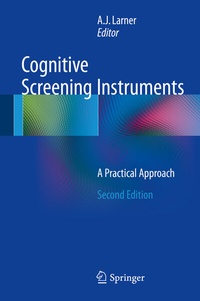
Cognitive Screening Instruments
Description

This revised and updated second edition provides a practical and structured overview of some of the most commonly used and easily available cognitive screening instruments applicable in the outpatient clinic and bedside setting. It now includes additional chapters on AD8 and also methodological aspects of systematic cognitive screening instrument assessment from the Cochrane Dementia and Cognitive Improvement Group.
Expert authors from around the world equip the reader with clear instructions on the usage of each screening instrument, its strengths and weaknesses, and the time required for administration. Rules on scoring are also provided, such as how to correct for variations in the patient's age or education, and suggested cut-off scores.
Cognitive Screening Instruments : A Practical Approach, Second Edition is aimed at both clinicians and professionals in disciplines allied to medicine who are called upon to assess patients with possible cognitive disorders, including neurologists, old age psychiatrists, neuropsychologists, primary care physicians, dementia support workers, and members of memory assessment teams.
Reviews / Votes
"This book is of great importance for experts dealing with mental health (psychiatrists, psychologist, neurologists, general practitioners.) . Instruments are presented in detail and are accompanied with research overviews with clear indication of both advantages and limitations. This last edition, enriched with new chapters, will for sure be as successful as the previous one." (Anamarija Bogovíc, Alcoholism and Psychiatry Research, Vol. 54 (01), June, 2018)"This second edition of a very useful book presents an overview as well as practical advice about the use of cognitive screening instruments in outpatient and hospital settings. . This is a useful book with practical tools and strategiesfor the use of cognitive screening instruments in clinical settings. Any physicians or clinicians who deal with patients with potential cognitive impairments should be aware of the tests that are referenced in this superb book." (Michael Joel Schrift, Doody's Book Reviews, May, 2017)
More details
Other editions
Additional editions
Person
AJ Larner is a consultant neurologist at the Walton Centre for Neurology and Neurosurgery, Liverpool, UK.
Content
Section 1: Introduction.- Cognitive Screening Instruments: Rationale, Desiderata, Assessment.- Cochrane Dementia and Cognitive Improvement Group Assessment of Cognitive Screening Instruments.- Section 2: Patient performance-related tests.- Mini-Mental State Examination (MMSE).- MMSE variants and subscores.- Clock Drawing Test.- Addenbrooke's Cognitive Examinations (ACE).- Montreal Cognitive Assessment (MoCA).- DemTect.- Test Your Memory (TYM) test.- General Practitioner Cognitive Assessment (GPCOG).- Six-item Cognitive Impairment Test (6CIT).- Section 3: Informant-related scales.- Informant Questionnaire on Cognitive Decline in the Elderly (IQCODE).- AD8.- Section 4: Conclusion.- The Place of Cognitive Screening Instruments.
